

Celtic Release Interim Six Months Report
Revenue, profit, and profit from player sales all down

Brian Wilson, Celtic Chairman: “The decline in revenue compared to the same period last year is primarily due to Europa League participation as opposed to Champions League participation”
On Friday evening Celtic PLC released its six months interim report, for the six months to 31st December 2025. Celtic are the only club in Scotland that release this 6 monthly update, because they are the only club in Scotland that is listed on the AIM of the London Stock Exchange.
There is currently an ongoing protest against the board of directors, organised by several Celtic fans groups and so it is perhaps understandable that this report was not released on social media, and instead only on the club’s website.
The headline figure is a 29% drop in revenue of £24.1m, down from £83.5m to £59.4m
This significant reduction in revenue is obviously concerning to Celtic fans and board members alike, especially given the majority of the drop cannot be explained away by timings of payments or any other anomalies. For example, season ticket money is paid up front by fans at the start of the season, and recorded as “deferred income” on the balance sheet. This revenue is then ‘recognised’ after each home match is actually played. Had Celtic played significantly less matches in the 6 months to 2025 compared to last year, then that could account for some of the drop.
Unfortunately for Celtic though, the numbers of matches played are similar in both years and in fact Celtic played one more home matches in all competitions to December 2025 (15) compared to the 14 played by year end in the previous year.
A 30% drop in revenue is monumental, but will be no surprise to those of you that are interested in the finances of Scottish football. Earlier in the week I included a segment on Celtic’s UEFA earnings through the years when looking at overall SPFL prize money so far this season, showing a near €30m (£26m) drop in UEFA prize money this year.
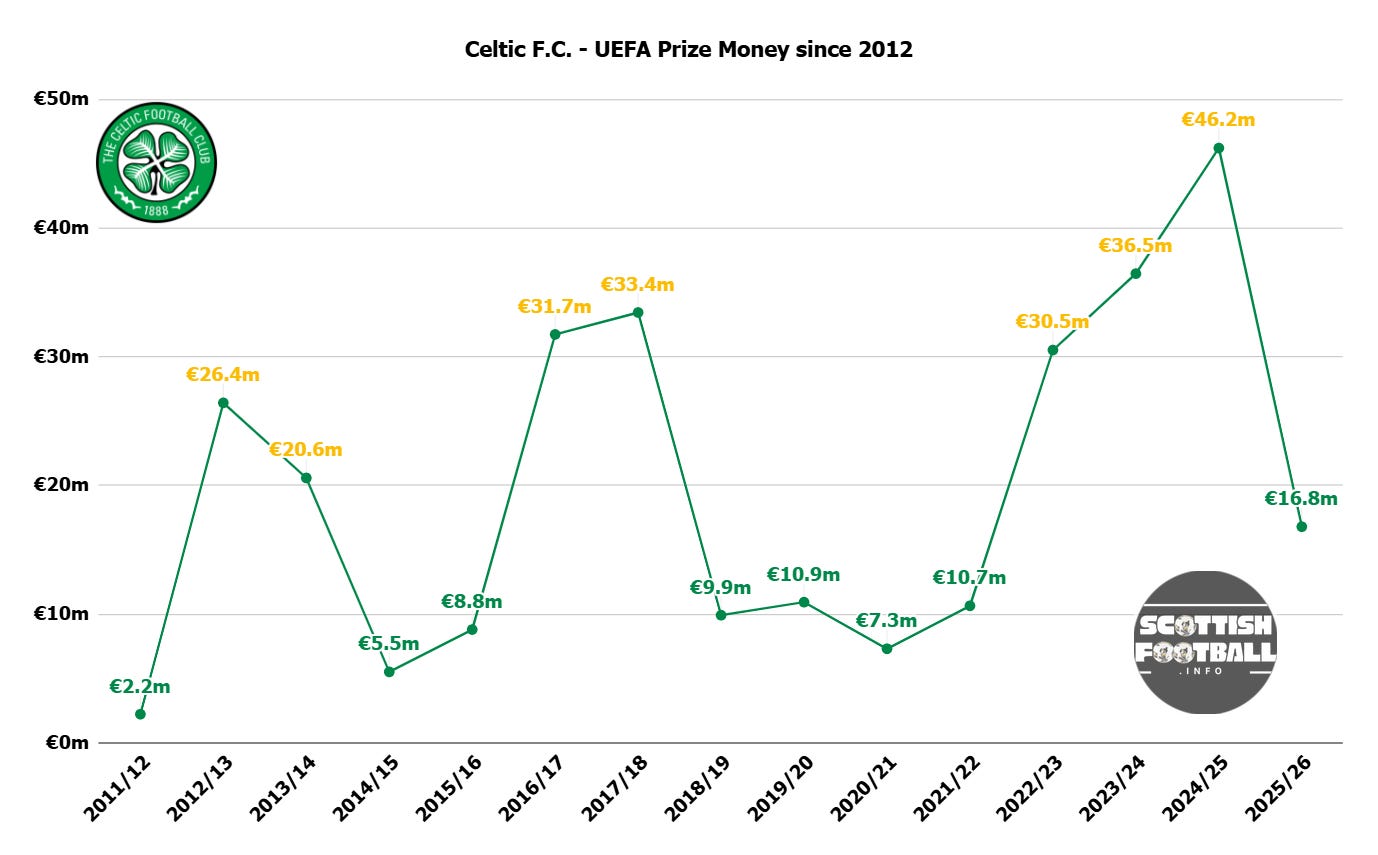
When UEFA revenue falls by £26m, the half year report showing a £24m drop in revenue is obviously unsurprising. As always though, the detail is slightly more complicated than that. In this article I will attempt to analyse Celtic’s:
Profit
Transfer activity
UEFA prize money
Including associated reductions
“Not another penny”
End of year figures
PROFIT
Celtic’s 6 month profit before tax dropped from a Scottish record £43.9m to ‘only’ £13.2m. This £30m reduction is gigantic, however the combined profit figures of all other Scottish clubs will not amount to £13m. It’s still hugely impressive to record this level of profit in Scottish football, and they remain lightyears ahead of everyone else, financially. Furthermore the bank balance sat at £67.4m, which is an increase from the £65.4m held at this time last year.
The most concerning impact for Celtic of failing to reach the Champions League is the effect on profit before player sales are taken into account (discussed next). This profit before player trading figure fell from £26.9m to £4.2m, which again is still very impressive for a football club. But it means that without taking into account their transfer business, Celtic ‘only’ have £4m of profit after half a year, compared to nearly £27m last year and £32m the year before.
The operating profit (which includes player trading), was £11.1m, which again is a fantastic number. But it’s a steep decline from the £42m recorded this time last year. Celtic’s operating costs remained relatively stable at £55.2m, down £1.3m from £56.5m last season. The end of year operating expenses for Celtic were a whopping £117.1m last season and so it’s likely this figure will be down by several million come the end of year.
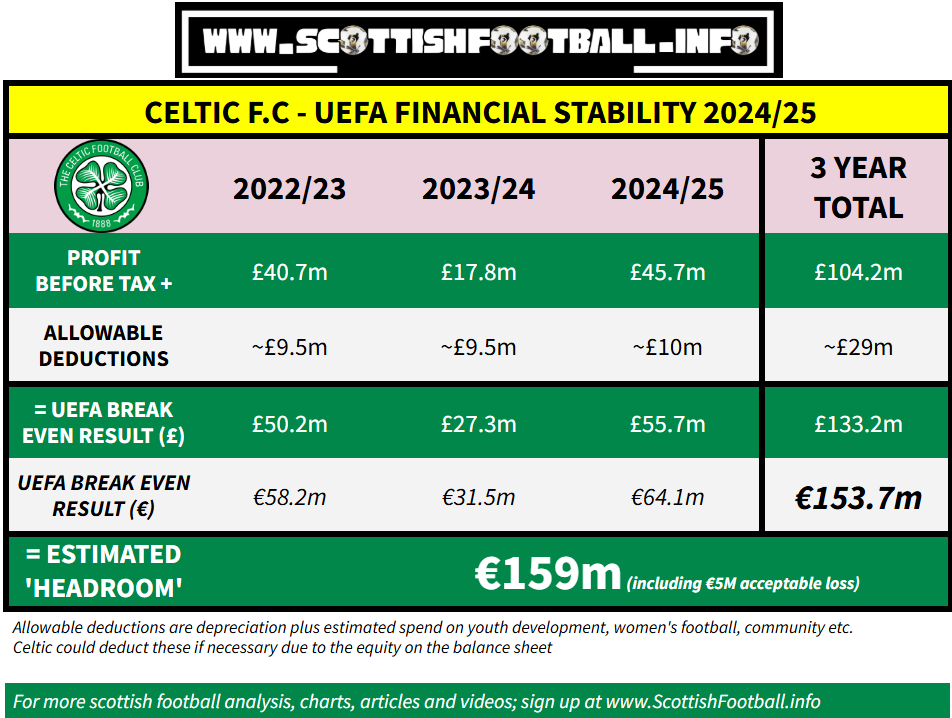
Celtic are in great financial health, of that there is no doubt. The drop of profit is still concerning for Celtic though. Much of it is attributable to the drop in UEFA prize money (discussed in detail later), however player trading also effects profit, which we will now discuss.
TRANSFER ACTIVITY
In the transfer market, Celtic spent £13.7m in the summer on 9 players (Yamada, Doohan, Osmand, Inamura, Balikwisha, Tounekti and Iheanacho + loans for Simpson-Pusey and Saracchi). That’s a near £15m less than the £28.1m invested in the purchases of Engels, Idah, Trusty, Bernarndo, McCowan, Sinisalo, Schmeichel in summer 2024.
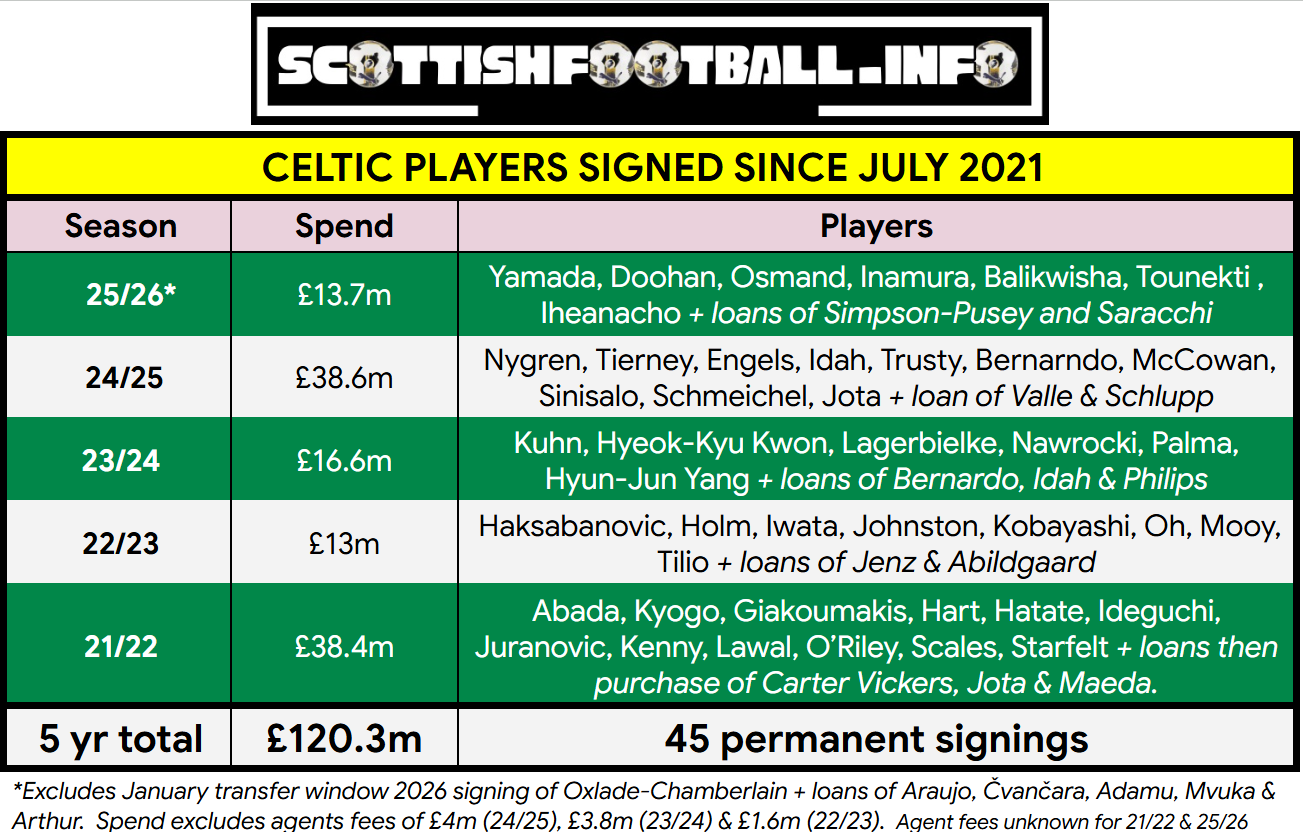
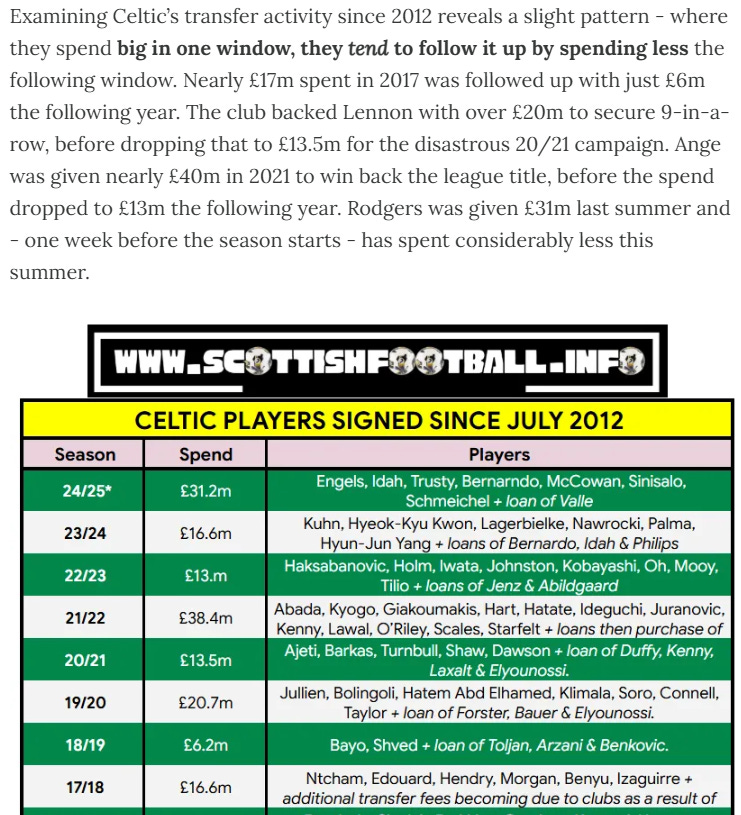
I previously wrote a deep dive on Celtic’s transfer strategy over the past decade, and my article predicted a drop in spending this year, even before accounting for the lack of Champions league football.
An extract from that article:
As for player sales, the “profit on the disposal of player registrations” is calculated by how much the club sold the asset for, minus the remaining net book value (NBV) of the player. The profit on player sales was £14.1m for the 6 months to December 2025, namely for the summer sales of Nicolas Kühn, Gustaf Lagerbielke, Marco Tilio and Adam Idah. This is down £7m on the £21.5m profit recorded for the sales of O’Riley, Lawal, Iwata, Johnston, Kobayashi, Kelly & Oh in summer 2024.
The individual breakdowns of player sales are not reported, and so the following figures are purely media speculation, used here to explain NBV further.
Celtic reportedly sold Kühn and Idah for a combined £20m+, so how was player sale profit only £14.1m? Take former club record signing Adam Idah as a good example. If he was bought on a five year contract for £8.5m, then his NBV after one year would be £6.8m. If the sale was for £6m, then that would actually represent an £800,000 loss on disposal of player registrations. If the combined profit on the other outgoings was £14.9m, then that loss on Idah would take this down to £14.1m, for example.
The same is true for last year, where a profit on player sales of £21.5m was recorded. Brighton were reported to be paying £25m for Matt O’Riley, two years after Celtic signed him for around £1.5m. Given the profit recorded on all of Celtic’s sales last summer was only £21.5m, it’s likely Celtic have several ‘contingency’ payments or add-ons built into the O’Riley sale.
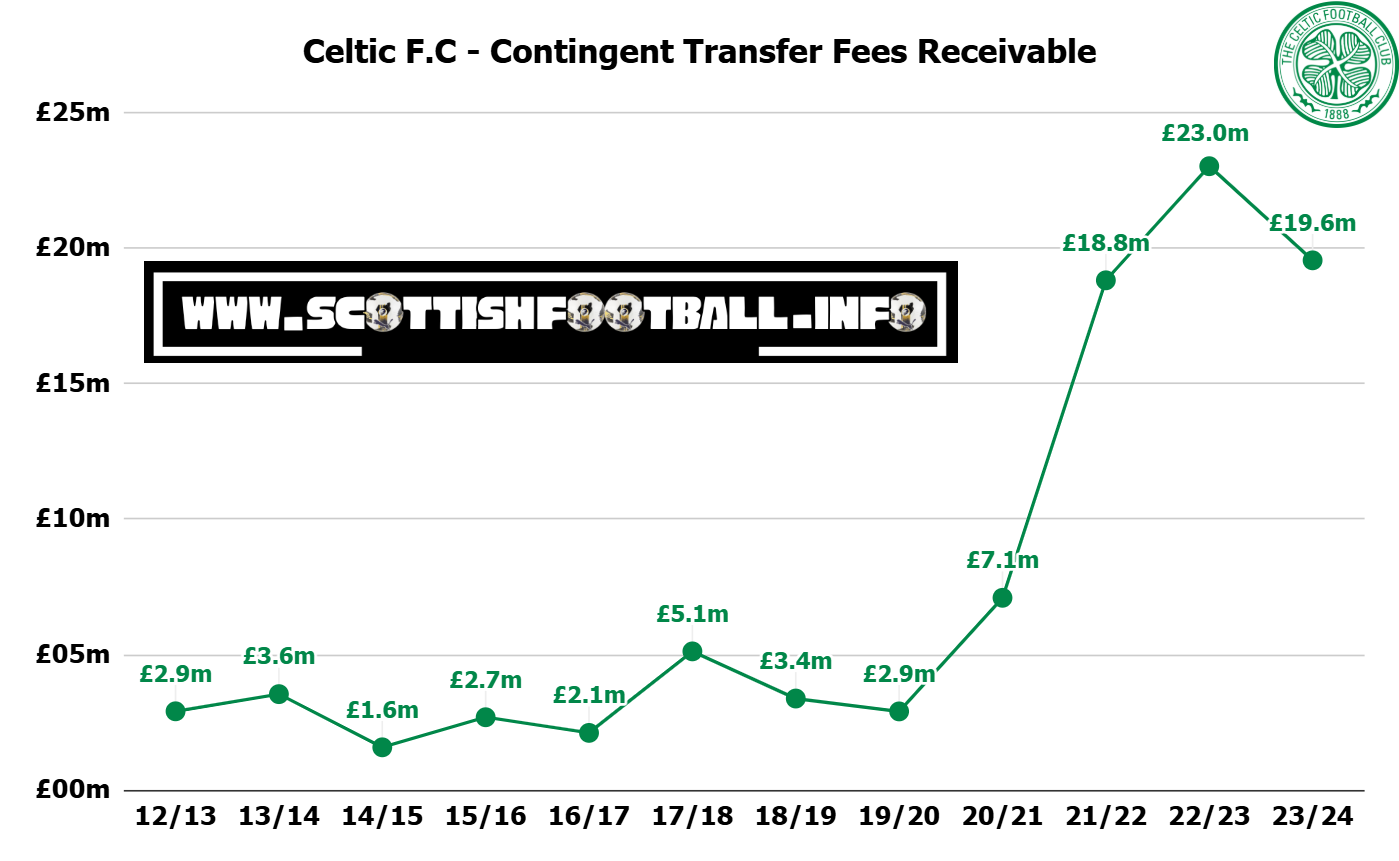
Therefore, Brighton’s recent recall of the player from his loan spell to Marseille could be good news for Celtic, as gives him more chance of hitting the appearance milestones to trigger some further payments to Celtic. Were Brighton to sell O’Riley in the summer, this is unlikely to be good news for Celtic. That’s not only because he may leave without achieving the appearance and success add-ons, but also because sell on clauses are almost always on the profit of the player. If there is no profit for Brighton then Celtic will receive no sell-on.
Celtic made less profit from player sales this year, which contributed to the reduction in profit. This wasn’t the main driver though; it was the failure to beat Kairat Almaty on penalties that had the biggest impact.
UEFA PRIZE MONEY
Similar to the recognition of season ticket cash, we can safely assume Celtic will only record UEFA earnings once it has actually been paid by UEFA.
Celtic F.C annual report: “an estimate of such revenues cannot be used as a basis for revenue recognition once the performance obligation has been completed.”
UEFA have specific dates for each of the payments it sends to the participating clubs. The bulk of the money is paid early in the season, and will be received by the end of the November - so would be included in these interim reports. But crucially, not all of it:
Keep reading with a 7-day free trial
Subscribe to Scotland's Coefficient to keep reading this post and get 7 days of free access to the full post archives.