

Craig Gordon Retires From Football
A look at the stats from Scotland’s Two-Career Goalkeeper

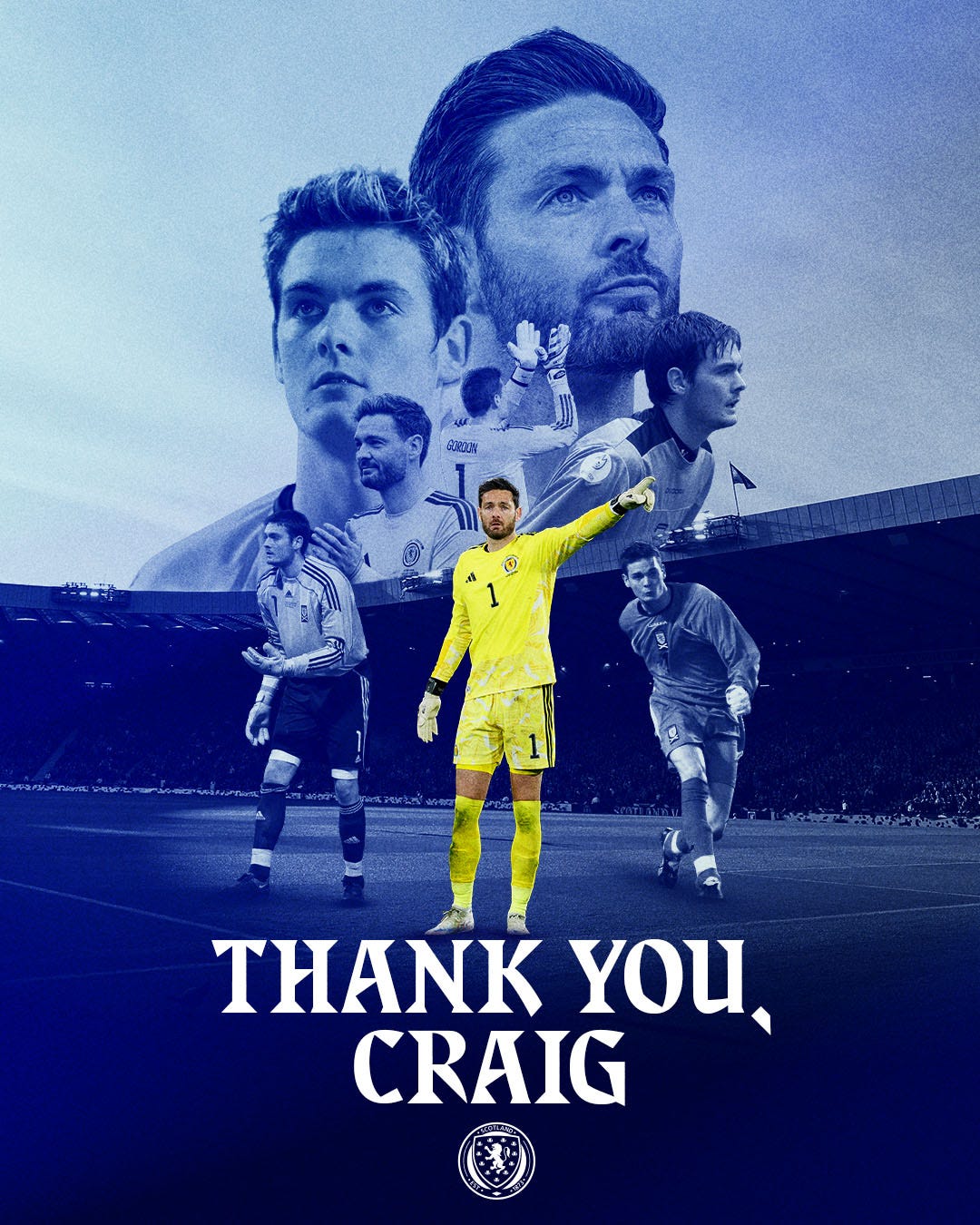
Craig Gordon retires from football with one of the best records of any Scotland goalkeeper in history. 84 caps, 42 wins and 34 clean sheets. Jim Leighton is still out in front on two of those three metrics, with 42 clean sheets from his 91 caps, but both share the same number of wins (42), giving Gordon a 50% win rate and Leighton 46%.
Craig Gordon is clear of the next few Scottish keepers by distance. Alan Rough, Andy Goram and Allan McGregor all achieved 16 clean sheets, with McGregor reaching that number in the fewest games (43) ahead of Goram on 42 and Rough on 53.
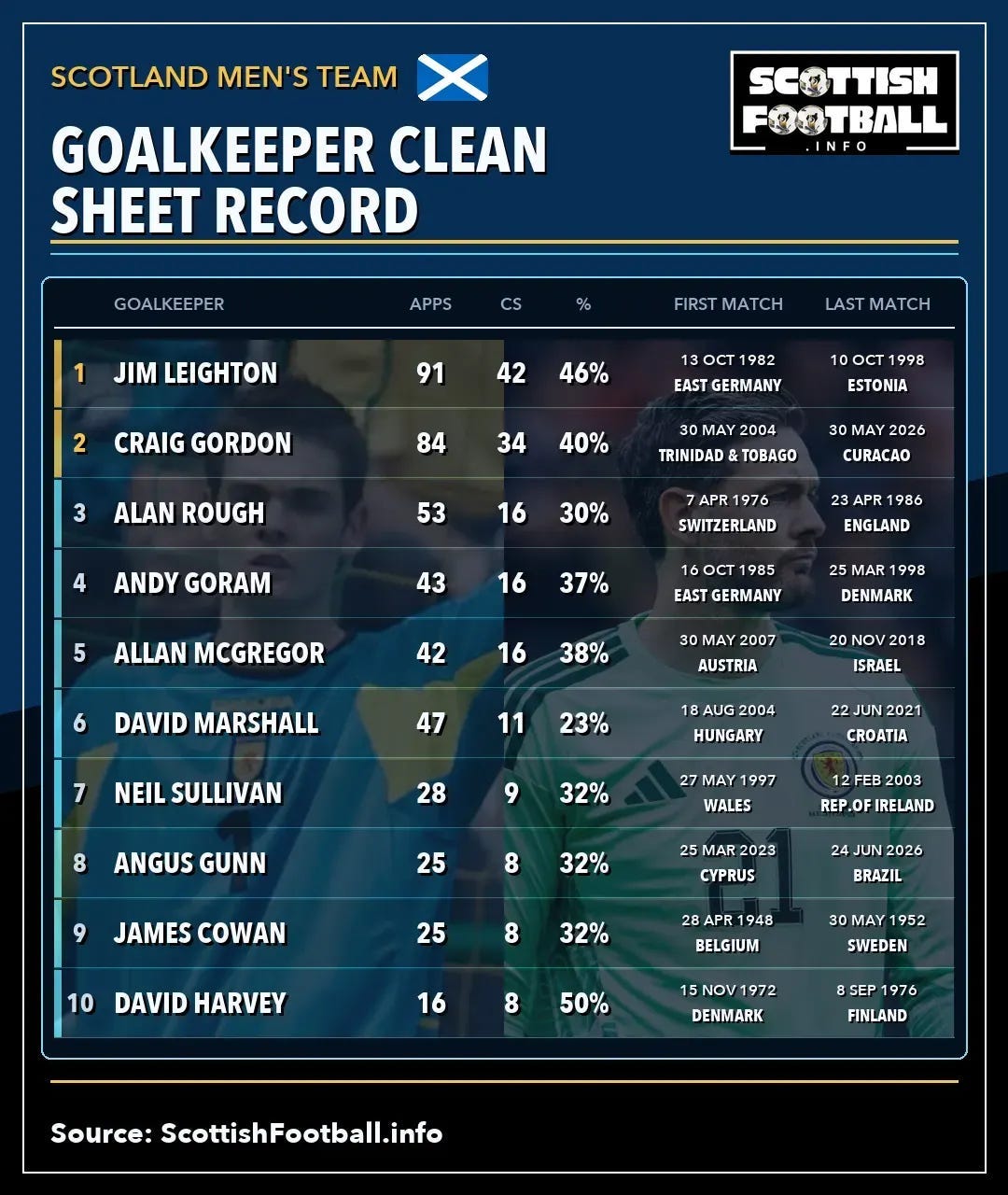
Gordon’s first cap came as a 21 year old on 30th May 2004, a 4-1 win over Trinidad & Tobago at Easter Road of all places. His first Scotland clean sheet arrived three caps in, a 0-0 World Cup qualifier against Slovenia in September 2004.
Two of his defining early Scotland nights came against the reigning World Champions France: the 1-0 win at Hampden in October 2006 and the 1-0 win in Paris in September 2007 in the 2008 Euro qualifying campaign were both Gordon clean sheets.
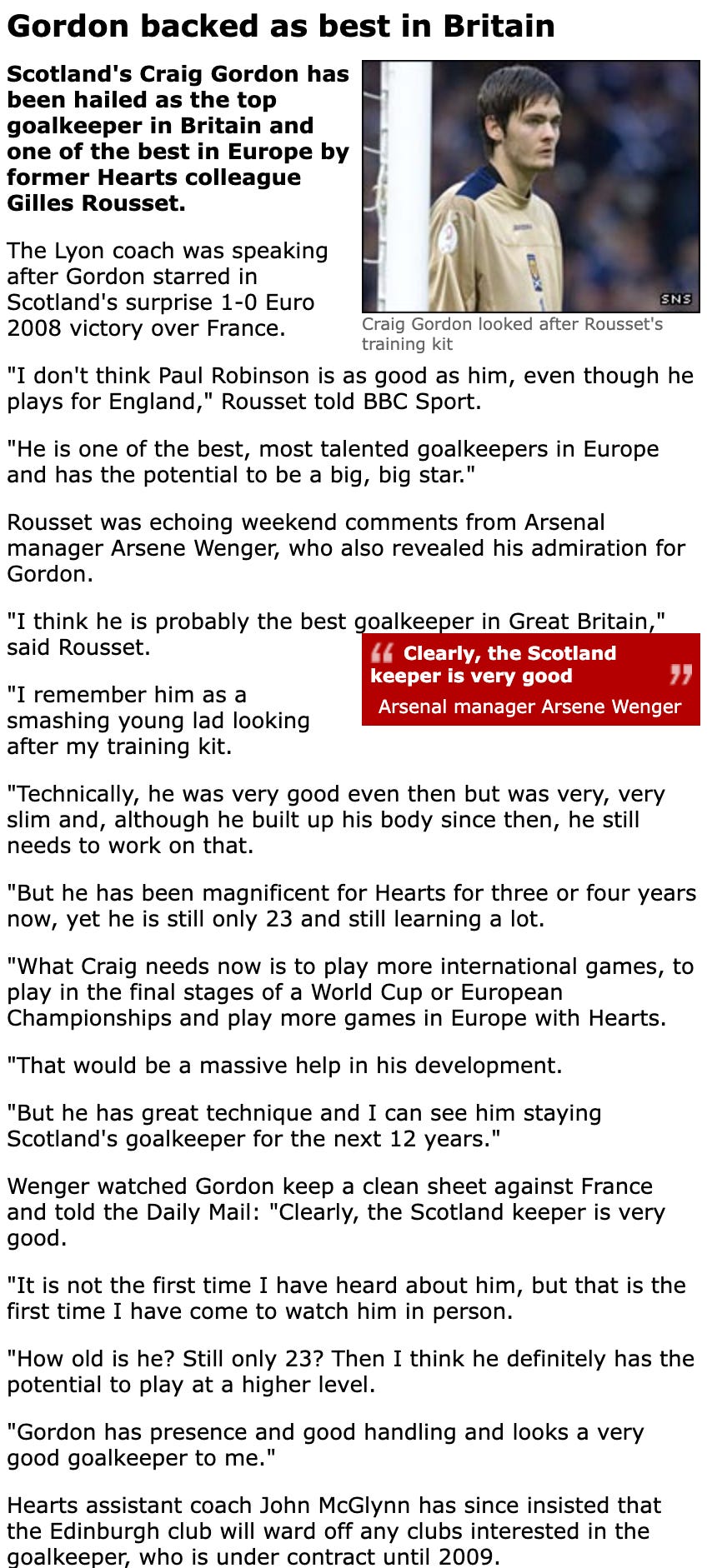
I’ve titled this article ‘Scotland’s two-career goalkeeper’ due to the gap between his Scotland appearances as a result of the major injury suffered, and the fact that his career was essentially over at the age of 30.
The first Gordon Scotland career ran to 40 caps. Then it stopped for a few years, and in that time most people - including himself - had accepted that his 40th cap against the Faroe Islands on 16th November 2010 was his last. His 41st cap came against England on 18th November 2014 - a gap of 4 years and 2 days (1,463 days) between Scotland appearances.
That’s a longer gap between Scotland caps than Jim Leighton endured, with Leighton spending three years out not due to injury, but due to the fact he was bombed out at Man United, losing his Scotland place at the same time. There were 1,246 days between Leighton facing Brazil at Italia ‘90 and his recall to face Malta in 1993.
It’s not the longest gap between caps for a keeper though, as David Marshall had 1,729 days between facing Sweden in 2004 and Norway in 2009 - ironically because of an injury suffered to Craig Gordon. The longest gap between caps of any Scotland player, that I can find, is Chris Burke’s 7 year-wait (2,461 days) from Japan in 2006 to Estonia in 2013.
Gordon had gone from Hearts to Sunderland in 2007 for £9m, then a British record fee for a goalkeeper. Unfortunately injuries took the next chunk of his career, as he made 95 appearances across five years on Wearside, before being released on a free.
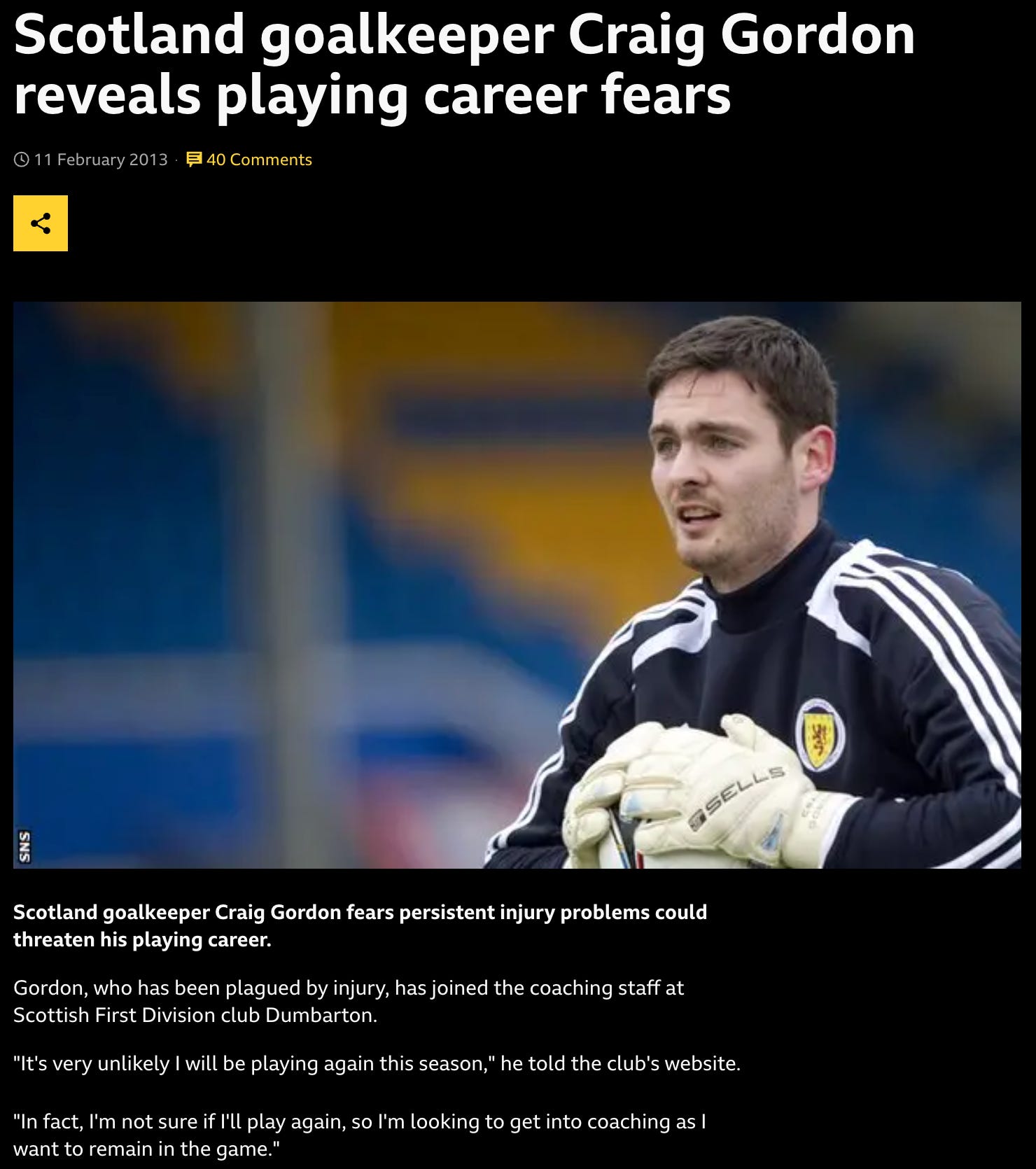
By 2013, his career looked over. After speaking to Dumbarton manager Ian Murray in a TV studio, Gordon agreed to do coaching for Murray at The Rock, while trying to rebuild his knee - and his career. At the time, the 30 year old Gordon said he was almost forced to get into coaching in order to stay within football, as he had come to terms with the fact he was unlikely to ever play football again.
In 2014, Celtic changed Gordon’s career trajectory. The hoops signed an unattached keeper who hadn’t made an appearance for two years. It was viewed at the time as a risk-free squad signing, who now has some coaching experience if the playing side doesn’t work out. Of course, it turned into much more for both parties, as Gordon would go onto make 242 appearances across six trophy laden years in Parkhead. He won six league titles, five League Cups and three Scottish Cups with Celtic, earning a recall into the Scotland squad after four years away.
Unsurprisingly his time at Celtic was the most succesful spell of his career. But his Heart undoubtedly belonged to Tynecastle, and so it was inevitable that he found his way back. Gordon was a Hearts academy boy, made his name in Gorgie, won the 2006 Scottish Cup, became the club’s most valuable sale, then came back to help Hearts back up from the Championship after their controversial relegation in the curtailed covid-19 season. Craig Gordon made 333 appearances for Hearts, with more than 100 clean sheets across his two spells.
His injury days weren’t fully behind him though, he made Steve Clarke’s Euro 2020 squad but then missed out on a place at Euro 2024 after another injury ravaged season at Hearts. Despite this, he battled back, again, and in May 2025, Hearts gave him another one year contract after he had reached 330 total appearances for the club.
He would only add three more competitive appearances in 2025/26 in what could have been the pinnacle of his career, had the Jam Tarts won the Scottish title. A neck and shoulder injury cost him the start of the season, while a German keeper 10 years his junior, Alexander Schwolow arrived, and Gordon spent most of the campaign as a back-up.
He still stayed close enough to the first team to be selected for Scotland, playing in one of the most famous nights in Hampden Park’s history (we’ll get to that shortly), before he injured his shoulder again and so did not play another club minute after January. The save in this video, to secure 3 points in the last minute at Dens Park, proved he was still capable of the world class, even as a 43-year old. It would have been remembered as a title-winning save for generations to come, had the Jambos made it over the finish line in May.
In November 2025, at an incredible 42 years and 322 days, Gordon started the famous 4-2 win over Denmark that sent Scotland to the World Cup for the first time since 1998. It was his 83rd cap, and it’s the night that will go down in Scottish folklore. Gordon, and the rest, finally achieved a lifetime ambition of qualifying for a World Cup. All those involved against Denmark will be remembered forever, irrespective of what came next.
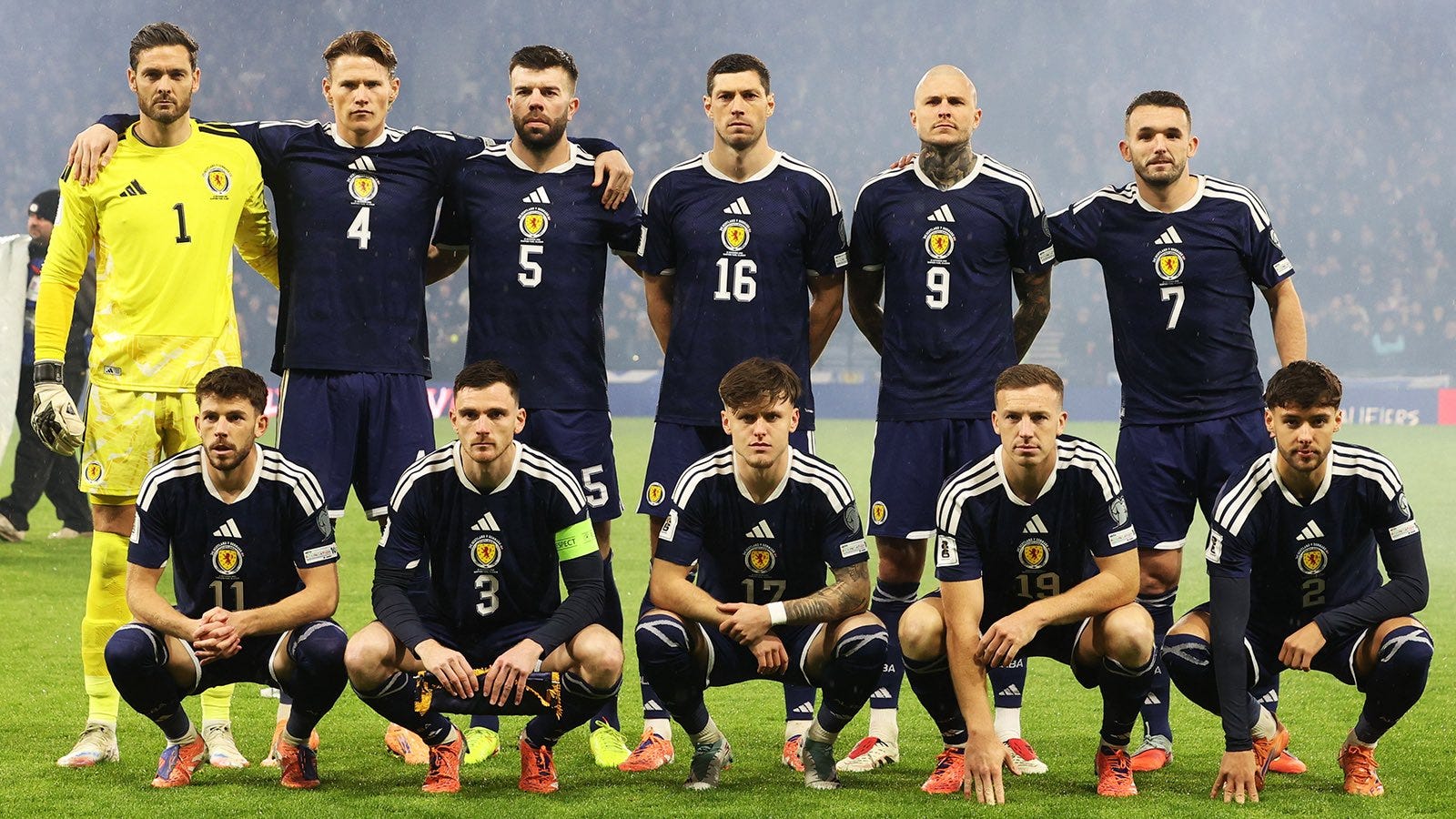
His last cap came at Hampden Park against Curaçao on 30th May 2026, a full 22 years after his debut. He was 43 years and 150 days old, Scotland men’s oldest ever player. In the 77th minute, as Clarke rang the changes, Gordon went off and his club-mate James Wilson came on. A somewhat fitting end to Gordon’s career, as Scotland’s oldest ever player made way at the same time that Scotland’s youngest ever player came on.
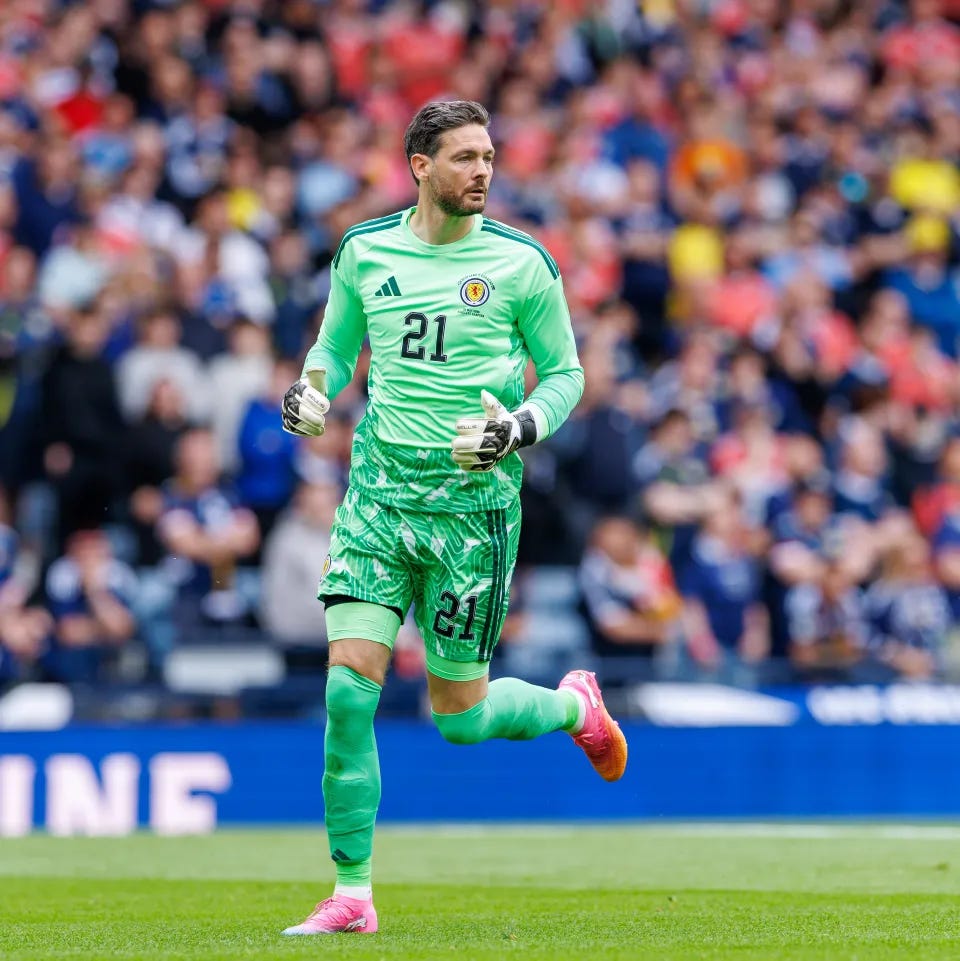
At the World Cup, Gordon was the oldest player in any squad but he did not play, with Angus Gunn playing the full 90 minutes in all three group games. That will be a disappointment to Gordon no doubt, but an understandable decision from Steve Clarke.
Gordon finishes his career second only to Leighton in the Scotland clean-sheet table, in a national team career which spanned an incredible 22 years. One record transfer, two serious comebacks, one World Cup squad, 15 major trophies and a sense of unimaginable pride, and likely disbelief that this day has finally come, 12 years later than he once thought.
Thank you for your service, Craig.
Thanks very much for paying me for the time and effort that goes into this website. It’s greatly appreciated!