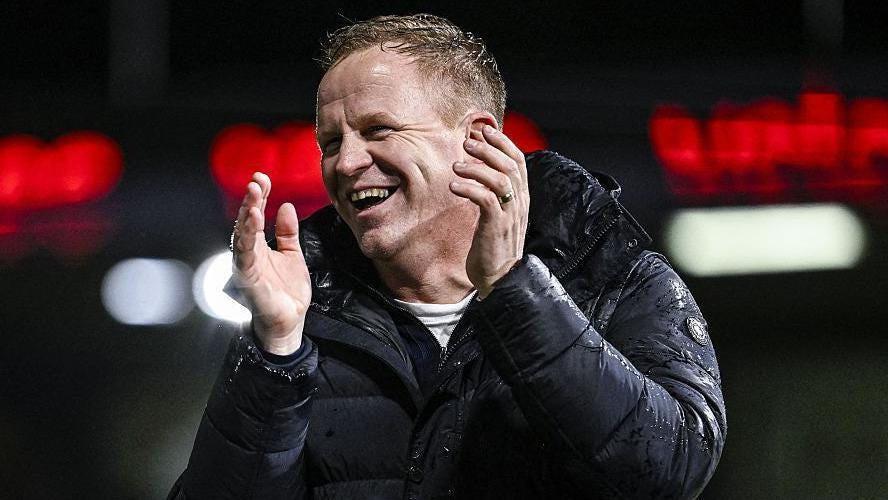
Hearts' New Head Coach - Wouter Vrancken
An insight into the coaching ideas of the man who recently signed a 2-year deal at Tynecastle


This article was written for Scottishfootball.info by Josh Duncan, an aspiring sports writer, who has his own Substack account. Please follow him there and on X.com.
Josh’s latest article is an analysis of the style of play of new Head Coach at Hearts, Wouter Vrancken.
Towards the end of last season, Hearts and Celtic were building towards one of the most exciting conclusions the league had ever seen. At the same time, those of us who support Rangers were wondering if Danny Rohl would survive the season.
Under the belief that Rohl wouldn’t last much longer, I began preparing a shortlist article, to discuss who could take his place. I watched a lot of teams in a lot of different countries and one of the coaches that my search led me to, was Wouter Vrancken.
The 47 year old Belgian coach led his Sint-Truidense side to third place in the Belgian Pro League last season. This was another moment in a managerial career filled with overachievement. Vrancken being just the second manager to win the Belgian cup with a side outside the top division, with KV Mechelen in 18/19.
The main thing that caught my eye when watching his Sint-Truidense side was their marrying of both positional and relational ideas in their play. The fluidity and rotations that the attacked with and their positioning in the build up had me intrigued.
While my overall list became redundant even with Danny Rohl leaving his post as Rangers manager, at least this research ended up being useful. Wouter Vrancken has joined Hearts after Derek McInnes left for Rangers.
In this piece, I hope to give some insight into Vrancken and how his coaching and ideas will translate to Hearts.
Out of Possession
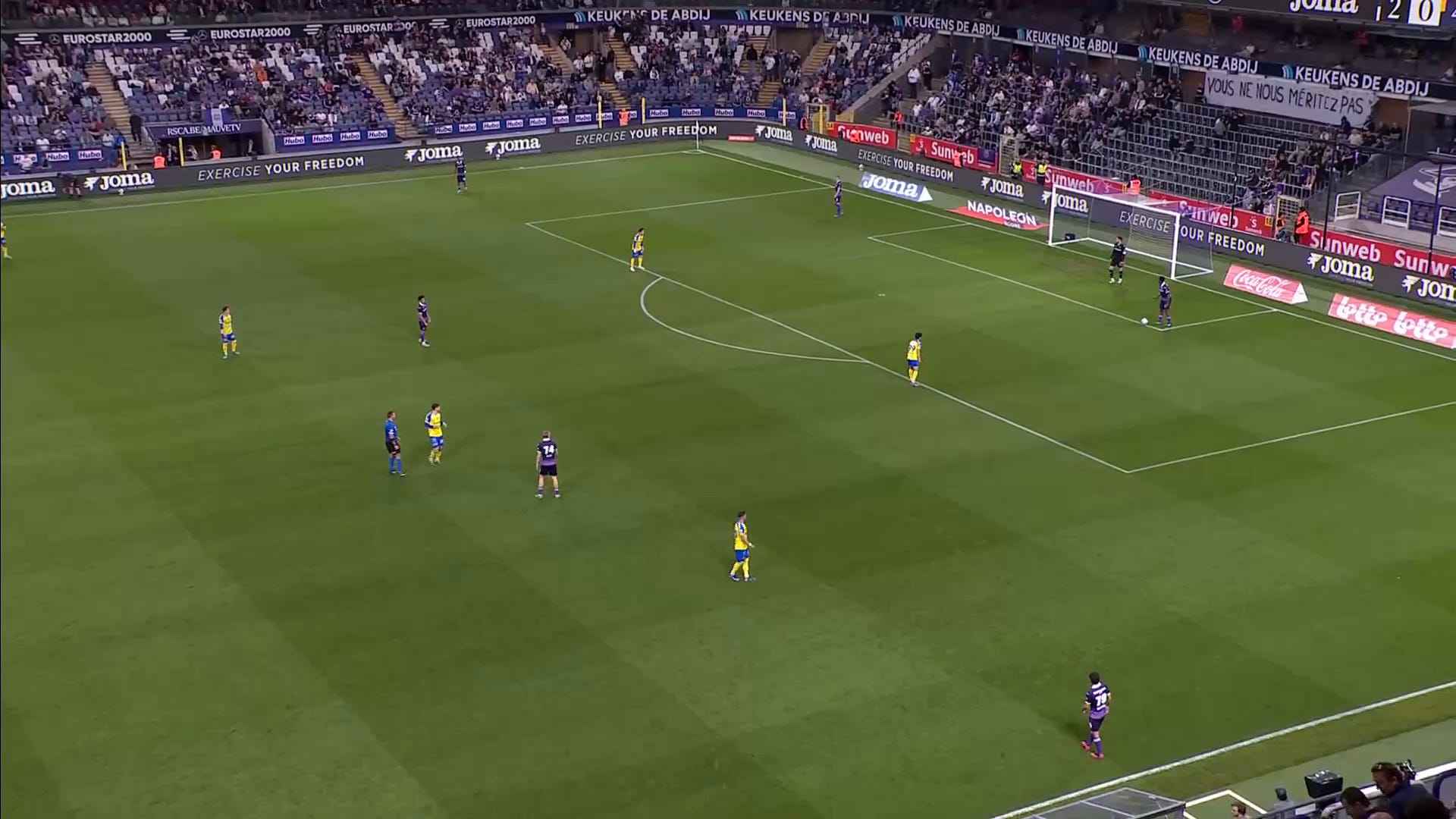
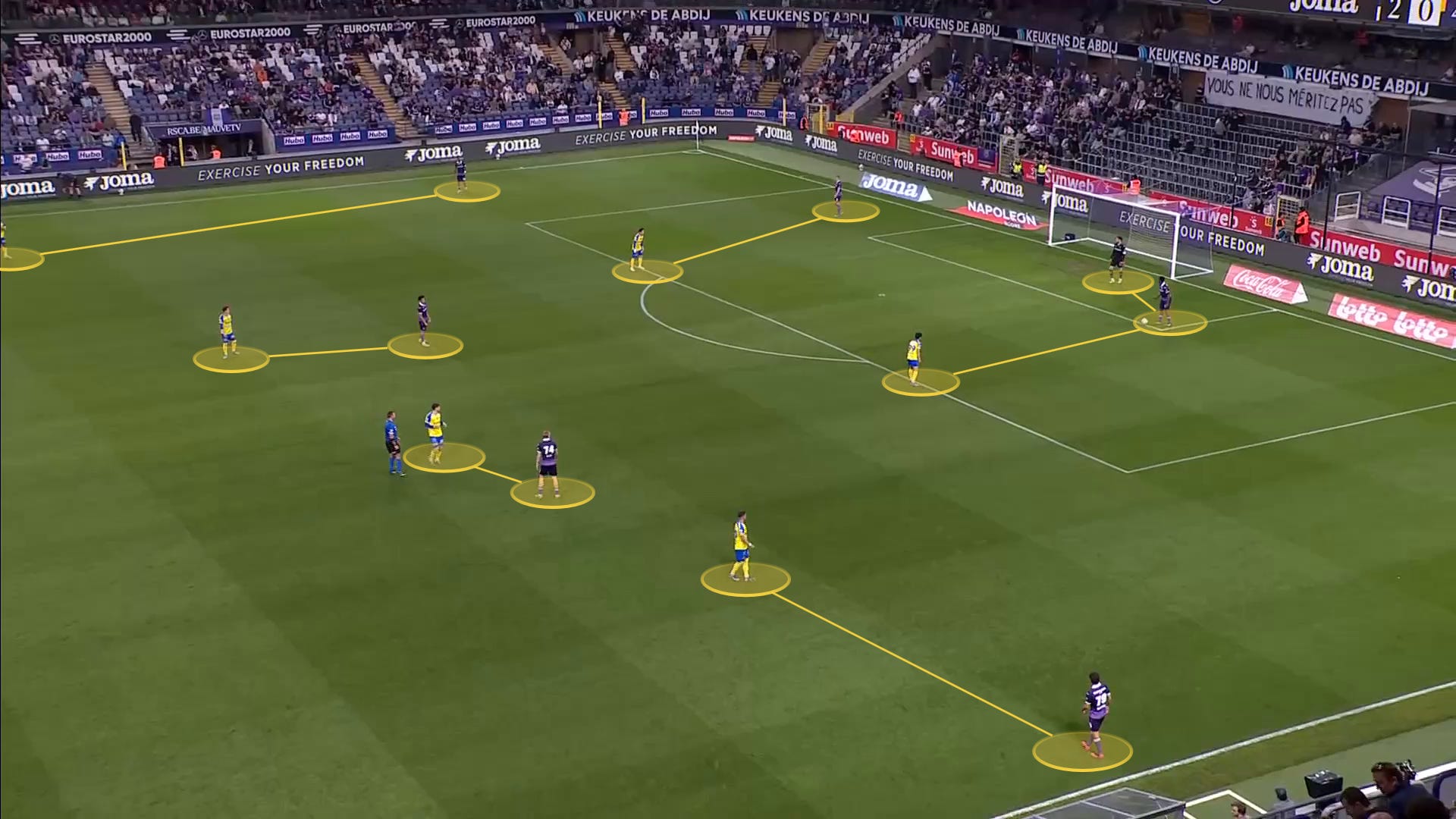
Despite lining up in a 4-2-3-1 on paper, STVV defend and press out of a few different 4-4-2/4-2-4 orientations. They alter the specifics depending on the opposition formation but what remains throughout is their intensity.
The goal is to force opponents away from the middle of the pitch and squeeze their play. Vrancken wants to protect against teams playing through and force them around the block.
Sint-Truidense worked extremely hard to prevent opposing midfielders from getting involved in the build up. The STVV midfield was tasked with intensely following their opponent all across the pitch, even if that meant ending up in the opposition box.
This intense level of pressing forces perfection from the opponent if they want to play out from the back. Most teams decide to be more direct to bypass the press instead.
Vrancken wants his team pressing all the way to the goalkeeper and they do this in a full man to man press. This means leaving the centre backs 1 v 1 if the opponent is playing two strikers.
This requires very athletic players throughout the team and defenders capable of covering large spaces. Being left in isolated duels throughout the pitch means that losing one can lead to a dangerous attack very quickly.
Build Up Play
When building up, Vrancken had his Sint-Truidense team setup to be dynamic and have multiple ways of breaking opponents down. They were built to have multiple options at all times, trying to play out through the defence while also having attackers stretching the opponent.
The above clip starts with STVV’s midfield dropping to receive and attempt to play through, they are consistently on the move and trying to give the ball carrier multiple options.
The midfielder then tries to hit a potential 2v1 on the far side, with the full back and winger advancing together. They are then forced to recycle the ball after it is well defended.
Once they are back into the build up, STVV try and bait the press forward as their attacking line try to exploit the overloaded defensive line. The ball forward ends in a good chance but a poor decision from the striker stops it in its tracks.
Sint-Truidense are also comfortable building through the middle to break free of opposition presses. The way Vrancken does this requires a forward that is adept at link up play to drop in and combine with others. You can see this in the clip above.
The striker, Keisuke Goto, drops in and positions himself diagonally to receive from the ball carrier. This puts him in position to combine and then use the space created by the combination to play a pass out of the press.
The next element is using diagonals to create deception and movement. The clip above shows Goto again dropping deeper, again positioning diagonally from the receiver.
This puts him in a position that’s extremely difficult to defend and gives him multiple options. There is another player diagonally behind Goto which allows him to dummy the ball and get straight on the move, he could take a touch and turn or release the winger into space.
These diagonal angles are so difficult to account for as most defences are setup vertically and defenders trained to press at certain angles, not designed to stop diagonal play.
The end of all this is organised chaos, runs from all over flooding the box. The final product is built on proximity and connections allowing attacks to be overwhelming for opponents to deal with.
The clip above all comes from those deep combinations I mentioned earlier. Once they are out from the press, it is immediately about pressing the advantage that has just been created.
This clip shows another combination in the middle leading to space out wide. As the ball swings out to the right wing, the goal is made through those diagonal orientations and deception in their movements.
Two players positioned diagonally from the ball carrier, one fakes a movement to receive and then spins in behind. The pass then goes to the second diagonal option, who has the perfect angle to find the original run in behind.
Of course this style of play comes with some drawbacks. It takes time and patience to instil all of these tactical ideas. It also requires high risk and the quality to stop that risk from becoming collapse.
Watch in the clip below how one slightly heavy pass leads so quickly to a goal. Difficult bouncing pass from the goalkeeper leads to a poor touch and then a turnover close to goal. Defenders are going the wrong way and can’t re-organise in time to stop the chance.
Conclusion
I think Wouter Vrancken and the Jamestown way of doing things are a strong match. Malachi Fagan-Walcott and Tom Renaud already look like the type of player extremely suited to how Vrancken wants to play.
Walcott is a talented athlete who makes unorthodox runs and movements for a centre back, willing to play forward at all times. Renaud a talented midfielder who thrives in chaotic situations.
It will likely require patience from the Hearts support to make such a drastic change in style successful but this feels like a good step into making Hearts a consistent force rather than a one off challenge.
Vrancken approaches the game in an extremely progressive way and if given the right talent, he can take Hearts up a level. The dynamism of his attack once built will give Tynecastle some serious entertainment. Hopefully it can allow them to make the step into Europe as well.
There are a lot of intricacies in Vranckens setup that I didn’t go into in this article, player profiling, pressing triggers and a couple others as I didn’t want the article to become overwhelming. However I hope this has given a solid insight into what Vrancken can bring to Tynecastle in the upcoming season.