



Scottish clubs have long struggled to retain their best players. It is a sad reality of modern football that every Scottish club is a ‘selling club’. But since Brexit, that challenge to even keep hold of academy players has become even more of an issue.
Brexit has meant that English clubs can no longer recruit most 16 and 17-year-olds from European academies, and FIFA regulations generally prohibit any sort of international transfers involving players under 18.
Scottish teenagers, meanwhile, continue to move across the UK border at 16. Faced with a smaller recruitment pool, these incredibly wealthy English academies have pivoted their recruitment strategy, away from Europe into taking what will be seen as risk free ‘gambles’ in recruiting the best young players from Scotland.
Of course, the flow of talent south does predate the implementation of Brexit (2020), for example Billy Gilmour left Rangers for Chelsea shortly after turning 16 in 2017. Since then though we have had numerous and continuous examples of this, including Josh Adam moving from Celtic to Manchester City, Ben Doak from Celtic to Liverpool, Rory Wilson from Rangers to Aston Villa and Dylan Reid from St Mirren to Crystal Palace. That list continues to grow year after year, and it affects all clubs.
This isn’t a slight on the youngsters that make the move. For the players and their families, the attraction is obvious. English clubs can offer salaries, facilities and a level of financial security that most Scottish sides cannot provide.
Professional football is a precarious career and every family knows how quickly injury, form or a change of manager can close the door and send their kids to the back of the dole queue. Turning down a potentially life-changing contract would be a huge gamble, and requires a great deal of faith in a pathway into professional first team football in Scottish football that may never materialise.
Nobody should blame a 16-year-old, or their parents, for taking that opportunity, and instead Scottish football must concentrate on giving them a convincing non-financial reason to stay. As it stands, many of the best youngsters choose to take that financial route - but for many this can be looked back upon the start of the end of their careers in football.
Disappearing into Academy Football
Of course, a move to England can work. Gilmour and Doak have both played at the highest level and are regular starters for the national team. There will also be plenty of Scottish youngsters that have benefited from better coaching, sports science and full-time facilities down south, and some will use that to carve a better career in the game than they might have done had they stayed in Scotland.
However that appears to be the exception, rather than the rule.
The Scottish FA’s extensive “Transition Phase Report” in 2024 included research into 1,223 players who left their country of development between the ages of 16 and 17. Only 13.1 per cent had played for the recruiting club by the age of 23. Just 23 of the 1,223 went on to make more than 50 appearances for that club.
An even more damning statistic; 81.6 per cent had made no professional appearance before turning 19. By 23, four out of five were playing at a lower level than the club which had recruited them as teenagers.
A talented player can leave Scotland at 16, spend several seasons moving between under-18 and under-21 teams, then reach the end of his contract with very little - or zeo - experience of competitive senior football.
Instead, a spell playing senior football in the lower leagues can be immensely valuable. The Scottish FA report found a strong pattern among players who eventually reached elite level.
None of the 33 players in its sample made their senior debut after turning 18, while 15 gained their first experience in the lower divisions of their domestic pyramid. The level of that first opportunity appeared less important than simply being given that opportunity to play senior football.
The report also cited analysis which found that around 80% of players involved in the Champions League quarter-finals were already playing adult football by the age of 17.
While those stats would indicate that as a country we should be giving youth a chance and letting them play, it’s fair to point out that correlation does not necessarily mean causation.
These Champions League Quarter Finalists may only have got the chance to play by the age of 17 as a consequence of exceptional ability. And as we’ll see later in the article from the list of youngest players to play in Scotland, being given a chance at 15 or 16 years old doesn’t guarantee a succesful career.
However research has proven, that the period between 16 and 18 is when talented academy players need to begin encountering senior football, whether with their parent club, through a loan or, as of last season, under Scotland’s new cooperation system.
Look at the Scotland squad at the recent World Cup. At least a third made their senior debut in football at a level below the top flight, including captain Andy Robertson, formerly of Queen’s Park. Difficult early experiences in these leagues, playing competitive football against men can accelerate a teen’s education in a way that another ‘comfortable’ season of academy football rarely will.
One Barrier Removed
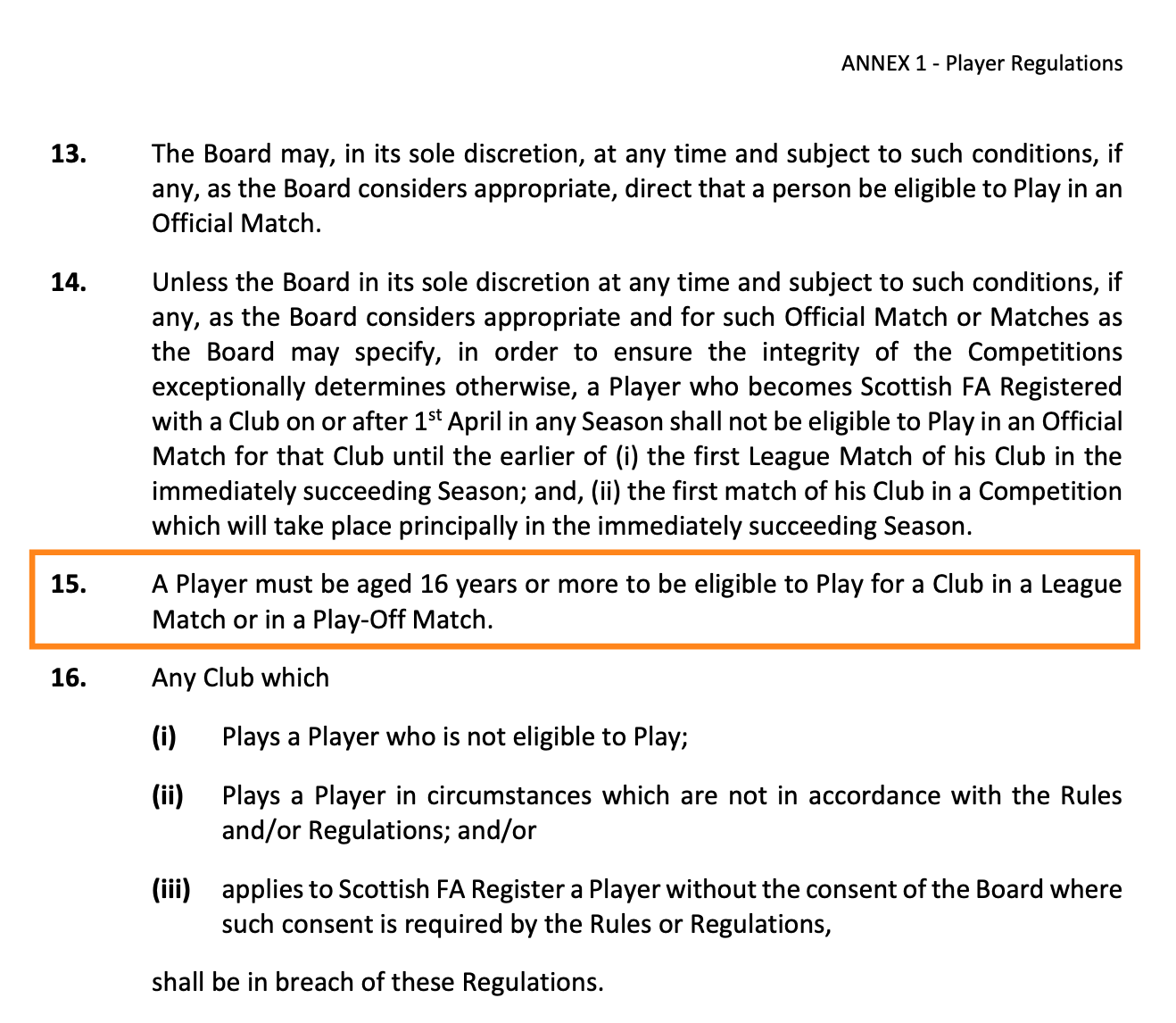
In January 2026, then Rangers head coach Danny Röhl wanted to involve 15-year-olds Kyle Glasgow and Ashton Scally in a Scottish Cup tie against Annan Athletic. In a post-match interview he lamented the competition rules prevented him from doing so.
Well, that barrier has now been partially removed - from SPFL competitions at least.
Under the 2025/26 SPFL regulations, players had to be at least 16 to appear in either a league match or the League Cup. Reports this week suggested the SPFL would change the rules later this week, but actually the SPFL regulations for the new season were updated last month, on the 10th June, reducing the minimum age to 15 in both competitions.
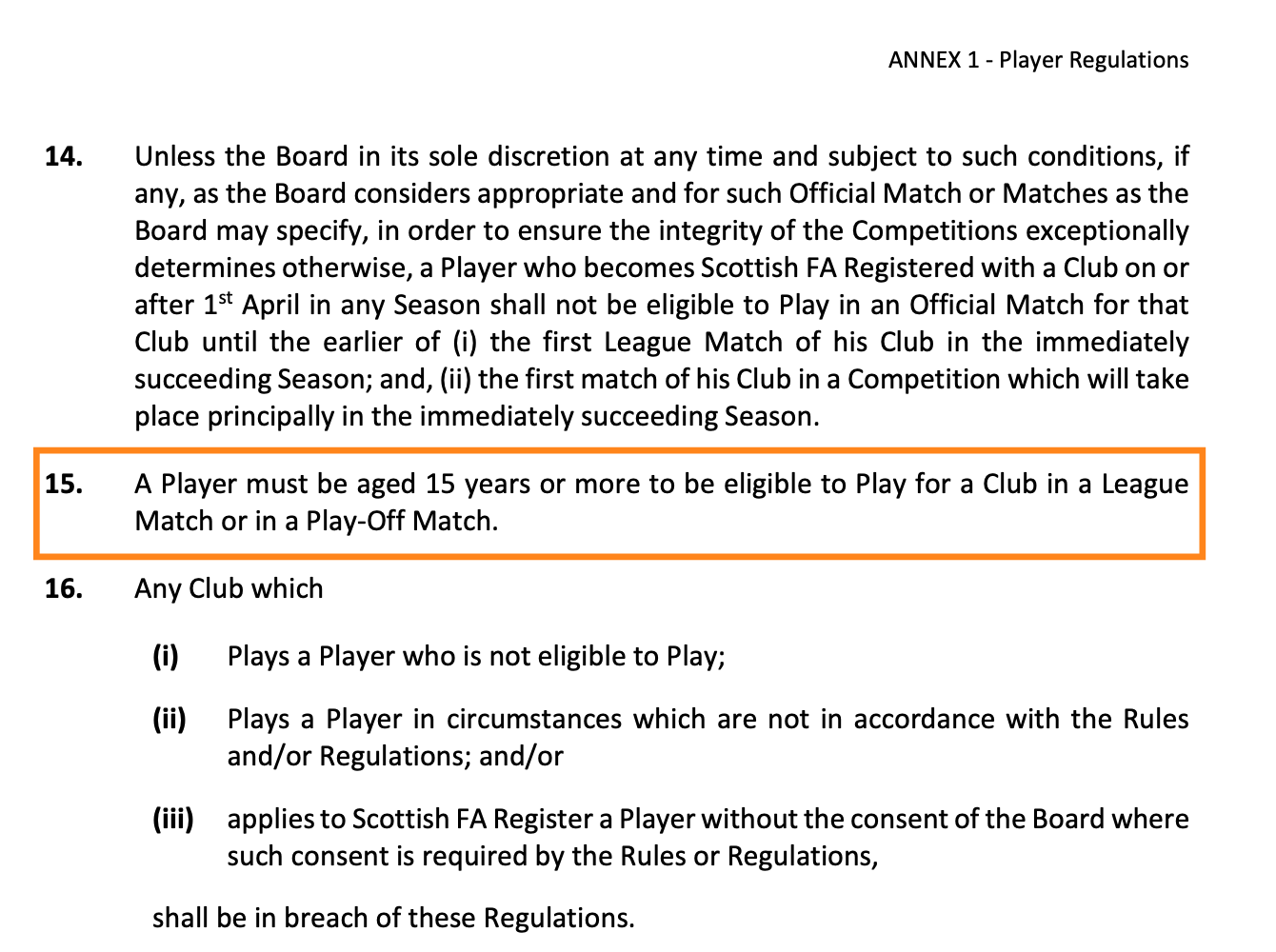
This rule change may end up having no effect whatsoever on the pathway to the first team across Scottish football. But this summer has shown signs of encouragement - with four SPFL clubs playing the youngest player in their respective histories.
Marcello De Barros became St Mirren’s youngest first-team player when he appeared against Dumbarton on 11 July- born in December 2010, he was 15 years and 218 days old.
Then a week or so later, Lorenzo Sassetti replaced Rory MacLeod (now at Dunfermline) as Dundee United’s previous record-holder when he made his debut against The Spartans. Sassetti, born in February 2011, was only 15 years and 162 days old. And by fan reports he looked really good, showing that if you’re good enough you’re old enough.
Andrew Fasanya was next, entering Aberdeen’s record books as their youngest ever player. He came off the bench during a 3-0 victory over Kelty Hearts at Pittodrie aged 15 years and seven months; he came close to scoring nine minutes later.
Lastly Greenock Morton also fielded two 15-year-olds, Calan Burgess and Haiden Lang, during their match against St Johnstone - with five teenagers making their Morton debuts that afternoon.
Of course it goes without saying most 15-year-olds will be physically and perhaps emotionally unprepared for senior football, and clubs retain a duty to protect them. Their selection should absolutely depend on maturity as well as ability, but the studies show that this selection is needed if they are to make it in football.
Unlike the SPFL, the SFA’s Scottish Cup regulations for 2026/27 continue to state that a player must be at least 16 years old. That’s unfortunate because cup ties - as demonstrated by Rohl at Rangers - often provide the most realistic opportunities for very young players at our top clubs.
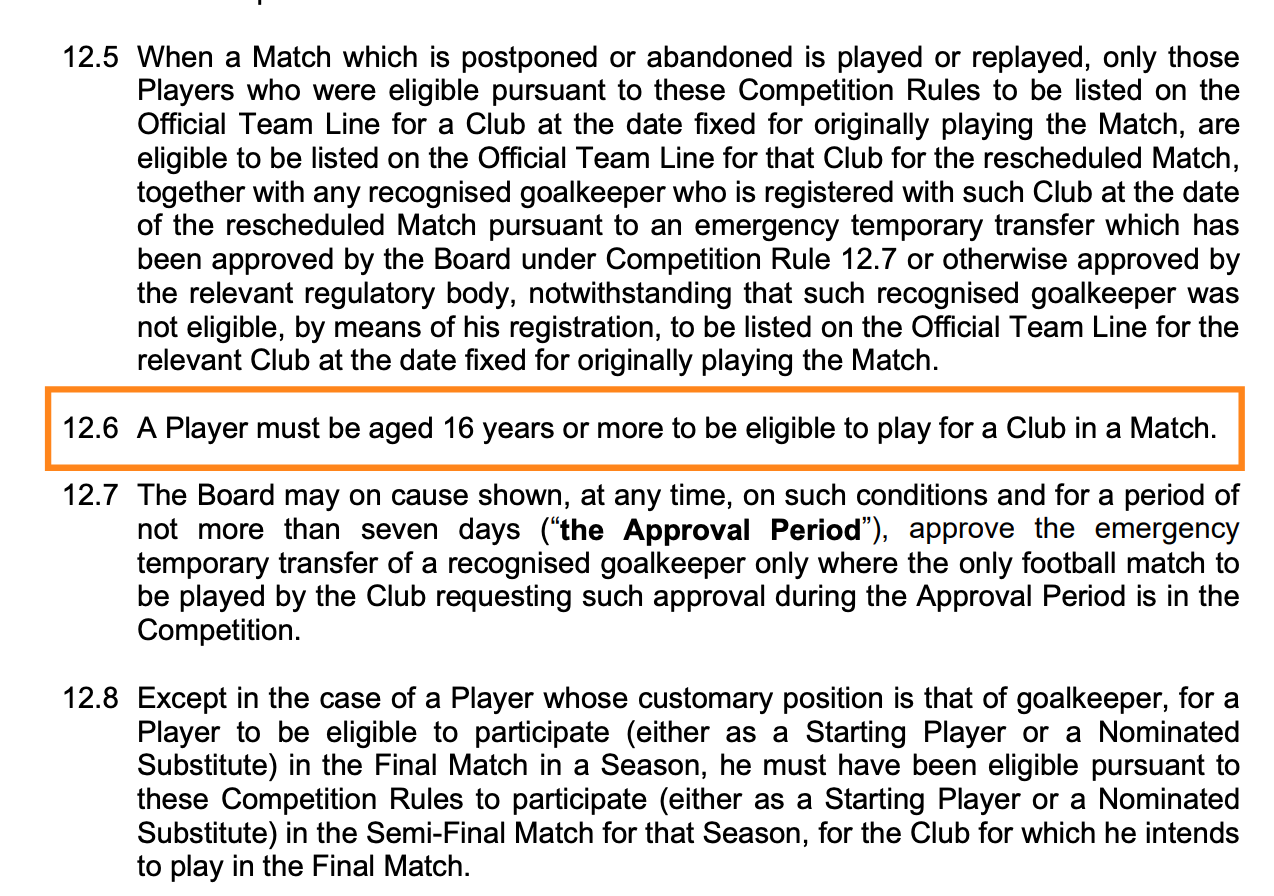
The Scottish FA has already acknowledged the wider problem. Its transition report concluded that Scotland trails comparable nations for minutes given to young players at every level of the professional game. The SFA subsequently introduced the cooperation system, allowing eligible 16-to-21-year-olds to move between a parent club and a lower-league partner in search of senior football.
A further SFA review of youth development has examined the pathway from grassroots football into the professional game. Logically then, hopefully the Scottish Cup is brought into line with the SPFL competitions next season - with the evidence produced during this summer’s League Cup group stage difficult to ignore.
Even with the rule changes, Scottish clubs will continue to lose talented teenagers to England, due to the money prestige and promises on offer from the so called best league in the world.
Therefore, playing time remains the strongest card Scottish football can offer. The tens of cases over the last decade should be evidence of the detrimental impact being ‘stuck’ in an English academy can have on a Scottish kid’s potential career.
For example, Dylan Reid became the youngest player of the SPFL era when St Mirren gave him his debut shortly after his 16th birthday in September 2021. Celtic bid six figures for him but he eventually joined Crystal Palace in February 2023.
Yes, his departure shows that even giving an early debut cannot protect a Scottish club from English interest. But Dylan Reid is now a 21 year old in an English academy, three years since his last senior league appearance.
What the Scottish clubs need is a credible pathway - showing the teenagers that they will get the chance to play here. Get 100+ games in Scotland and then move to England as a mature 20/21 year old with more senior games than the entire academy combined.
The Youngest Ever Players
As mentioned earlier, four SPFL clubs - three from the Premiership - have fielded their youngest ever player this summer, and so this article will end with the 10 youngest players ever to make a senior appearance for each of the 42 SPFL clubs - ignoring war-time matches or regional tournaments.
While I have several GB of lineup data and d.o.b data saved, these lists are likely not exhaustive and there may be some players missing - please get in touch if you spot any errors.
For that reason you should always click through to ScottishFootball.info rather than reading any article in your email inbox. Any errors corrected will not be reflected in your email version of the article.

PREMIERSHIP
Aberdeen

Celtic

Keep reading with a 7-day free trial
Subscribe to Scotland's Coefficient to keep reading this post and get 7 days of free access to the full post archives.