

Scottish Football Catching Up
A look at how teams in Scotland are changing to match the rest of Europe.

This article was written for Scottishfootball.info by Josh Duncan, a Rangers fan and aspiring sports writer, who has started his own Substack account you can follow. You can follow him there and on X.com where you can find more of his threads in the coming months.
This article is an analysis of the evolution of the tactical approach seen in Scotland, particularly by teams facing Celtic and Rangers.
Rangers vs Dundee, January 25th. A game that resulted in a fairly innocuous 3-0 Rangers win. I watched the game first as a fan, excited to see two new signings make their league debut. I then watched it back as I was working on an article about Rangers striking options.
My reasons for watching football aside, there was another thing I happened upon while watching this game. Dundee were pressing man for man at Ibrox, The team in 10th place were taking the game to Rangers.
This wasn’t the first time a team had been more aggressive at Ibrox this season, though it was the first the novelty had registered with me. In the past teams have always been intense when defending against either half of the Old Firm, rarely had that intensity reached all the way to the opposition box.
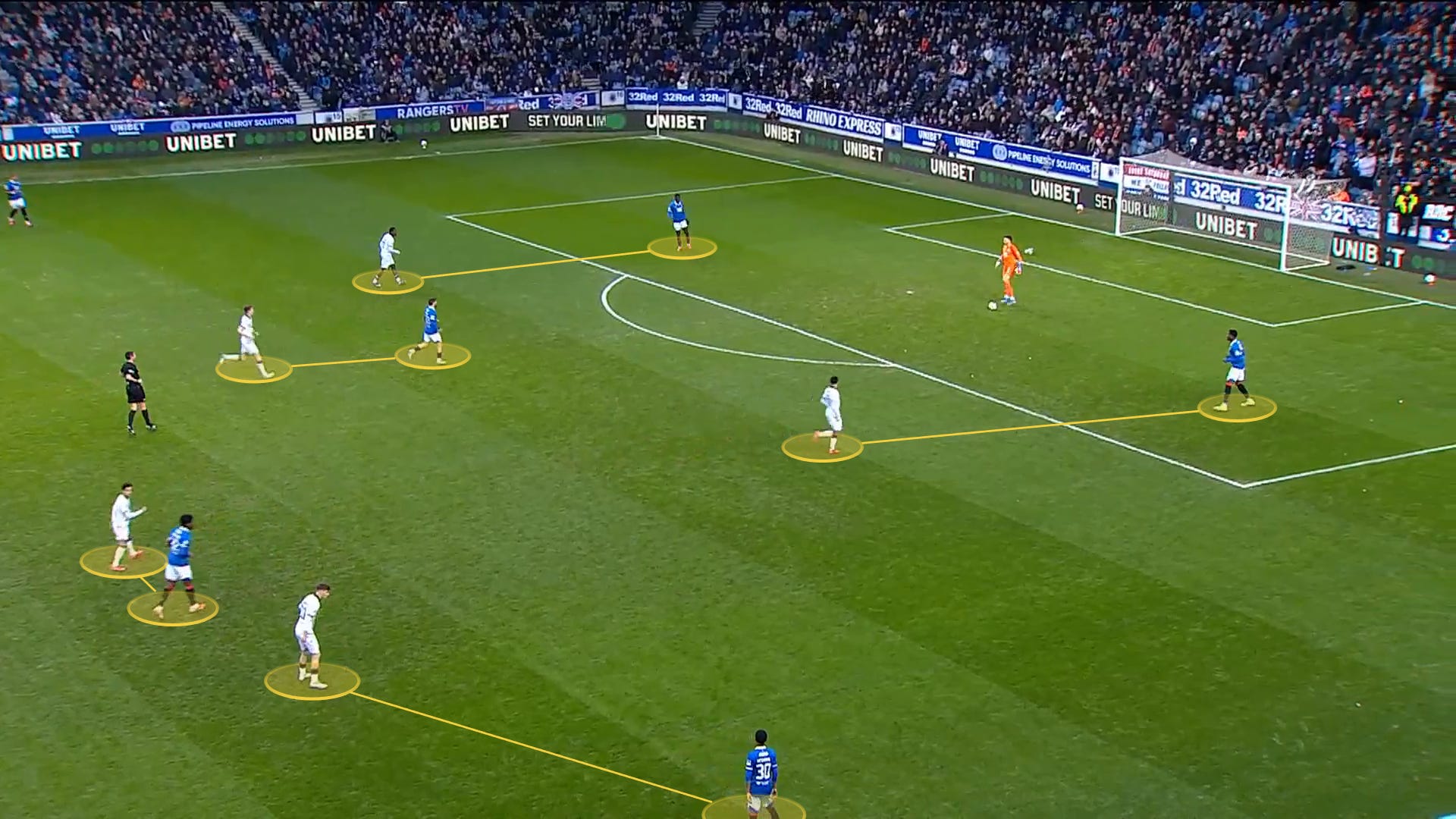
If you watch any of the top 5 leagues or some European competition, this style of defending is nothing new. Scottish teams have been behind this evolution though, and it’s interesting to see the development within our game.
It’s that development that I wanted to take a look at today. Why man to man pressing has become the footballing norm, how it has worked in Scotland and how teams are evolving to exploit it .
Man to Man Origins
It is hard to pinpoint an exact origin for this wave of defensive ideology. What it won’t surprise you to know is that it has something to do with Pep Guardiola. With his style of passing out from the back dominating the biggest league in the world, there was always going to be an adaptation.
Teams began to realise that zonal pressing played right into the hands of opponents that were playing out from the back. Trying to cover areas meant that teams had too much space to exploit and break out of presses, leaving defences open and vulnerable.
The adaptation for most was to assign every player one opponent to be responsible for. This meant that the only free man when building up would be the goalkeeper. This is how defences would restrict the best attacks.
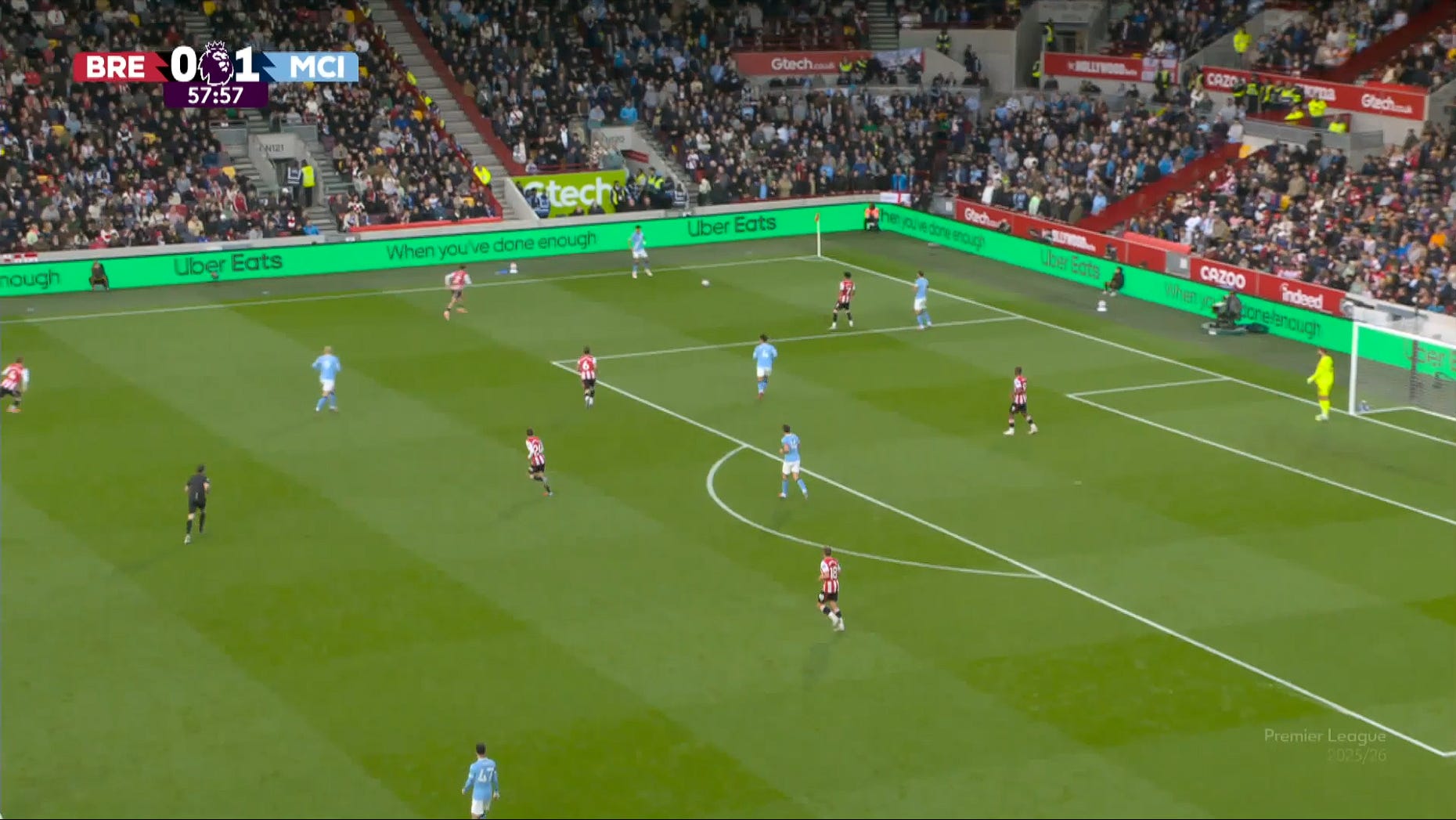
Timing and distances are key here. Players need to be aware of how they angle their body and runs to cut off line breaking passes behind them. They also can’t be touch tight as they need to be able to collapse in and help teammates. You can see in the example above how similar the distances each Brentford player is keeping to each Man City player.
As these styles of defence have become more prevalent, it has changed the way teams attack too. Direct play from long balls has increased massively. In the English Premier League, passes per match have decreased from 941 in 23/24 down to just 870 in 25/26. Teams want to get the ball forward quickly to bypass these constant high presses.
Set pieces have become massive in this Premier league season. League leaders Arsenal being ‘infamous’ for their success with them. Non-penalty set-piece goals have made up roughly 28% of all goals scored in the Premier League this season. That’s up from 20% last campaign.
There are a couple of main ways teams have found success in this style of game. Arsenal have leaned into it. Their recruitment has been based on elite physical attributes and duel winning. It is massively difficult to break them down and they keep the game under control through suffocation.
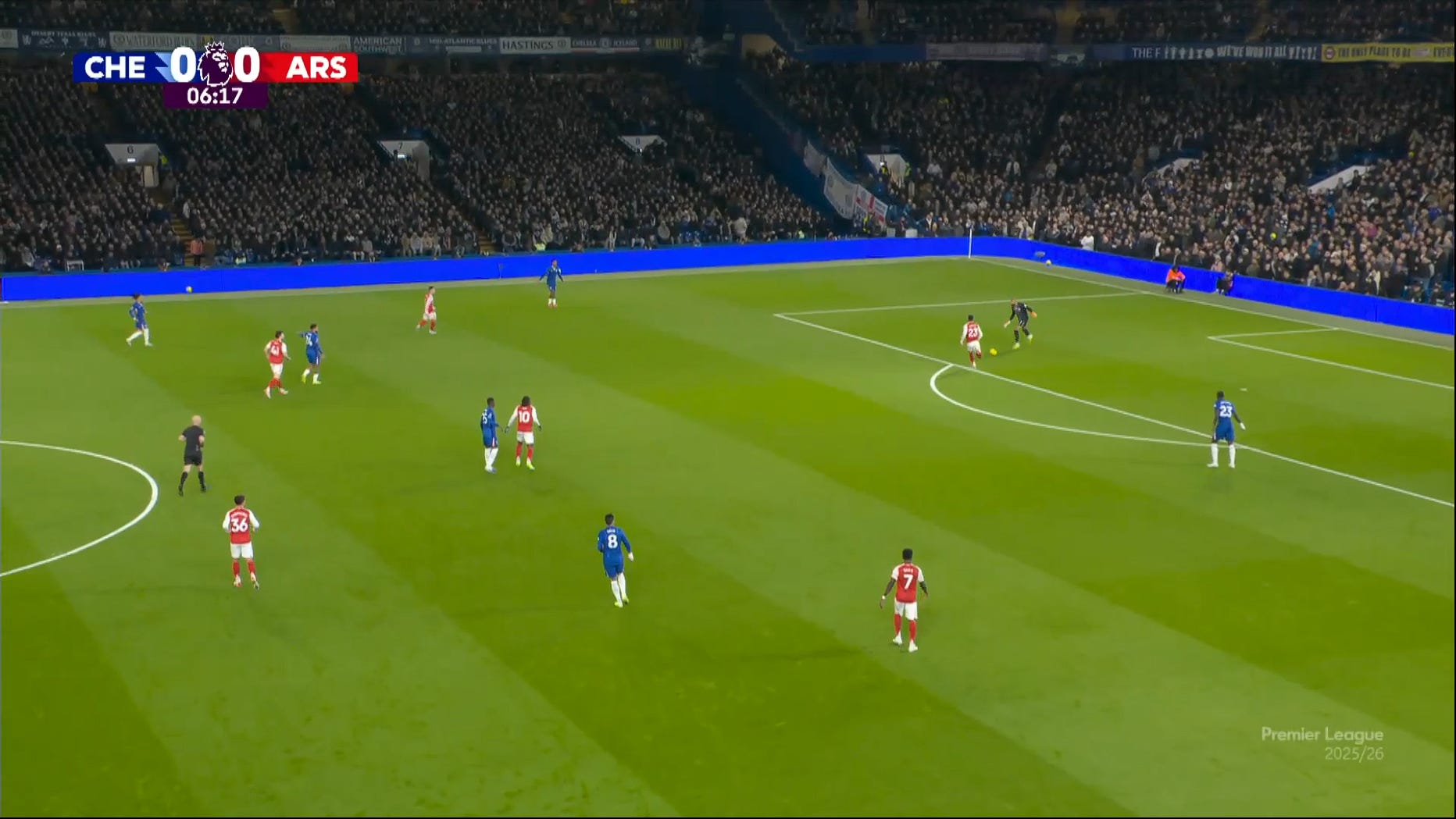
This comes with a major drawback, Arsenal really struggle to create goals from open play. They are so infamous for their set-pieces because it becomes the only way they can score in a lot of games. This means they can struggle in matches that they are forced to have the ball and create for themselves - rather than through turnovers. This season they have become so clinical at set-pieces that this seems to be working for them.
The second school of thought is based around positional fluidity. If you can move your team around so much that you make a mess of the opponents structure, then you can exploit the space in the chaos.
PSG were the first major players here, it won them the Champions League last season. It has evolved this season by Bayern Munich under Vincent Kompany.
The above clip is not during extreme pressure but I chose it because it illustrates the fluidity very well. Try to follow along, as I describe the clip:
The player pinging the long ball out of defence is Harry Kane, Bayern’s main striker. As he does this, defensive midfielder Joshua Kimmich is in the centre back position looking to receive the ball. Left back Josip Stanisic has taken his place in midfield. Lennart Karl receives the ball on the right wing despite being the number 10. Right winger Michael Olise has taken Kane’s striker position in the mean time. The move is finished by the man who started it, this time on the left wing. Taking the space Luis Diaz vacated to make an inside run.
This style scores plenty of goals but you can imagine where the drawbacks come from. You either thrive in the chaos you create or you die by it. In games where Bayern do the latter, they concede a lot of chances. This means conceding more goals. It will be interesting to see where elite football goes next.
While football may have felt like it’s going backwards with these changes in the meta, this is how you win in the modern game. So what about in Scotland?
SPFL Evolution
Scotland has often been behind the curve in the footballing world. While the Old Firm teams have generally faired a bit better in this regard, this most recent era has given them problems.
The changes started with teams moving from low to mid blocks. Allowing opponents the ball in the defence, then pouncing when a bounce pass in to midfield was played. These ideas were difficult to break down without quality play and allowed the teams a platform to win the ball high and counter.
Some SPFL teams still prefer this style of defence over pressing purely man for man. You can see the recent game between 9th place St Mirren and 1st place Hearts below. The home side are happy to let Hearts play out from the back; but are ready to pounce when the ball is progressed.

Teams then began to push it further. The best of the rest started to realise that taking the game to either of the big Glasgow teams would be something they weren’t prepared for.
It started to bear results too, as the Old Firm were creating less and dropping points more frequently. Teams throughout the league began to take notice. It now doesn’t matter the quality, teams in Scotland have started to level the playing field through sheer intensity.
This doesn’t just concern Rangers and Celtic now though. Teams will press man to man against any opponent who dares to build their attacks from the goalkeeper. You can see Aberdeen pressing this way on their trip to Easter Road this season.
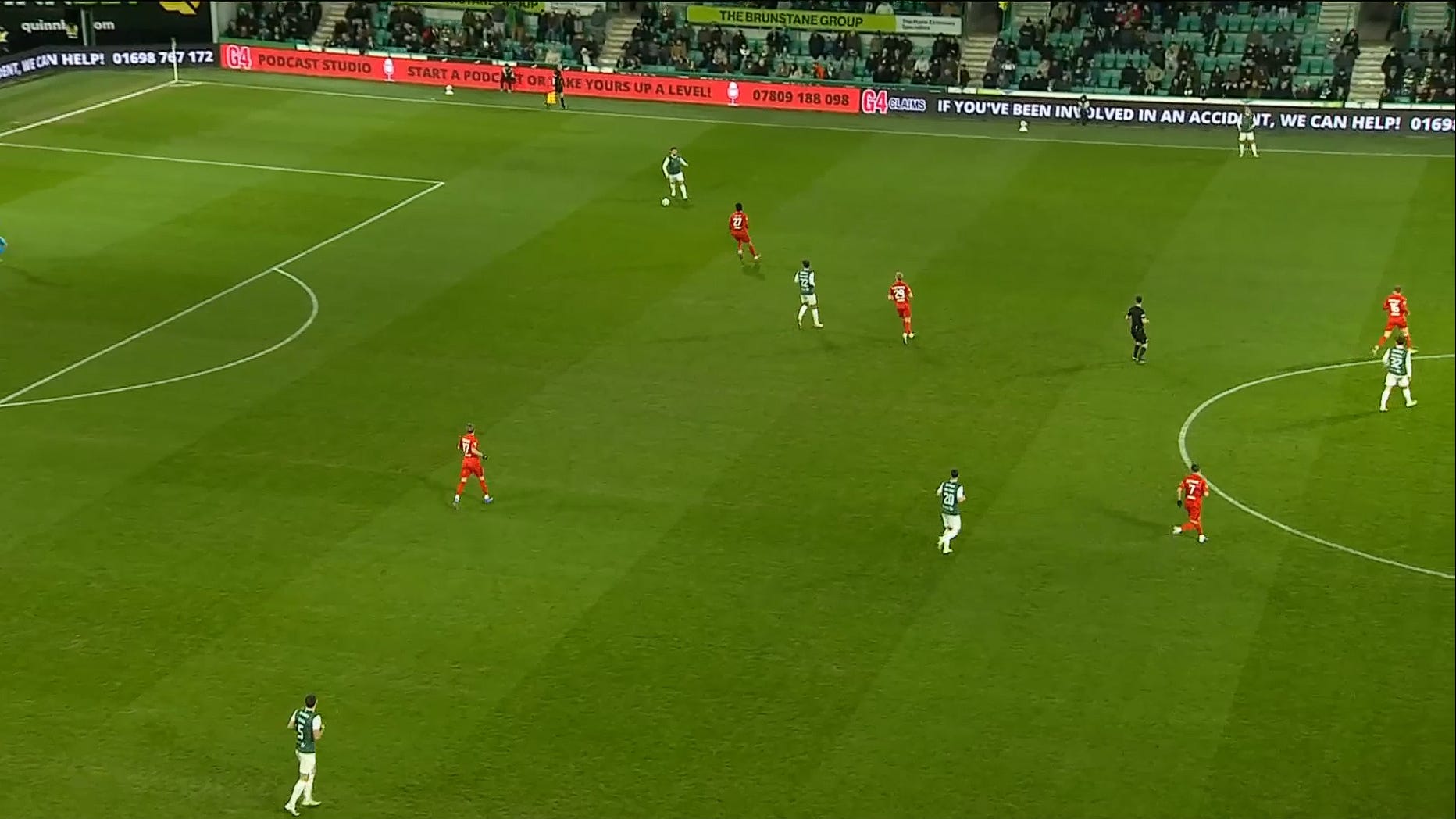
The final evolution was pragmatism. As teams got more comfortable implementing these presses, they started to adapt them more to their opponents.
Notice here that Motherwell press the two Rangers centre backs and goalkeeper Jack Butland. They know that Butland can be forced into mistakes with his feet so putting him under pressure is useful. They also leave 19-year old Jayden Meghoma as the out ball, forcing him to take the difficult pass down and then pouncing on him to try and force a turnover.
Motherwell used these pressing tactics to great effect against Rangers this week - and they dominated the ball. Rangers did show from their goal that these presses are not impenetrable and that brave football can break Motherwell down.
You can see above how Chukwuani has moved into a sort of third centre back position. This makes him a free man from the Motherwell press. He changes the tempo with a first time pass to Diomande. The Ivorian rolls his man and has acres of time and spaces to pick out Nico Raskin, who finishes with aplomb. This goes back to the fluidity of positions that we talked about earlier.
Despite this moment, Motherwell’s smart use of man to man pressing and tactical traps gave them dominance. The level of which has rarely been seen before against the Glasgow giants. This is where embracing modern play has taken Scottish football.
Improving all the Time
Some teams have been getting smarter. Hearts and Motherwell have been the surprises of this season. Strong recruitment and decision making have allowed them to pounce on the decline and poor management at both Rangers and Celtic.
Tony Bloom has used his analytics department to make consistent shrewd signings. Regardless of whether Hearts do close out this title race, players like Claudio Braga and Alexandros Kyziridis will be in the running for personal awards. They may not have a found a proper team identity yet but good players win matches and Hearts have signed good players this season.
Motherwell have been recruiting strongly on their own, too. Elliot Watt has been massive for them, joining for free in the summer. Tawanda Maswanhise is the Premiership’s top scorer, an extremely impressive achievement for a player at the fourth place team.
Motherwell have also achieved something that Hearts have yet to do. They have an identity. Jens Askou has Motherwell playing the best football in Scotland, no matter the opposition. They are extremely impressive, comfortable on the ball and fluid positionally. With players that are enthusiastic to play this way.
You can see in the clip above just how comfortable Motherwell look in possession. The constant movement of the players unsettles defences. The patience of the player on the ball is clear, they are confident in what they are doing and know to wait on the right moment.
These teams are catching up on and off the pitch, which has been very impressive to see. Hearts and Motherwell will almost surely both be representing the country in European competition next season. We will find out just how far they’ve come when they enter that theatre.
Lost Giants
Finally, after all this talk about the teams who are chasing, where do Scotland’s two giants go next?
The teams typically below them have improved and adapted to football as it is today. It’s been impressive work to narrow that traditional quality gap, especially given the ever-widening financial gap. As always though, it takes two to tango and the Old Firm have had just as big a part to play here.
Both teams have been run poorly of late and have been banking on the lack of quality in the rest of the league to maintain their position. This year, that credit is starting to run out.
After changing managers, it seems Rangers have decided on their answer to this problem; tactical flexibility and an extremely physical squad. Their games under Danny Rohl have been understandably likened to Arsenal. Physically dominant, set-piece goals and poor creativity.
The mix of that physicality and creativity brought in during the winter transfer window may be enough to propel the club on a better path. Time will tell on that front.
Celtic are in a much more confusing position. Going through three different managers this season has left the champions with no real identity. They have a squad mixed with players who don’t really make sense together.
There doesn’t seem to be any defined approach to bringing the club back to it’s best either. Martin O’Neill will likely be gone in the summer and Celtic will have to start again. They may yet win the league this season but they still don’t look convincing.
If Celtic get the manager decision right in the summer, they still have a mess in terms of squad building under a hierarchy that has never really proven they know what they’re doing on that front.
An Exciting Future
In general it is exciting to see a league that is trying to get better. The success of those attempts isn’t always there of course. The only way that the league will see better fortunes is if clubs start pushing the game forward.
Clubs performing better at home and hopefully showing positive signs in Europe will contribute massively to the product of Scottish football. In the end it should even push Rangers and Celtic to take the strong position on the European stage that they’ve always had the potential for.
Let’s hope it continues.
 | A guest post by
|