

SPFL Annual report - year ending May 2025
Record financial results again for the company responsible for maximising the prizemoney in Scottish Football

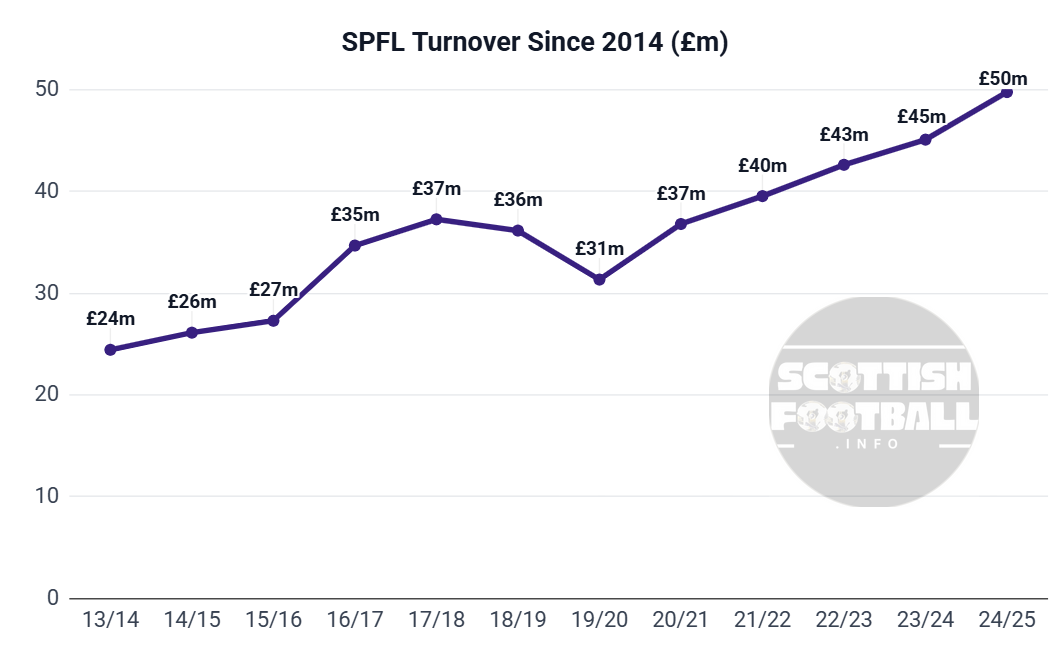
The SPFL accounts have been released for the year ending May 2025, with the highlight being company turnover hitting a record high of £48.7m, an increase of 10% from the previous year’s £44.3million. This follows the 6% increase in the previous year; meaning SPFL ‘company’ turnover has risen from £41.9m to £48.7m in just 24 months.
Since the SWPL joined the SPFL group in 2022/23, the SPFL reports both ‘company’ (SPFL) and ‘group’ (SPFL & SWPL) turnover. The below chart includes all group turnover.
WHAT IS THE SPFL?
The Scottish Professional Football League (SPFL) is the organising body responsible for running professional league football in Scotland, namely the SPFL and the SWPL. It is not the overall governing body of the sport, as that is the Scottish Football Association (SFA) who oversee rules, referees, discipline, and national teams.
The SPFL are responsible for “commercially exploiting” Scottish football, including broadcast and sponsorship deals, before distributing these revenues to its member clubs.
The SPFL are also responsible for three domestic cup competitions, the Scottish League Cup, the Challenge Cup and the SWPL League Cup (not the Scottish Cup, as that is the SFA’s). One of the key responsibilities is to ensure the tournaments generate as much money as possible, and as part of that ensuring all tournaments have title sponsors, which is currently the case:
The William Hill SPFL
The ScottishPower SWPL
The Premier Sports Cup
The KDM Evolution Trophy
The Sky Sports Cup (SWPL League Cup)
WAS IT A GOOD YEAR?
Neil Doncaster, SPFL group chief executive: “We’re extremely pleased to be able to announce the strongest turnover and total group distributions in the history of Scottish league football. These figures are by some distance the best financial figures in the 12 years of the SPFL”
Revenue and club distributions are at record levels. Attendances are higher than ever at over 5 million per season (including cup matches); the best supported top flight in Europe on a per capita basis. It’s not just those that go to the games, as more than 15 million people watched SPFL games on Sky Sports. Across 47 matches the average viewership is around 320,000 per match, up from the previous year’s average viewership of 285,000; a further increase from the 228,000 of two years ago. In April 2024, Rangers 3-3 Celtic became the most watched Scottish game on record - 1.44million viewers watching legally through Sky Sports.
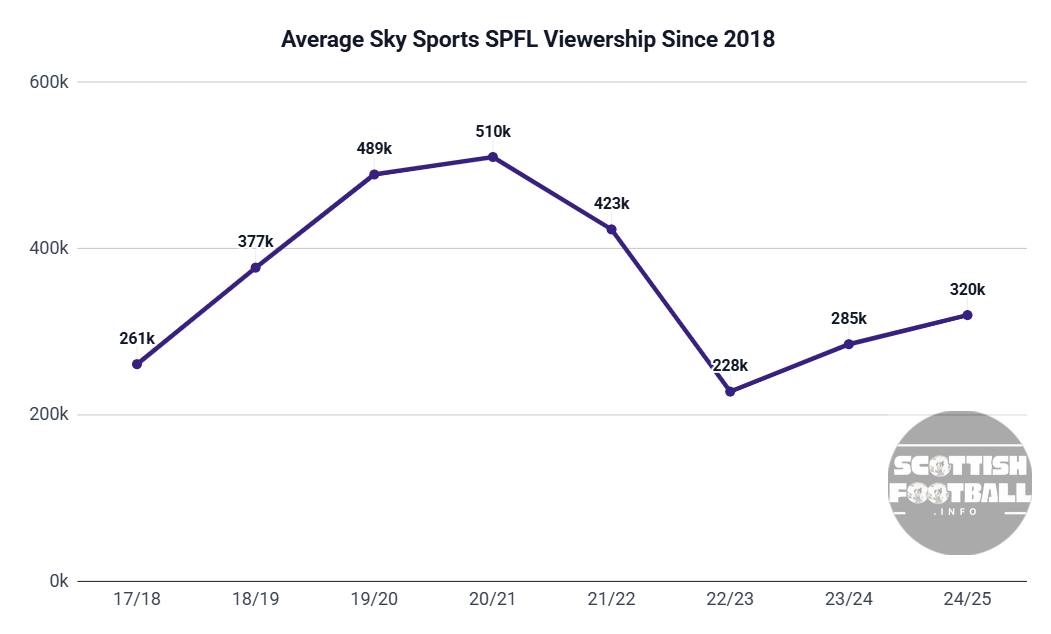
Although the “average viewership” number is down from the pre-covid years, this can be attributed to the fact a wider variety of matches have been selected for broadcast in recent seasons. Although this may have brought the overall average viewer number down, there is the obvious greater benefit of providing coverage to more teams - raising the profile of the league as a whole.
The SPFL are a small company in terms of number of employees, just 18 people employed in the last financial year. They operate not to generate profits for shareholders, instead solely to distribute funds to clubs, which falls under the accounting term “cost of sales” (£45.6m). The distribution pot is finalised after the reduction of SPFL costs such as administrative expenses, which for the SPFL group now sit at £3.99m, a small increase from the £3.78m recorded in the previous year. This nearly £4m in expenses encompasses legal fees, marketing, advertising and PR, referee expenses, and the “significant investment” in match production; 6 cameras per non televised match instead of 4, to improve the VAR system.
This article will delve into the detail behind the TV deals and where the money in Scottish football comes from and then how it is distributed.
If you are not yet a paid subscriber, please consider a 7-day free trial to read on. After reading this article, and any of the 250+ others, you can then decide if £20 per year is good value or not. Now is the best time to join, as new subscribers joining from February 2026 onwards will pay a higher subscription fee.
THE RISE IN INCOME - THE TV DEALS
SPFL income is at record levels firstly down to the recent increase in sponsorship revenue, but last year’s rise was mainly due to an increase in TV rights; the existing improved Sky TV deal and a brand new Premiership TV deal with Premier Sports - who showed 20 matches last season.
The new Premier Sports deal is worth around £3.2m per year, running alongside the existing Sky Sports deal worth around £30m per year.
With around 15 million total viewers of men’s Scottish football on Sky Sports last season, Sky’s £30m deal means they pay an average of £2 for every viewer received, before the women’s game is factored in. This is an approximation, and is of course not a ‘unique viewer’ number, merely the total number of views over the season. The contract allows Sky to show up to 60 of the 228 Premiership matches, valuing the ‘price per game’ at £500,000.
This ‘price per game’ metric is often referenced by the SPFL’s Chief Executive Neil Doncaster when challenged on the value of the TV rights deal. Other similar sized nations may earn more money through their TV deals, but often this is to broadcast more (or all!) matches in a season, substantially reducing their own ‘price per game’. Those that believe the current rights deal undersells Scottish football would argue that the total amount received is all that matters, and that the price per game is irrelevant - especially when Sky once again did not take up their entire quota of matches (showing 47/60 in 2024/25 and 41/48 in 2023/24).
As part of the new Sky deal, the 12 clubs can sell only five home matches per season through their own PPV channels (60 games total). Other games beyond this cannot be shown, and so critics of the deal would argue that it is therefore a deal for a lot more than 60 matches - as the remaining 88 games can’t otherwise be shown elsewhere. When only 9% of total revenue in to Scottish football comes from broadcast deals (the 2nd lowest % in Europe), it could be argued that allowing the clubs to sell all the matches not shown on TV would be a step forward for the clubs’ own revenue generation.
Keep reading with a 7-day free trial
Subscribe to Scotland's Coefficient to keep reading this post and get 7 days of free access to the full post archives.