

The 2025 UEFA European Club Finance and Investment Landscape Report
An analysis of UEFA's recent report, comparing the Scottish Premiership to other leagues around Europe


UEFA’s European Club Finance and Investment Landscape report is published annually, with a detailed analysis of the money involved in European football, covering 700+ clubs. The main takeaway from this year’s 112 page report will be of no surprise; revenues are at record levels - but so are costs.
Even though the clubs are generating more money than ever before, nearly half are unprofitable. A point underscored by the fact that Celtic are once again one of the most profitable clubs in Europe, despite playing in one of the smaller European leagues.
Andrea Traverso, UEFA Director Financial Sustainability & Research:
“Improvements in wage control and record transfer profits mean that more than half of Europe’s top-division clubs reported a profit before tax in 2024, the first time since before the pandemic. The combined top-division losses before tax decreased to €1.1bn in 2024, with a similar level projected in 2025.
Regrettably, the lack of consistent domestic-level financial regulations will likely prevent European football reaching pre-pandemic levels of profitability”
This analysis will review the report in detail from a Scottish point of view, similar to my review last year, while also comparing the figures to the top 20 leagues across Europe. You can also find an in depth look at several Scottish clubs in the financial reports section, with more to be added in the coming weeks.
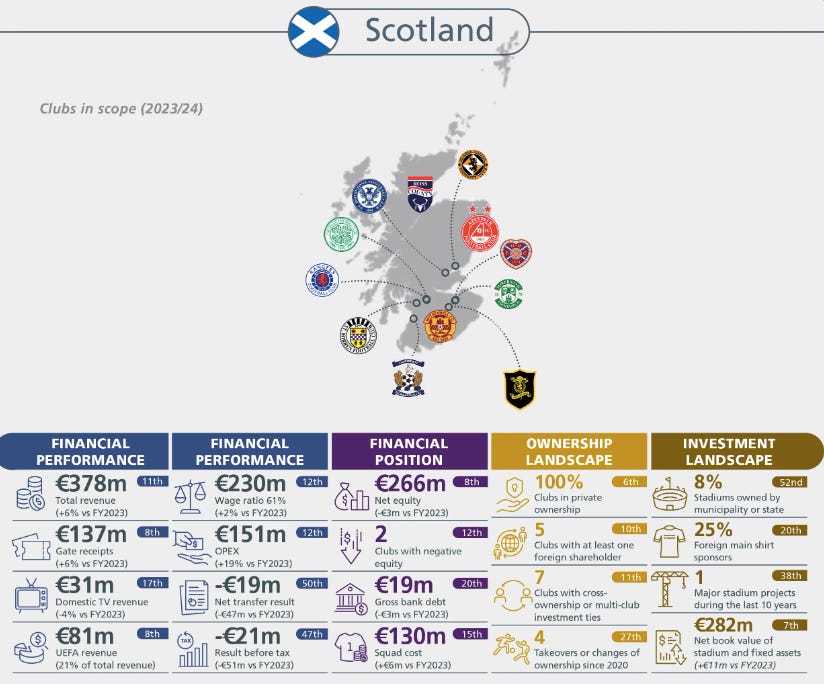
In UEFA’s report, there may be some accounting period and currency discrepancies, as all of UEFA’s figures are presented in Euros whereas our clubs obviously all report in GBP. As with most financial analysis, the figures are largely already out of date (2023/24), however 144 clubs in 37 countries clubs do provide UEFA with “early 2025 financial data” used by UEFA in formulating this report. Some of the figures are therefore from 2024, while other figures will come from 2025, for the early reporting clubs. It’s also worth remembering that for the Scottish aggregate figure in each category, a large chunk will always be generated by Rangers and Celtic.
In Scotland, five clubs provided early data to UEFA in preparation of this report; Aberdeen, Celtic, Dundee United, Hibernian and Rangers. There were nine English clubs which did so, and it was reported last week that some were unhappy that their ‘early data’ provided to UEFA was released to the public without warning. For example, Chelsea’s record loss of £355m had not yet been released by the club themselves as they hadn’t yet published their 2024/25 annual report!
This article is very detailed, probably best read over a number of visits. It’s broken down into five main areas:
REVENUE
Ticket money
UEFA prize money
TV deal & Scotland’s imbalanced distribution model
Commercial income including shirt sponsors
EXPENSES
Wages & Operating Expenses
PLAYER TRADING
PROFIT
INVESTMENT
Multi club investment and American ownership
If not yet a member, take out a 7-day free trial now to view over 300+ existing articles and videos before deciding if an annual subscription represents value for money at 50p per week. You’ll also get access to the coefficient group chat on Substack with over 1,000 members!
REVENUE
UEFA breaks down the revenue for each country into gate receipts (matchday tickets and hospitality), domestic TV revenue, UEFA prize money and commercial revenue (sponsorship, merchandising and other commercial activities). At an aggregate league level, Scotland’s Premiership clubs generated €378m total revenue in 2024, an increase of 6%, which ranked 11th out of 55 UEFA member associations for total revenue.
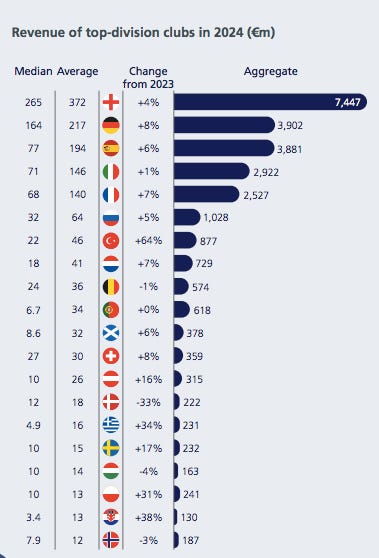
What sets Scotland apart from most other leagues is where that money comes from. As a league we are very much ‘attendance-dependent’ with any major total growth normally attributed to an increase in UEFA prizemoney. Whereas the English Premier League for example would be much more ‘TV dependent’; a drop in attendances or UEFA prize money wouldn’t be felt at the aggregate level as much as it would in Scotland.
GATE RECEIPTS
Across Europe, total gate receipts reached a record €4.4bn, a 16% rise from last year - thanks in part to a 22% growth in hospitality sales. Ticket sales is Scotland’s most impressive metric, where we are ranked 8th in Europe. The Scottish Premiership brought in a total of €137m through ticket sales, which is 36% of our total revenue figure of €378m.
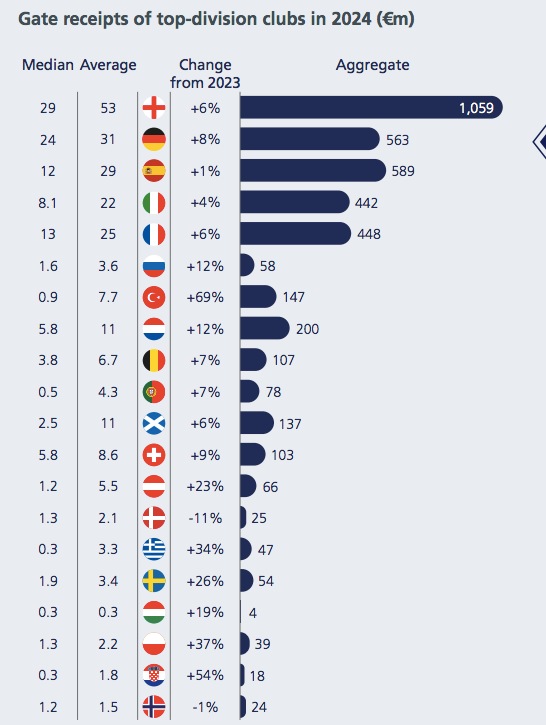
This once again demonstrates how dependent our clubs are on the match-going fans. Scotland’s percentage of income that comes from ticket money (36%) is by far the highest in Europe, considerably more than England (14%), Germany (14%), Portugal (13%) and Denmark (11%). In fact no other nation is above 30%, and only seven are over 20%. The combined €137m our clubs earned from ticket sales dwarves the likes of Norway (€24m), Denmark (€25m), Poland (€39m), Austria (€66m) and even Portugal (€78m) and Belgium (€107m).
With this in mind, while most supporters likely back the idea and the theory behind a price cap on tickets - this is much harder to implement in a league that is so dependent on ticket money. The German Bundesliga is always regarded as the gold standard for ticket pricing with clubs financially looking after their fans. But when only 14% of your revenue comes from ticket sales, and 29% comes from the TV deal - as it does in Germany, this is much easier to achieve. A price cap in Scotland would not dramatically increase attendances - we are the best supported league in Europe per capita, but it would decrease the clubs revenue.
CELTIC AND RANGERS - GATE REVENUE
Keep reading with a 7-day free trial
Subscribe to Scotland's Coefficient to keep reading this post and get 7 days of free access to the full post archives.