

Those Pesky Bairns
A tactical breakdown of Falkirk Football Club, following their successful first campaign back in the top flight

This article was written for Scottishfootball.info by Josh Duncan, an aspiring sports writer, who has started his own Substack account that you can follow. Please follow him there and on X.com - where you can find more of his threads in the coming months.
This article is a tactical analysis of Falkirk, looking at the Bairns in possession, out of possession, their defensive issues and a focus on Brad Spencer.
When Falkirk sealed their return to the the top flight last season, most would have viewed simply staying up as a successful season. In reality, they sit sixth, above Dundee United and Aberdeen with just a few games to go before the split.
In the midst of the best title race in years, Falkirk have fallen under the radar. This is a serious success for a newly promoted team to be doing so well and playing a decent brand of football.
John McGlynn has led his team into the fight for a place in the top half of the table. Falkirk have been well worth this position, the numbers and the eye test agree that they deserve to be where they are.
So let’s take a look at Falkirk as a team and figure out how they have achieved their success this season.
In Possession
Falkirk setup in a 4-2-3-1 most weeks. This formation provides a platform for the team to play in a couple different ways while maintaining a consistent philosophy. That philosophy is based on getting the ball forward quickly.
In games where Falkirk have a good share of possession, you will see the first style they like to attack in. They are happy to play out from the back - but the goal isn’t to carve through the middle of teams. Falkirk would rather create space to get the ball into dangerous areas quickly.
When building from the back, Falkirk position their full backs high, pinning the opposition into their own half. From this situation, the centre backs can play long balls forward and this is where the formation provides an advantage.
The 4-2-3-1 allows close proximity between the midfield and the forwards. When Falkirk go long, they have a lot of bodies ready for the second ball. When they win the second ball you then see how quickly the players stream forward, creating great chances in the box. This is illustrated in the clip below.
When this doesn’t work, Falkirk are quick to use the wide areas to attack. They move the ball side to side at speed to try and get their wingers or full backs into good space. Sometimes they will play into the midfield to draw their opponents narrow and then shift out wide to players in space.
From here they will look to get shots off or get the ball into the box early. Falkirk’s midfield are excellent at reading these crosses and flooding the box. This often leads to overloads, which allow the wide players plenty of options to aim at. The next clip shows this at its best.
Out of Possession
While Falkirk have found success with the ball this season, their style really flourishes in games where they see less possession. Their strengths are amplified when they can get the ball forward in space. They get this opportunity if they can counter quickly.
You can see some of the elements that Falkirk show with the ball but amplified by the space that is there for them to attack. This time, they press high enough to force their opponents to go long. Once this happens, they use the proximity of the formation to win the second balls and get on the attack. They did this in their game against Hearts recently.
Falkirk are very good at forcing their opponents into long balls. You see how much pressure they get on the Hearts defence in the clip above. Once the header is won, you then see Falkirk swarm the player trying to control the ball. Once they win it, bodies stream forward, leading to a decent opportunity. You can see another example of this below.
If the opponent settles into possession, then Falkirk will try and trap them out wide. They cover one side of the pitch with the angles of their pressing and try to force the build up over to the wing. This often forces the opponent to play a risky pass and lose the ball. Leading to the situations that Falkirk thrive on, flooding into space.
Below is a clip of them doing this against Hearts. You can see how the path to the far side of the pitch is blocked by the Falkirk press. Halkett feels the pressure closing in and forces a pass into the midfield, allowing Falkirk to win the ball and break. A bit more composure and this is probably a goal.
Defensive Issues
Falkirk aren’t perfect of course. When watching them, you see that there is a clear flaw in their defending. That flaw is defending their penalty area. Balls into the box have been the bane of Falkirk’s season.
It is clear that they are just not comfortable when a ball comes into the box. No matter if it’s a cross, corner or throw in. You can see just how unconvincing Falkirk are in these situations by watching this goal conceded against Dundee United.
When the opponent sends crosses into Falkirk’s box there is a sense of panic. Even when they are able to clear away the initial cross, Falkirk are very scrappy when a second ball comes in.
This was how they lost the game against Hearts. You can see below that Falkirk deal with the original cross quite comfortably. When Hearts send the ball forward again, Falkirk’s shape is all over the place. This disorganisation allows Hearts far too much space in the middle. The ball gets into the box and some scrappy defending allows Hearts to score.
So now that we have an understanding of how Falkirk like to play, I would like to talk about a player who has been massive in their success this season.
Brad Spencer
Brad Spencer is Falkirk’s vice captain and has led the team most of this season in Coll Donaldson’s absence. He plays as part of a midfield duo that sit in front of their backline. He has been consistently one of the best midfielders in the Scottish Premiership this season and facilitates a lot of what Falkirk do.
He is a very aggressive defender, who puts opponents under a lot of pressure. His intensity can be felt throughout every game, where you can see him win the ball and get Falkirk moving.
This aggressiveness should not be confused for being rash, though. Spencer is very aware of his positioning and the danger opponents pose. So even if he isn’t winning the ball, you will see him slowing down attacks and snuffing out danger. You can see examples of this in the clips below.
Compared to his peers as a deeper lying midfielder, Spencer is an excellent attacking influence. Amongst defensive midfielders with 1000 minutes played this season, Spencer ranks first in ‘expected assists’. This shows how much of a creative influence he is.
He does only have one assist this season but what that tells us is that his teammates aren’t always being clinical with the opportunities he creates. His expected assists number comes from his ability as a shot creator. He is consistently able to find teammates in spaces to get shots away.
Below is a clip of his only assist of the season. Spencer finds great space in the box and shows the composure to find a teammate when the ball comes to him.
You can see from the below graph that the data backs up these strengths. Spencer is a ball winner who can get his team moving. This is why he is perfect for this Falkirk team and how they like to play.
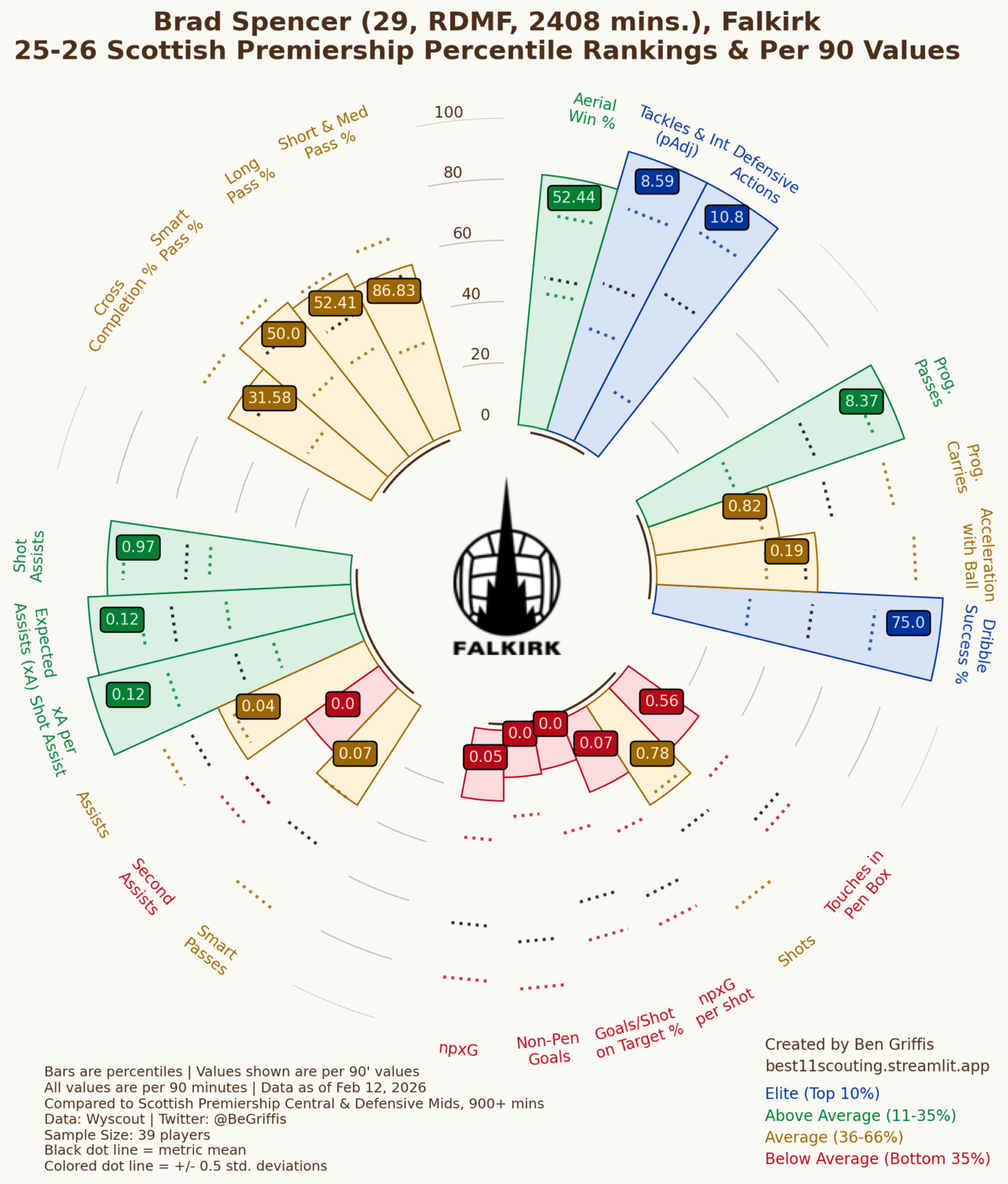
His ball winning and defensive stats are excellent in comparison to his peers. He is above the 90th percentile for successful defensive actions, showing his consistency without the ball.
It is also clear how well he creates shooting opportunities for his team. Looking at the left hand side of the graph you see the above average ranks in all three shot creating metrics. It shows how much of a creative impact he has relative to his position.
Can Falkirk Keep it Going?
When a newly promoted team has success like this, there is often a feeling that it won’t last. Teams may '‘figure them out’ the next year or maybe they will lose key players to bigger clubs.
In the case of Falkirk, I think that the success is sustainable. Falkirk are actually underperforming their xG this season; Scoring 32 goals from 37.5 xG. While you do see them be a bit wasteful in front of goal, there is room for positive regression here, resulting in them scoring more goals.
In terms of defending, Falkirk have conceded 36 goals from 38.8 xGA. This shows that they are conceding goals in line with what is expected. This number is the 6th lowest xGA in the premiership, which is the position they sit in the table.
This data is surface level and looking at data is never the be-all and end-all when understanding a football team. What it can do is give us an indicator of future performance. In Falkirk’s case, the indications are positive.
These numbers, mixed with what I have found from watching Falkirk, give me the impression that they can carry this success into the next season. Their style fits both the squad that they have and the league that they play in. That marriage has brought great results.
Falkirk have had significant contributions from loan players this season. Henry Cartwright, Kyrell Wilson and Filip Lissah have all been involved consistently throughout the campaign. If these players are not here next season, being able to replace these minutes adequately will have significant bearing on next season.
If Falkirk can keep hold of their manager and can replace the retuning loan players, I believe they can continue this success into next season.

Wow great read, bairns must be your passion 👏
Great read 👏