

2025/26 - The Year Of The Outsider
Hearts aren’t the only club to upset the usual order across Europe this season.


It’s not just Hearts that are giving the big boys a bloody nose this season. Across Europe, 2025/26 is becoming a season of broken monopolies in many of the small to medium sized leagues. In fact, were Hearts to win the Premiership, it would only rank as the fourth rarest title in Europe this season, given three leagues have already produced first-time champions!
This article discusses the impact of UEFA prize money on competitiveness, the surprises in league winners this season, and the current seedings for the Champions League qualifying rounds.
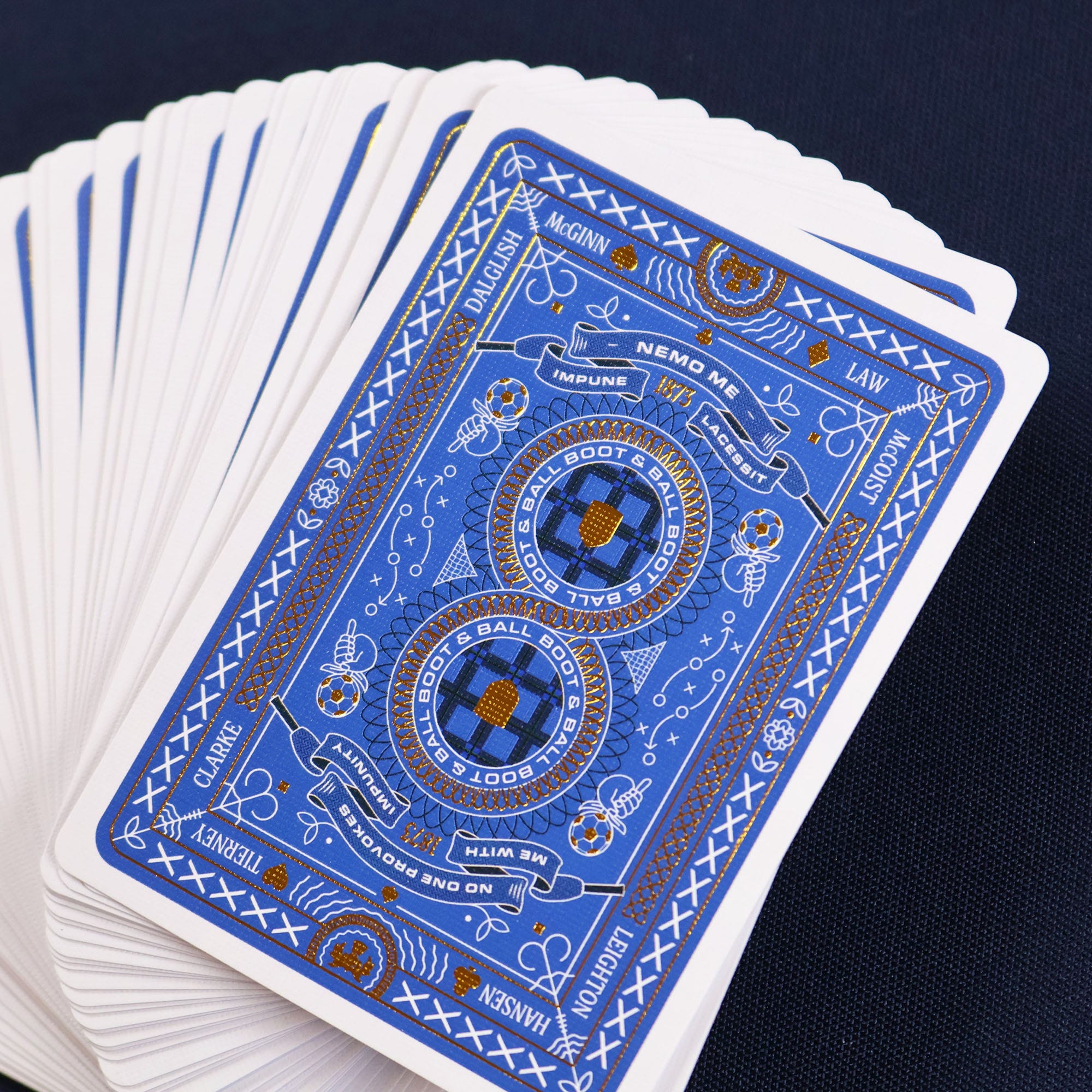
I’ve teamed up with ‘Boot & Ball’ to promote their Scotland national team playing cards.
It is genuinely a fantastic product, with cards featuring King Kenny Dalglish, Andy Robertson, Scott McTominay and more.
UEFA Prize Money Skews the Competitive Landscape
Several leagues around Europe - including ours - have either already been won, or are currently led, by ‘smaller’ clubs trying to end droughts that stretch back decades. Many fans will view this as refreshing, given streaks of the same team winning year after year have become a common part of the European landscape. Celtic are currently on 4-in-a-row league titles, after Rangers won one to interrupt their 9-in-a row. Other examples include Bayern Munich and Dinamo Zagreb who both managed 11-in-a-row, while Ludogorets did 14-in-a-row until this season.
One of the contributing factors for such streaks is that the prize money on offer from UEFA has grown year after year, and is often only attainable by only one or two clubs, especially in the smaller leagues. Those clubs can end up earning sums from UEFA which far exceed the total domestic prize pot for their entire league. This has meant that in many leagues, the teams that often qualify for the European tournaments regularly have become untouchable domestically. This becomes a difficult cycle to break because the big clubs, pumped full of UEFA cash, then win their league again, qualify for Europe again, and pull further away financially from those left in their wake.
We’ve seen that cycle in Scotland, to an extent too. Of course, Celtic already start with an in-built advantage over all others given the size of the fanbase that fills the 60,000 capacity stadium. So their financial success is not built solely on UEFA revenue. However in the years in which they reached the Champions League group stage, their financial advantage surged to levels previously not seen in Scotland.
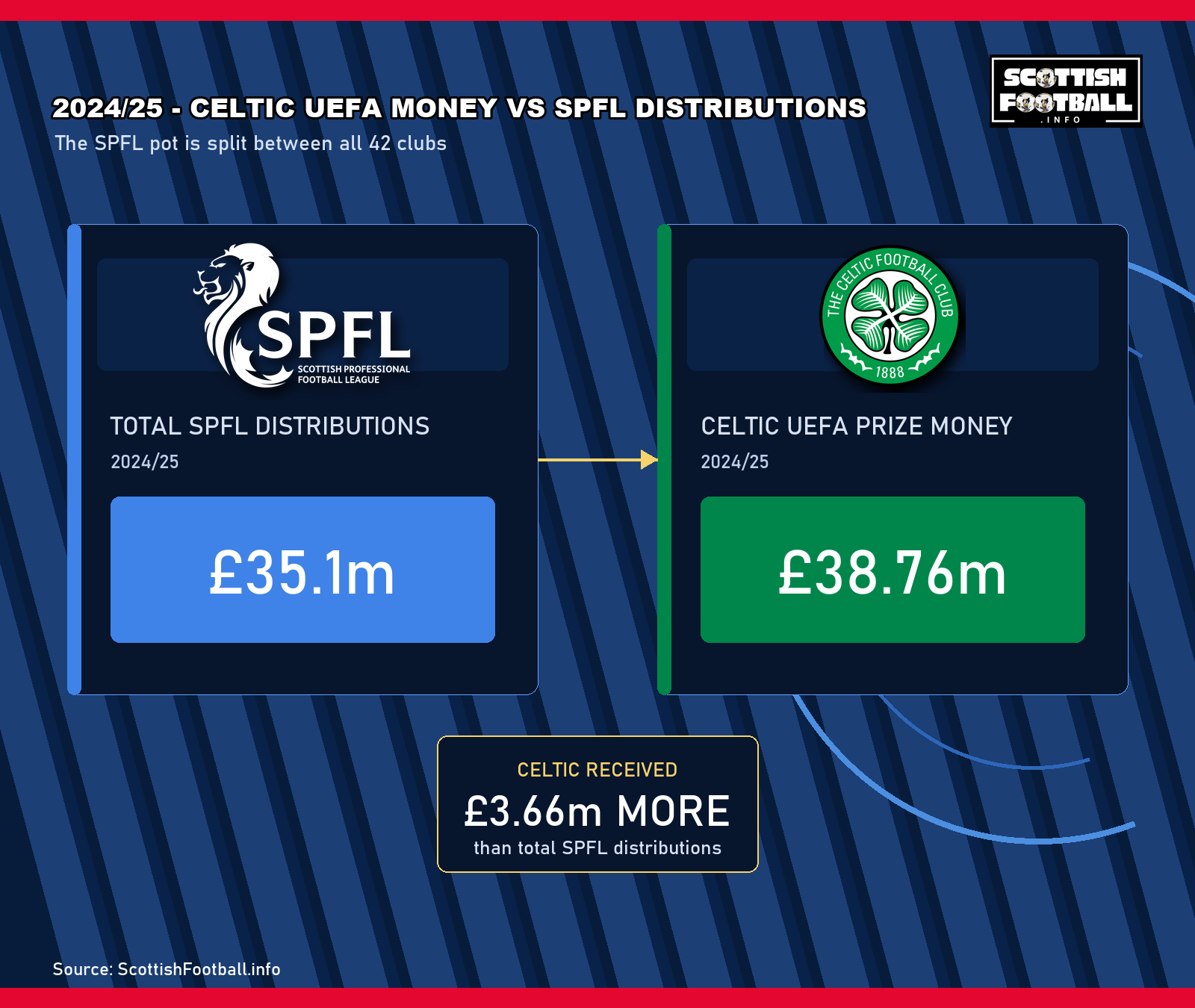
The hoops have been able to earn more from UEFA in one season than the SPFL have to share between all 42 clubs. Then, as Champions Celtic then take the largest share of the SPFL pot (~£4.5m), and so their financial gulf grows year-on-year. I have previously argued that our distribution model is not conducive to a competitive league, and have proposed a change in the model that gives less to the top two clubs, and more to the clubs further down the league. If not an overhaul in the model that changes the percentages awarded to each place, then I’d like to see a “UEFA” tax, similar to what they have in the Netherlands.
Scotland could have a system where if a team earns a certain amount through UEFA competition, then they automatically give 5% of that back to the SPFL for redistribution to the clubs. When Celtic (or whoever the Champions are) earn £40m from Champions League, that figure alone dwarves the the entire SPFL distribution pot of £35m. I don’t believe that the Champions should then also take £4.5m of that pot. Either the Champions share of the SPFL pot should be reduced, or they should give a % of UEFA earnings back to the league for re-distribution, in my opinion.
While UEFA earnings have had an effect in Scotland, UEFA’s money can skew things even further in leagues with less revenue than Scotland - especially in countries where only one team is regularly qualifying for Europe. With Rangers, we’ve at least had two teams with a financial advantage over everyone else, rather than just one.
With the financial discrepancies witnessed in leagues across Europe, it increasingly becomes a more notable achievement for any smaller team to win their domestic league. Taking the title away from the top team - especially if they have such a pronounced financial advantage - seems completely unachievable for most clubs in Europe.
But not this year, apparently.
The Real Fairytales
The biggest ‘fairytale’ from all the ‘outsiders’ this year has undoubtedly come in Sweden. Mjällby had never won a major trophy in their history, and were in the Swedish third tier only seven years ago. In fact, they were one game away from dropping to the fourth tier of Swedish football before earning back-to-back promotions. The team is made up of mostly locally born players, and play their football in a village called Hällevik, which has less than 1,000 inhabitants.
Mjällby would have been 150/1+ to win the season behind the traditional bigger Swedish clubs such as Malmö, Hammarby, Djurgården, AIK and Häcken. However, in October 2025 Mjällby became champions of Sweden for the first time in their history, winning the tile with ease - as they eventually finished 13 points clear of Hammarby. Sweden’s top club, Malmö, finished all the way down in 6th, 26 points off the pace - despite winning eight championships in the previous 15 seasons.

Not far behind the Swedish story is the season that has unfolded in Switzerland, a league which in 2023 adopted “the Scottish model”, 12-team / 38 match split format that we’ve used here for 25 years.
Thun is a small Swiss town with a population that could fit into Hampden Park with a few thousand to spare. After five years in the second tier, FC Thun, returned to the top flight last season. In their first season back they were naturally rank outsiders for the league title, but Thun have now won the Swiss Super League for the first time in their history, with games to spare. They are already 11 points clear of St Gallen with three games left, with the big boys Basel and Young Boys down in 5th in 6th. Since the “Swiss Super League” was launched in 2003, the title had only been won by Basel, Young Boys or FC Zürich and so it’s quite incredible that the newly promoted club have added their name to that list.
Surprises, but not small teams
It’s important to note that not all of these ‘upsets’ I’ve highlighted have been caused by ‘small’ teams. In Bulgaria for example, Levski Sofia have won the Bulgarian title for the first time since 2009, ending Ludogorets dominance. Levski are not a ‘small team’ in that country though, they’ve won 27 titles and are the best supported side in Bulgaria, ahead of CSKA Sofia in second. The situation for Levski over the past two decades was one of severe financial difficulties, before being swept aside by Ludogorets, a side who have a much smaller fan base hailing from the small town of Razgrad. Ludogorets have had had substantial investment in order to build the monopoly they’ve enjoyed over the last 10-15 years.
Similarly AEK Athens lead by six points in Greece with three games to go, and they are one of the country’s biggest clubs. However they’ve only won two league titles since 1994. I’ve included Champions League finalists Arsenal on the list, who are clearly not an underdog given the hundreds of millions of pounds they’ve spent on their squad in recent seasons. However the Gunners lead the EPL with three games left, but also have no title in over 20 years. Therefore I’ve considered them ‘outsiders’ purely due to the dominance of Manchester City and Liverpool, and the length of time since they last won the league.
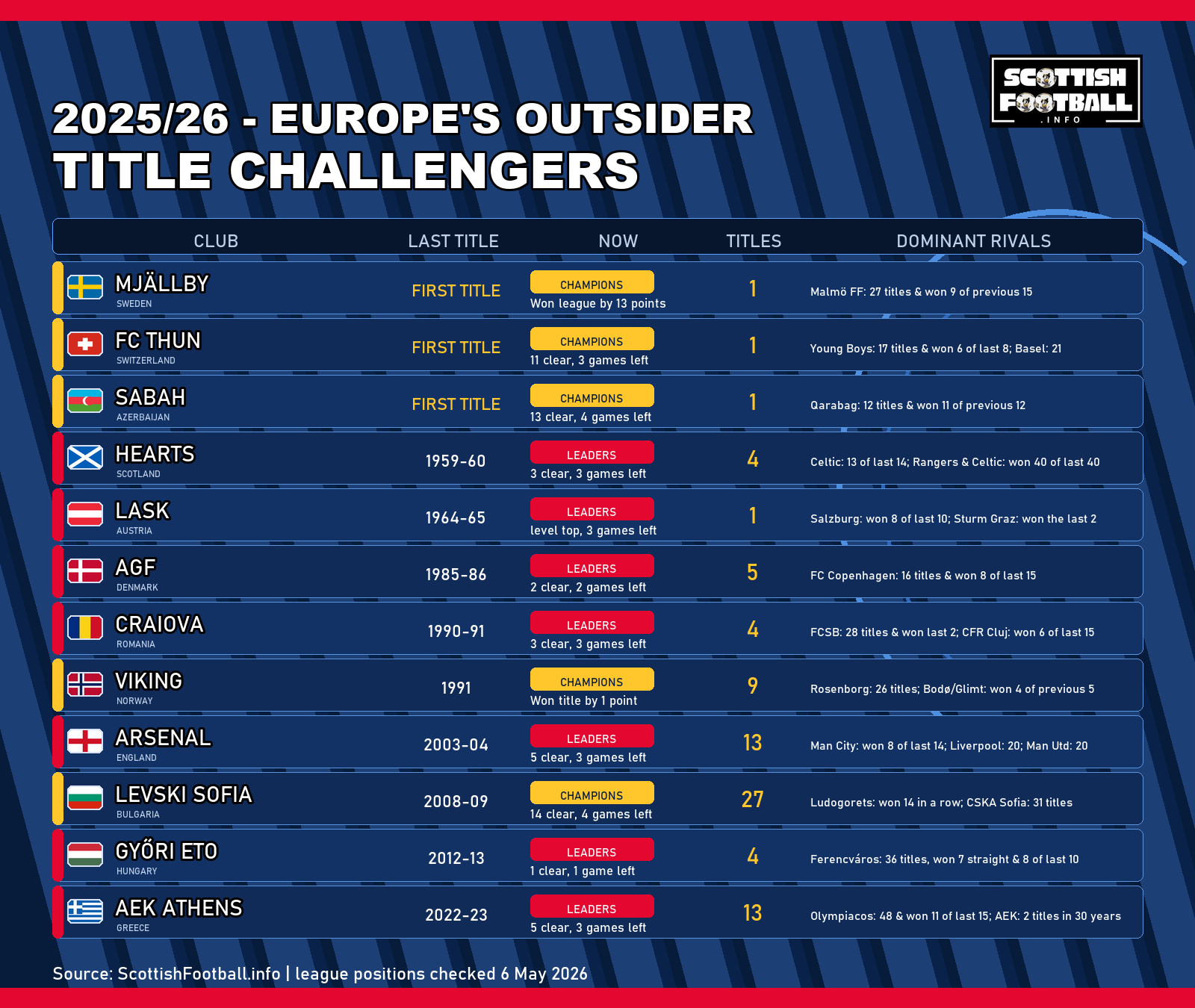
Sabah have done something similar in Azerbaijan, and will be the ‘newest’ club to win a title this season. Founded only in 2017, they have claimed their first league title, again with games to spare, as they are 13 points clear of Qarabag with four matches left. Qarabag had won 11 of the previous 12 championships, and so this is one of the clearest breaking of a monopolies in Europe this season.
The fourth ‘most rare’ title win in Europe would be in Scotland, if Hearts can hold on to the top spot they’ve held for most of the season. Three points ahead with three games to go, means the bookies now expect Hearts to win their first title since 1959/60. As we know, Celtic have won 13 of the last 14 Scottish Championships, but it’s the fact that nobody other than Rangers or Celtic have won any of the last 40 leagues that makes the Hearts story so astounding. “It’ll never happen in my lifetime” will be an answer given in pubs up and down the country when their mate asks them if their club will ever win the Scottish Premiership. For Hearts fans, they are close to making the seemingly impossible a reality, thanks in part to the partnership with Tony Bloom, which I wrote in detail about exactly one year ago.
Elsewhere in Europe, if the leagues ended today then in Austria we would see LASK win their first league title since 1964/65 and only their second ever, ahead of Red Bull Salzburg (8 of the last 10 titles) and Sturm Graz (won the last two titles).
In Denmark, AGF are two points clear of Midtjylland with two matches left, closing in on their first league title since 1985/86. In Romania Craiova are three points clear with three games left, chasing their first league title since 1990/91. They would do so ahead of 28 time winners FCSB and CFR Cluj, the team that’s won six of the last 15.
Another summer league saw a surprise champion, with Viking winning the Eliteserien for the first time in 1991, winning their ninth overall title by a solitary point. They won the Norwegian league one point ahead of Bodø/Glimt, who had won four of the previous five titles. Since then, we’ve seen Glimt go 3-0 up in their Champions League last 16 tie against Sporting Lisbon in March, before losing the return leg 5-0 in Portugal. Lastly the title will go down to the wire in Hungary, too. Győri ETO are one point clear of Ferencvárosi with one game left, looking for their first title since 2012/13 and fifth overall. Ferencváros have 36 titles and have won seven straight, eight of the last ten, makin it another huge upset if they lose their crown.
Impact on the Scottish Champions
What this spate of upsets means for the Scottish Champions, whoever that may be, is that potentially there might be a ‘weaker’ opponent waiting in the Champions League Playoff round.
Now, the term ‘weaker’ here is only true if you are judging the clubs on a historic or financial point of view, or judging a team on their experience of European competition. For example, LASK Linz may narrowly win the Austrian league ahead of two teams - RB Salzburg and Sturm Graz - who have more money and more experience of Champions League football.
However if LASK are the Austrian Champions - they are the best team in the country over a season, and so they are by definition not the weaker team. If Hearts win the Scottish league then of course historically and financially they are still weaker than Celtic. But would they be an easier game for the others in qualifiers, compared to Celtic? Maybe not.
So the same goes for the opponents that our Champions might face. An underdog winning the league may be the stronger team in their country over the course of a season, but they may have less European experience and more chance of seeing their squad being broken up in the summer through player sales.
The Champions League Seedings
The following graphic shows where the 40+ Champions across Europe will be seeded, as all leagues currently stand. This excludes the Champions of the top 10 leagues, as they automatically qualify for the Champions League. From this list, we can see the potential opponents that lie in wait for the Scottish Champions.
The graphic shows the four qualifying rounds, from QR1 to the playoff, and in which round the Champion of each country enters. The stage each country’s champion enters cannot change (i.e. Scotland’s champion will enter in the playoff round) - only the club name may change between now and the end of the season, and thus the seeding status (i.e. Hearts would be an unseeded team whereas Celtic would be seeded).
Round entered in is based on country coefficient, while seeded status within each round is based on club coefficient.
Keep reading with a 7-day free trial
Subscribe to Scotland's Coefficient to keep reading this post and get 7 days of free access to the full post archives.