Scouting For Rangers: Squad Building and Goalkeepers
Part 1 of Josh Duncan's series on the summer rebuild at Rangers

This article was written for Scottishfootball.info by Josh Duncan, an aspiring sports writer, who has his own Substack account that you can follow. Please follow him there and on X.com - where you can find more of his threads in the coming months.
His previous writing for the website includes a well-received tactical analysis of Falkirk F.C this season. Josh’s latest article will be the first in a series of ‘squad building’ exercises, looking specifically at Rangers F.C.
After the climax of this crazy Scottish Premiership season, Rangers will be faced with an all too familiar situation in the summer. After sacking the sporting director and CEO in November 2025, the new ownership seemingly admitted that most of the decisions made at the club last year - especially in recruitment - were a mistake. It’s therefore reasonable to conclude that the club are likely in for yet another summer rebuild.
Regardless of the quality of the squad, it is clear that changes will need to be made to prepare for a full season under Danny Röhl. Much of the current squad was recruited for Russell Martin and that will need to be rectified. There are also a considerable amount of loan players in the squad, who will need to be replaced in some way.
This summer will be the first major test of the clubs new committee style transfer strategy. This is how the club restructured its recruitment process after the sacking of Kevin Thelwell, operating in this way during the January window. This time however, they will have had more time to better prepare for the summer window.
I thought it would be an interesting exercise to explain how I would go about transitioning this squad. Explaining how I would build through each position group and giving transfer targets; talking through the process for each one. One of the biggest clubs in Scotland have struggled to build a sustainable core of players for several years now - but I’m sure that I can fix everything in a few articles!
The opening article of this series will focus on explaining my overall thoughts on building the squad. As well as an explanation of the scouting process and how I will use data to inform those decisions. I will conclude by giving my goalkeeping targets.
Squad Building
The first step in building the squad is obviously looking at what you already have. For the purpose of this series, there will have to be some assumptions here, and I will discuss these for each position in turn. I will be trying to explain what I think Rangers should do with the squad, while keeping things as realistic as I can.
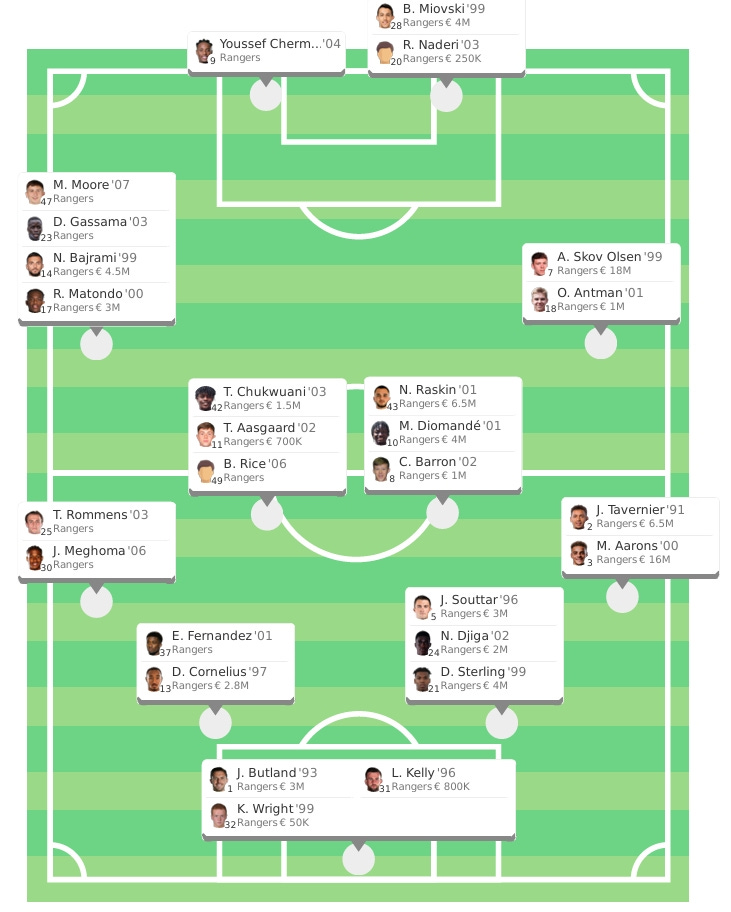
The above is the Rangers squad for the title run-in. The 27-man squad includes six loan players who will need replacing, especially given four of the nine defenders are loanees (Meghoma, Cornelius, Djiga and Aarons). Additionally, there are a few contracts about to expire for which decisions will need to be made. Then we have loan players returning from other clubs - although a few of them I expect will be candidates for sale.
We will be building for Danny Röhl’s style of play, which focuses on counter pressing and direct attacks. So as much as we want to find good players, they must also be a fit for the style or at least have potential to develop the necessary skills.
The goal will be to have a squad that has quality over quantity, targeting specific profiles for each position. This may mean a thinner squad but this will afford opportunities for academy players to form the depth. The use of utility players like Dujon Sterling will supplement the squad as well. Adding a bit of experience will be needed as well, given the average age of the squad.
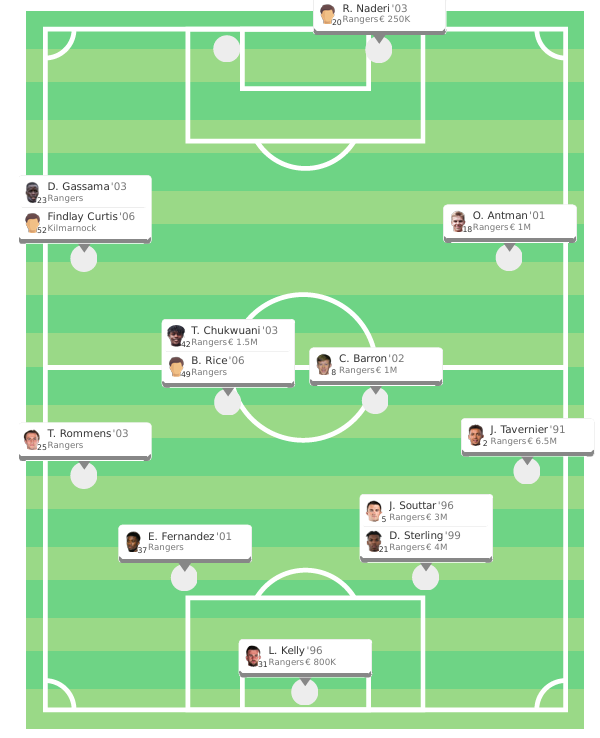
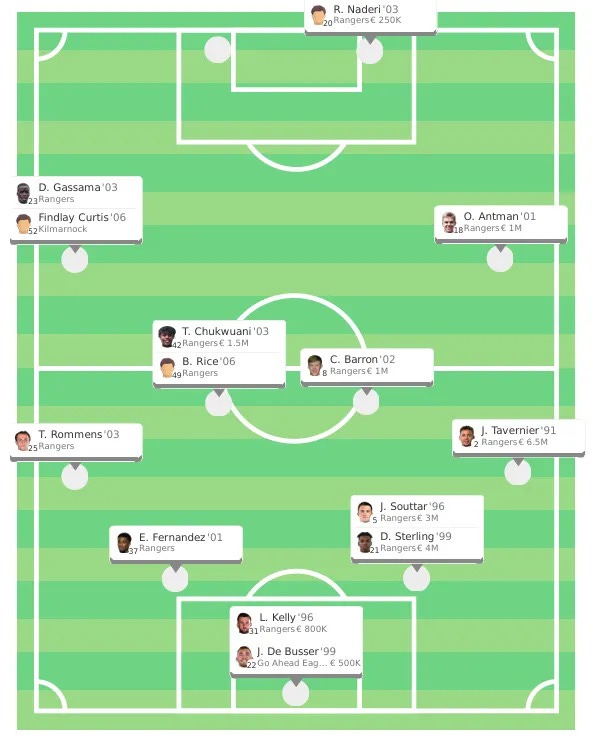
This is the foundation I will be working from to begin with. There are definitely a few areas that may be confusing at first viewing. The squad having 3 players who are due to be out of contract is one of them, while there are several players I believe should be sold.
As we go through each position group, I will explain my thought process behind which players should stay and which should leave.
Some of the players that I advocate for being sold are interchangeable. What’s more important is freeing up the spaces at each position. We want to build a new core that fits Röhl’s system. Plus it would be no fun doing this and only changing 3 or 4 players!
Scouting and Data Usage
When you see scouting online, it is generally very data focused. The use of data is a massive part of modern football but relying on it entirely to make decisions would be a mistake. Often you see a lot of conclusions made about players purely from data or specific stats; this is something we want to avoid.
For each different position, we want to define a profile that encompasses everything a player needs to have for that specific role. This means figuring out technical qualities required to perform these roles, as well as looking at age and physical traits.
Once we have each profile, this is when the data becomes useful. We can set data parameters to identify players who have the traits we need. Once these players have been identified, we can learn as much as possible about them and decide who is the best option.
The way we gain information is by watching as many games as possible from each player. This gives us an understanding of their qualities in many different settings. You can also learn a lot of things that won’t show in the data, as well as gaining context on the data itself.
After all of this, I will present a couple of targets at each position, with an explanation of the data and some video analysis as well. Multiple targets at each position gives us options in terms of building the squad. Each group will end with my conclusion on which target is best and a discussion about how they fit into the overall squad.
Now that we have in idea of how everything will work, we can see it in action by looking at the first position in the team; the goalkeepers.
Goalkeeping Situation
The Rangers goalkeeping situation is a bit awkward heading into this summer. Jack Butland is entering the final year of his contract, while Liam Kelly and Kieran Wright both have their contracts ending this year.
Butland has been very hit and miss throughout his time at the club. At his best he can make some great saves but his worst has seen some costly howlers. His handling and positioning have both been suspect and his ability with the ball at his feet can be poor for a modern keeper.
With one year left on his deal, trying to move him on would be best for the club, in my opinion. He will be 34 by the end of his current contract and while it would be easier than finding a replacement, committing more years to him as the number one is risky.
Liam Kelly has been a serviceable backup, as well as contributing to the homegrown rules in UEFA competition. Extending his contract to keep some continuity in the goalkeeper group feels like a smart move. He is perfectly good enough for the cup games and giving the no.1 a rest.
Finally, the third spot has been occupied by 26-year old Kieran Wright for a while now. I think it’s time to give this position to academy talent. Bringing through young goalkeepers for some first team training experience and maybe some cup minutes could be beneficial for the club long-term.
Goalkeeper Profile
So, if we’re replacing the number one goalkeeper, what are we looking for in that replacement?
The first thing we want is reliability. The inconsistency in form for Jack Butland is something we want to avoid. You may get less incredible saves but a goalkeeper who stops all the ‘shots he should save’ is the baseline. Goalkeepers are the most difficult position to measure statistically, but we will still use data to help us find candidates.
To help here we will be using the Goals Prevented statistic, which is based on xGOT (Expected Goals On Target). This measures how well goalkeepers are handling shots based on the chance quality and execution. Like with xG, the higher the number the better.
I looked at goalkeepers who had a goals prevented measured at more than 0, both accumulated and per 90 minutes. This allows us to see some options who are performing at least as well as expected.
For the rest of the profile, things are a bit more simple. We want a keeper young enough to develop, but with decent first team experience. So I looked at options aged 26 and under, who have at least two seasons with over 1,000 minutes played.
Next we want our goalkeeper to be strong in the air; having someone who can claim balls into the box and end the threat is key. So we’re looking at keepers who are 6’2 or taller and who have above average aerial duels p90. This won’t tell us how good their decisions are in the air but it gives us a starting point to find an aggressive keeper.
Finally, we want someone who is more confident with the ball at their feet. We aren’t looking for a Manuel Neuer regen here but we do want someone who can play from the back with comfort, while being able to pick out teammates with longer passes. I looked at goalkeepers with over 30 passes p90 and with an 85% or higher accuracy on those passes.
The Targets
After using the profile to narrow down potential targets, I ended up looking further into about 14 different goalkeepers. I watched a few full matches from each of them and decided on two potential targets that I thought would fit well.
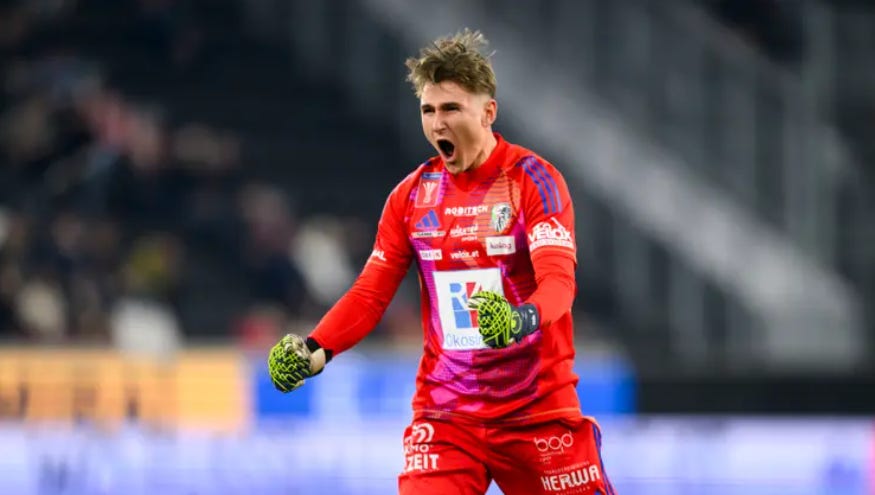
Nikolas Polster
Nikolas Polster is a 23 year old Austrian goalkeeper, playing for Wolfsberger AC in the Austrian Bundesliga. Standing at 6’2, he is a decent size for a goalkeeper while still having agility and speed of foot.
After a mixed bag to start out his time at Wolfsberger, this season he has settled into solid form. Accumulating over 2 prevented goals so far this season, according to Wyscout. Now entering the final year of his contract, I believe has has a lot of the skills necessary to be Rangers next goalkeeper. With rumoured interest from Brighton and Rapid Wien in January, there might be some competition for his services.
Polster is a solid shot stopper, there are some areas he excels in and a couple parts of his game that he can develop. These strengths and weaknesses are revealed in the clips above.
In close angled shots his positioning is excellent, he covers the near post while staying ready to get down quickly. His decision making when deciding between saving with his hands or feet is very good.
He is quick and decisive when coming off his line and understands his angles. Because of this he is strong in 1v1 situations. He is also very solid with ranged attempts and will generally save everything you’d expect him to.
His biggest weakness comes from parrying. He will generally deal with first attempt but when saving with his hands, Polster often parries the ball back into danger. In fairness, he rarely seems to get help from his defence in these situations - but it is a weakness. In the set of clips, I have included a couple of the goals conceded from this issue.
The only other consistent issue is his reaction to back post crosses. Sometimes Polster gets really tight to the near post side when defending a cross; when he has to shift across his goal, he arrives too late for a back post shot.
Polster’s best attributes are his handling and aerial ability. He makes quick decisions on balls in the air and is great when he gets there. Polster shows great strength when contesting for catches in the air and almost never drops them, even when fouled.
His instincts when choosing between catching and punching are really good as well. The number of times he alleviates pressure for his team in this way is fantastic. You can see some of these moments in the clips above.
His distribution is another strength, he is comfortable with both feet and varies his passing choices a lot. He has the confidence to put his foot on the ball and bait a press, then has the skill to play passes into it. His long passing is solid on both feet as well; he rarely launches the ball aimlessly, preferring to try and pick someone out.
Jari De Busser
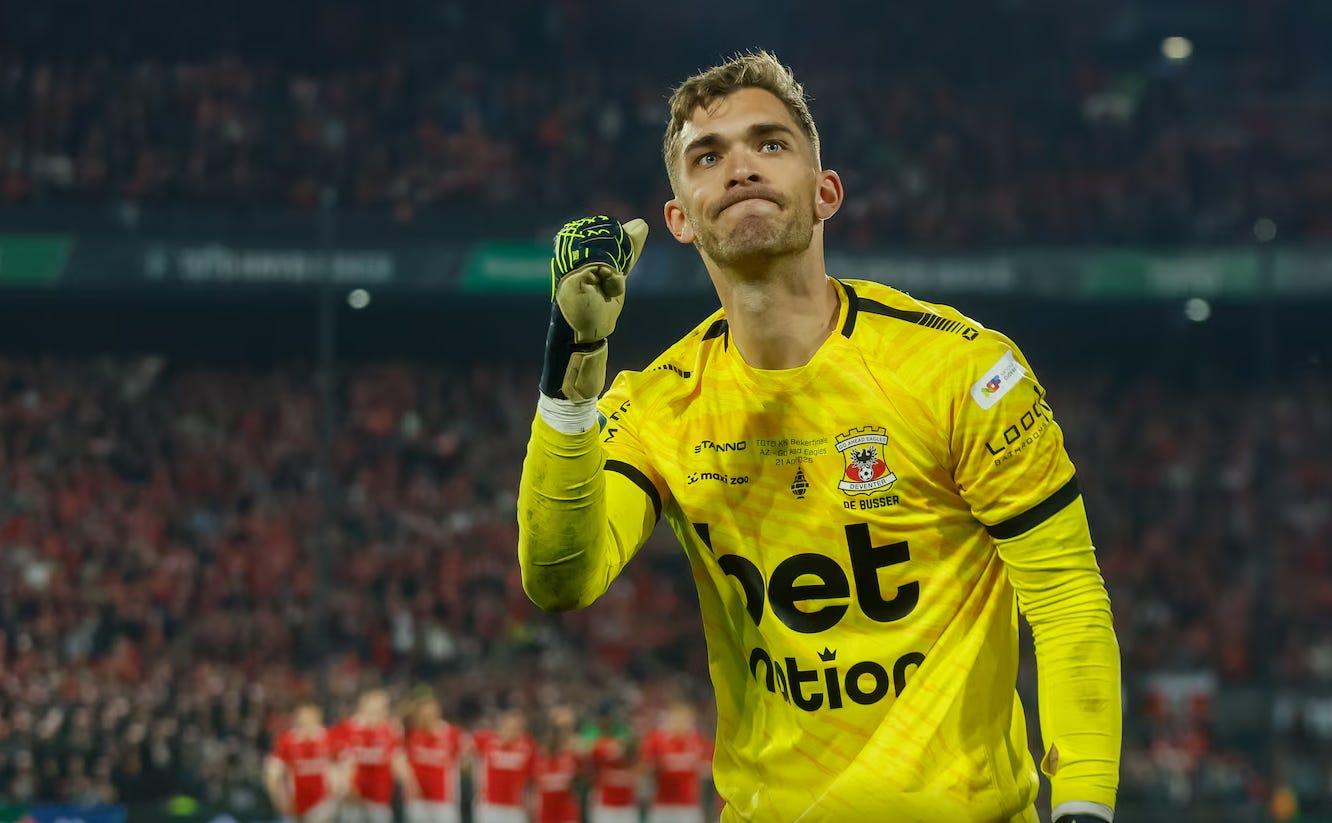
Jari De Busser is a 26 year old Belgian goalkeeper who plays for Go Ahead Eagles in the Eredivisie. He is slightly taller than Polster at 6’3 and is extremely strong, he is also particularly agile for his size.
Like Polster, there is only one year left on De Busser’s contract. This makes him a prime candidate to move club this summer, with links to Feyenoord and Lorient of late.
The Belgian is a genuinely fantastic shot stopper. His performance in the final of last years KNVB Beker final carried GAE to their first trophy since 1933. This performance included some remarkable saves as well as saving 3 penalties. The selection of clips above are some of his best stops in a GAE jersey.
You can see in these clips how he stays low in his stance. Allowing him to react quickly and get down to shots in time. From this position he also generates good power in his legs to spring up to higher shots.
De Busser shows strong awareness of his positioning and understands his angles well. He also makes himself really big when closing down 1v1s, and his strong body control allows him to make saves with his legs as well.
His handling and Aerial skills are a bit more of a mixed bag. With his strength and size there is clear upside in this area but his decision making can be lacking. This inconsistency is outlined in the clips above.
When he goes for contested catches he generally wins them but too often he backs out and decides to punch. This leads to a lack of conviction and poor punches which gives the opponent chances to score.
If he can gain more confidence to use his physicality and claim the ball more often, this will improve his game considerably. Goalkeepers have a different ageing curve to the rest of football which leaves ample time for him to develop.
His distribution is also a bit inconsistent and much more one footed than Polster. Firstly, De Busser is really good when playing the ball on the ground and so his play out from the back is solid. He can play through pressure and is happy to take the ball in dangerous positions.
His long passing is slack however. Too often his passes sail way over the intended target. He does clear the ball with intention to find teammates though. In a team like Rangers who want to be direct, he may improve this skill.
Conclusion
There isn’t a lot that separates the two keepers. Polster is three years younger but the age difference isn’t as much of a factor at this position and they both make up for their deficiencies in different ways.
If we were going for system fit then I would say Polster is the better option. His skills with direct passing would benefit Danny Röhl’s style of play. His aerial ability is also a bonus in a physical league.
However, the goalkeeper is the position which I would assign the least value for system fit. Even in the modern game, the first job of a goalkeeper is to stop goals. Prioritising the player with the higher floor seems best to me here.
This is why I would choose Jari De Busser as Rangers number 1 goalie next season.