


The SPFL announced the fixtures for the 2026/27 season last month, and we’re now just two days away from the league campaign kicking off. Rangers’ trip to Tannadice is the first fixture, live on Sky Sports on Friday night.
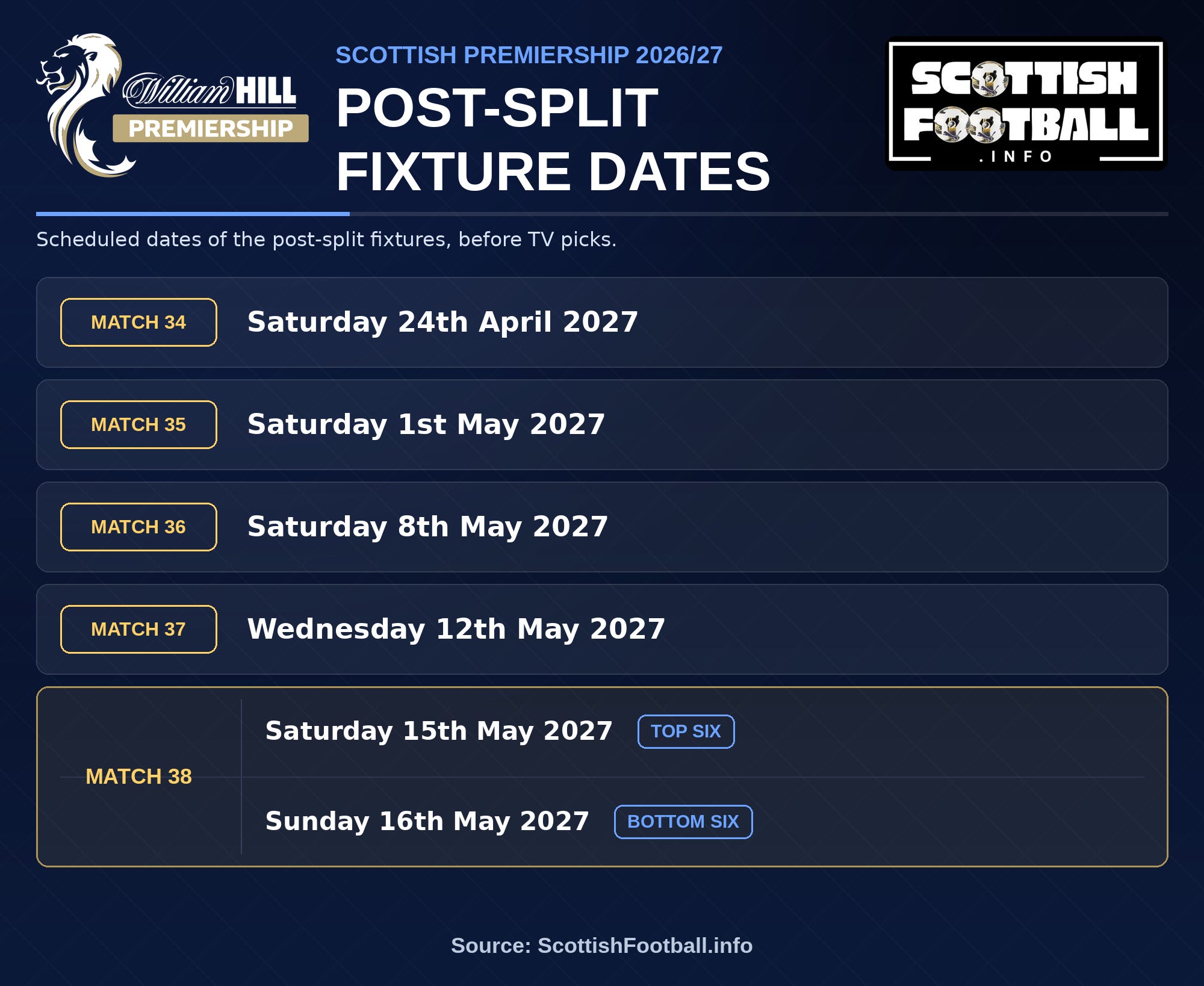
For the Premiership, of course, we know only the first 33 rounds. The five post-split fixtures will be announced in April 2027, after each club has completed its first 33 matches.
As ever, I will post my post-split fixture predictions early in 2027 and update them once the top and bottom six teams are locked into their respective halves. I have predicted these correctly in each of the past three seasons, mainly because there are only so many solutions to any potential imbalances.
The split keeps the season at 38 matches. Without it, all 12 teams playing the other 11 sides four times would produce a 44-match campaign. That would be too demanding, especially for clubs in European competition, and far longer than most European top flights, some of which play only 32 league games.
It is European competition that massively restricts the windows available for domestic football more than ever. This season for example, 10 fixture rounds have been set aside for the UEFA league phases, removing four slots from previous SPFL calendars. The pressure on the schedule is highlighted by the fact the first completely clear midweek in Scottish football this season isn’t until 22/23 December. The expansion of UEFA’s calendar is the main reason we no longer have a winter break in Scotland and are unlikely to ever regain one under the current format.
I am a fan of the split, and a big part of that is the drama it creates. In the run-up to the split, teams fight to secure a place in the top six; after it, every round pits teams against direct rivals for important positions in the division. Last season, the SPFL was able to schedule a final-day title showdown between Celtic and Hearts at Celtic Park, after both were involved in a three-way title race when the post-split fixtures were revealed.
Last season’s TV figures were healthy too, with Sky Sports reporting that total Premiership viewing rose by 22% year-on-year to 28 million viewer hours. Closely fought title races with dramatic finishes undoubtedly help, while Sky’s increased interest and growing number of broadcasts should bring more eyes to Scottish football.
Sky Sports figure of 22% measures total viewer hours. The average audience per match hasn’t been revealed, and therefore some of the growth may simply reflect the increased number of broadcasts. The average viewing figures over the years are shown below, with a nominal 20% increase included for 2025/26. We will not know the actual average until the SPFL releases its accounts later in the year.
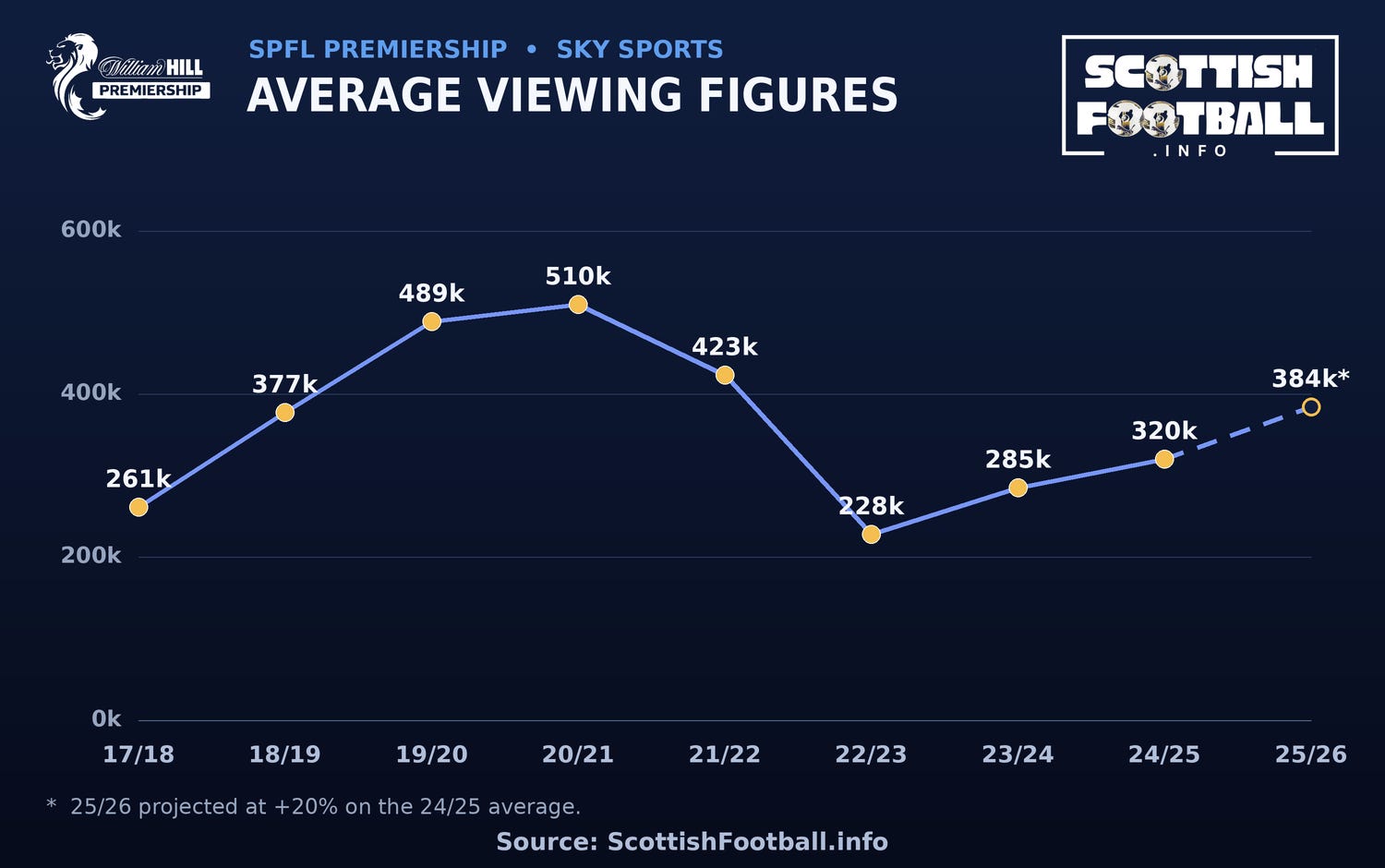
To be fair to its oft-criticised main broadcast partner, Sky Sports showed more games than ever before last season, with 53 live games. This season, it is starting by showing all six opening matches for the first time. Premier Sports can now show up to 22 league matches too, in addition to its coverage of the domestic cups. BBC Scotland will continue to show Championship football on Friday evenings, while BBC ALBA can again broadcast up to 12 League One matches. Most of these contracts run for another three years, and so the SPFL has stability and guaranteed income from TV rights until 2029.
The Fixtures
Historically, Premiership pairings have been ‘flipped’ by the SPFL from one season to the next. For example, if Dundee United played Aberdeen at Tannadice in the first 11 rounds last season, the corresponding fixture would be at Pittodrie in the first 11 rounds this time.
However, following discussions with the Competitions Working Group and to “provide more flexibility in the Premiership fixture list”, the guarantee that pairings would be flipped applies only to the Dundee, Edinburgh and Glasgow derbies this season. The opening Old Firm game is therefore at Celtic Park and the first Edinburgh derby is at Easter Road; last season, the first meetings were at Ibrox and Tynecastle respectively.
This article explains what goes into the ‘supercomputer’ for the first 33 rounds of matches before detailing what the post-split fixtures will look like for each team.
SPFL group chief executive Neil Doncaster: “We are thrilled that our main broadcast partner Sky Sports are showing all six William Hill Premiership matches live across the opening weekend in what is a first for Scottish football. We greatly value Sky Sports’ support of our game, which saw more live games than ever before shown last season.
This is the SPFL’s 11th season working with US-based company GotSport to produce the annual fixture list. GotSport works with leagues and governing bodies around the world, including those in France, Switzerland, Poland, Denmark and Greece, as well as CONMEBOL, CONCACAF, Liga MX and the CBF in Brazil.
There is a common misconception that the fixtures are entirely random, leaving some fans to air their cynicism that “the supercomputer magically won’t have the Old Firm playing each other on the opening weekend”. That specific fixture has not opened the league season since it did so twice in the 1970s because the schedule is not random, and is openly constructed around agreed constraints
The SPFL provides GotSport with a range of criteria and restrictions, which can change from season to season. GotSport uses its optimisation software to generate several versions of the fixture list that meet those requirements, which are then refined before a final decision is made for each division.
One obvious restriction is that city rivals such as Celtic and Rangers, Hearts and Hibs, or Dundee and Dundee United cannot be at home on the same day. Those pairings are treated as ‘opposites’ when the fixtures are compiled. There are, however, numerous other stipulations, including specific requests from clubs and Police Scotland.
Fixture Stipulations
Some stipulations concern the timing of particular matches. The SPFL may provide specific weekends for Old Firm games, for example, or ensure that an Edinburgh derby is played over the festive period.
Clubs can also submit requests each year.
For example, if a club is carrying out work on its pitch, it may ask to begin the season away from home in case the work is not complete by the opening weekend. Kilmarnock have replaced their artificial pitch with grass this summer, while Dumbarton are moving in the opposite direction, from grass to artificial. Both teams are away in their first fixture - at their request.

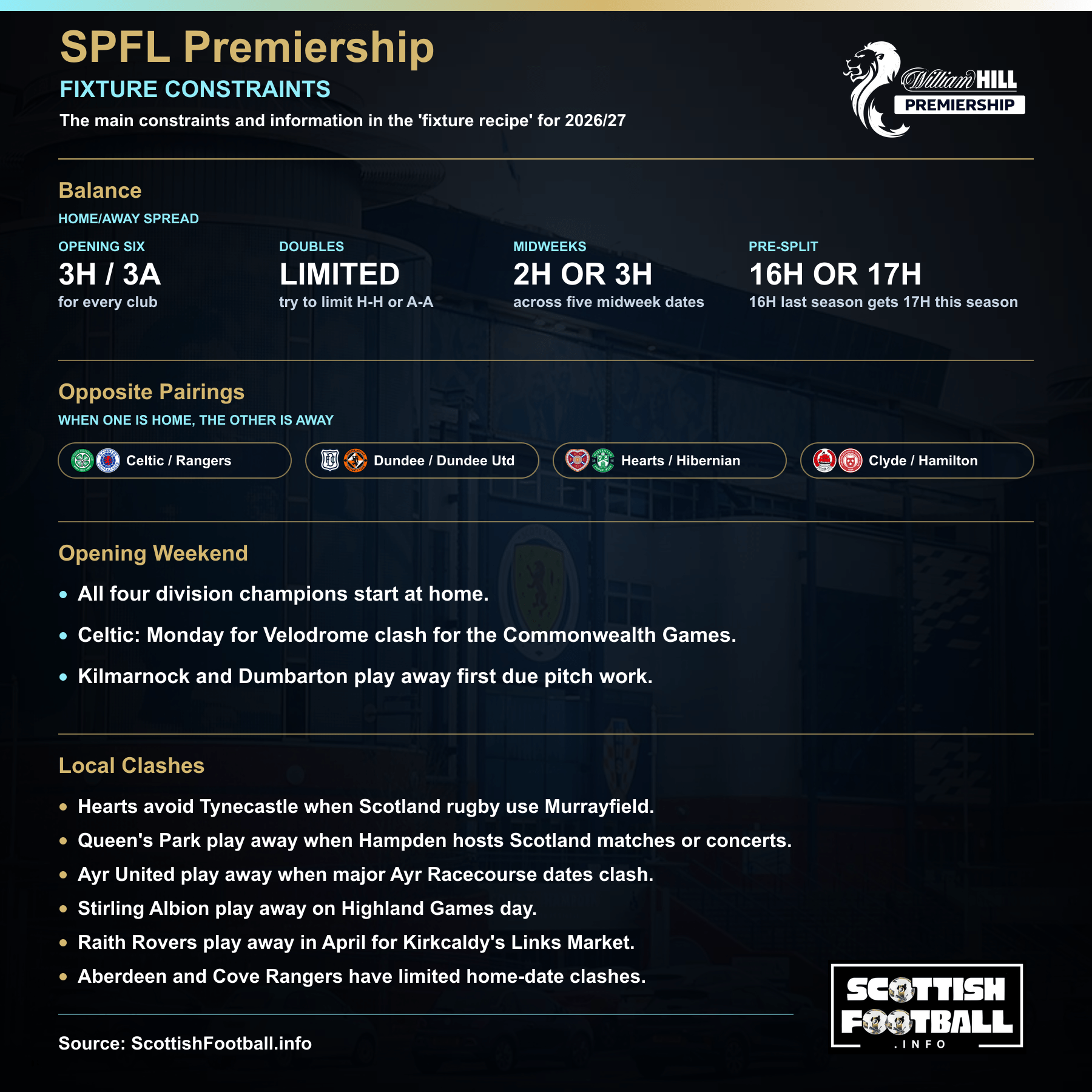
Even without any other fixture constraints, it is mathematically impossible for every team to alternate between home and away matches all season. The SPFL therefore tries to limit the number of ‘doubles’ each team has: two consecutive home fixtures or two consecutive away fixtures.
There are also five Premiership midweek rounds, which are less attractive to home clubs because attendances tend to be lower than at weekend matches. The SPFL has therefore ensured that every club has either two or three home games across those five dates, rather than any club getting four out of five at home.
Also, every Premiership club that had only 16 home games before the split last season will have 17 this season. Having 17 pre-split home fixtures is an advantage in that it guarantees a club 19 home games by the end of the campaign. Only clubs with 16 pre-split home fixtures are at risk of finishing with an 18-home, 20-away split.
You can read my ‘split fixture’ analysis, which shows who was most ‘inconvenienced’ or ‘benefited’ by the split over the past 25 years.
Lastly, any club involved in the play-off round of a UEFA competition in August can again postpone its third William Hill Premiership fixture without requiring the agreement of its opponent.
This policy was introduced last season, and the Competitions Working Group unanimously agreed to continue it in the hope that it can help Scottish clubs reach the league phase of UEFA competitions.
All five European entrants have taken up the option. Celtic, Hearts and Rangers are guaranteed to be involved in a play-off round, so their matches will be postponed. Motherwell’s and Hibs’ fixtures will be moved only if those clubs reach the Conference League play-off round, with Hibs facing a two goal deficit they must overturn tomorrow night to keep their campaign alive.
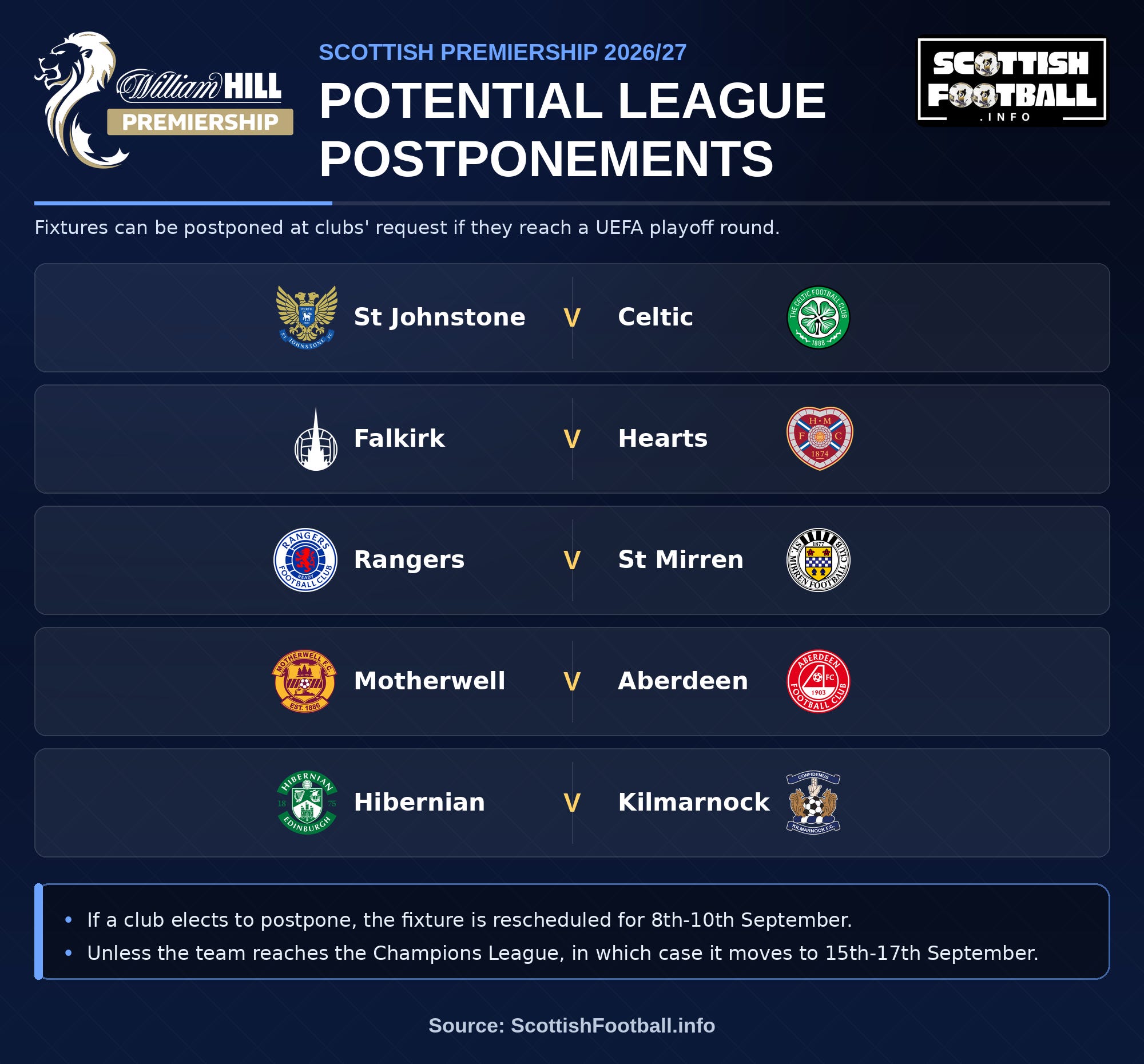
Postponed matches will be rescheduled for the first exclusive matchweek of a UEFA competition for which the club did not qualify. Clubs that qualify for the Europa League or Conference League will therefore play their postponed league match during the exclusive Champions League midweek of 8/9 September. If they reach the Champions League, the rearranged fixture will be played during the exclusive Europa League midweek of 15/16 September.
The confirmation deadline is new this year. It was introduced after Rangers initially requested the postponement of last season’s match against St. Mirren, before then-manager Russell Martin suggested in a post-match interview that they might withdraw the request and play the match after all in the hope of developing some cohesion in his new team. They played the match in the end, drawing 1-1, thanks to a late Findlay Curtis equaliser.
Post-Split Balance
One of the main disadvantages of the split format is its inability to guarantee every team 19 home and 19 away games. A specific fixture can, and often is, played three times at one club’s ground and only once at the other’s.
This causes predictable ‘controversy’ online every year, normally fuelled by misleading headlines suggesting that a title challenger will be unscrupulously sent to a venue perceived as difficult for a third time.
Now that rounds 1–33 have been released, we can determine how many home games each club will be due after the split and which teams it would host if both finish in the same half of the table.
This graphic shows how many home games the club will play before the split, and therefore how many they are ‘due’ after the split. It also lists which teams ‘should’ visit them after the split, but it of course depends who ends in the top six.
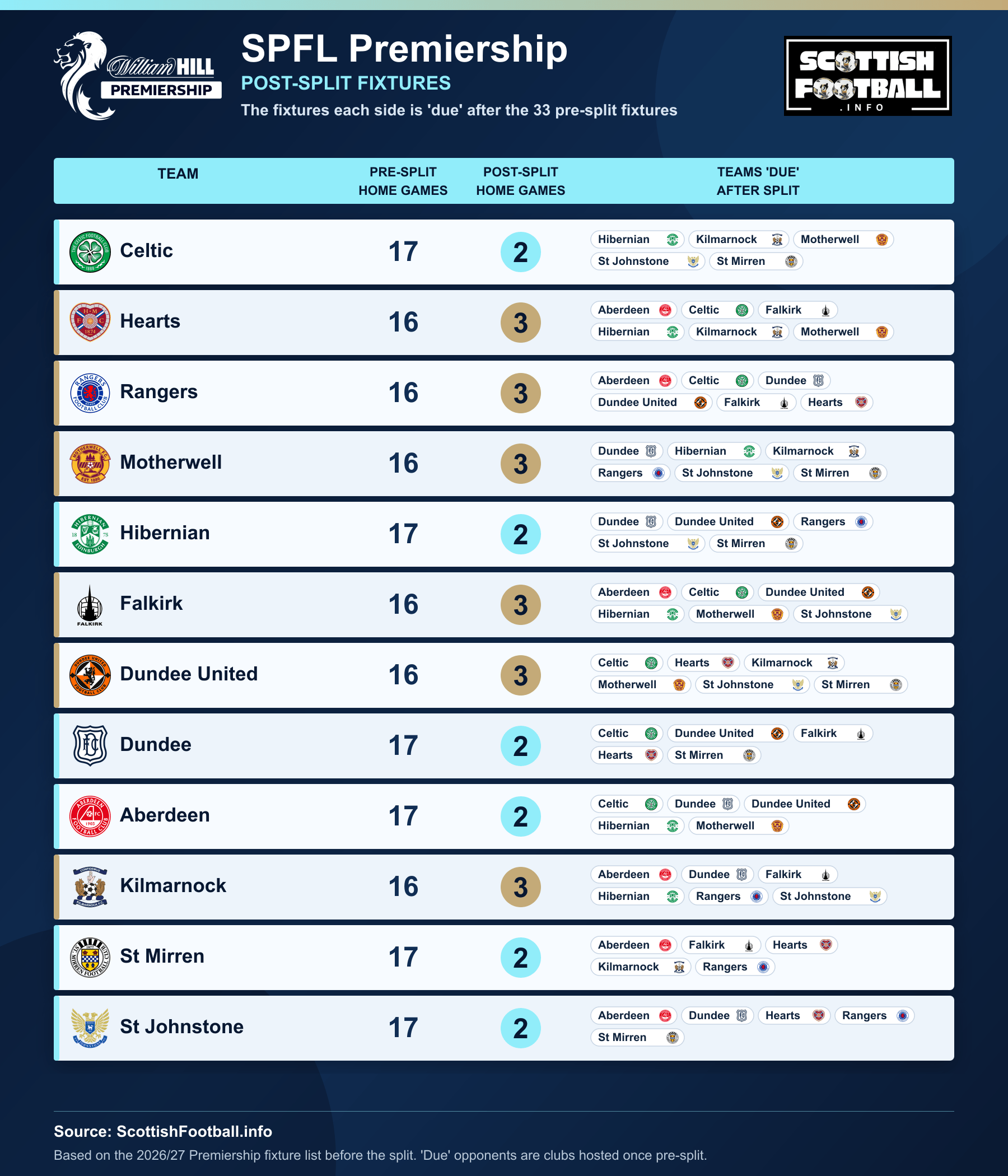
Each team will play either two or three home games after the split, depending entirely on which clubs finish in each half. We can already say with certainty, for example, that the post-split Old Firm match will be at Ibrox and the final Edinburgh derby will be at Tynecastle if the clubs involved finish in the same half. The SPFL guarantees that none of the three city derbies will be flipped.
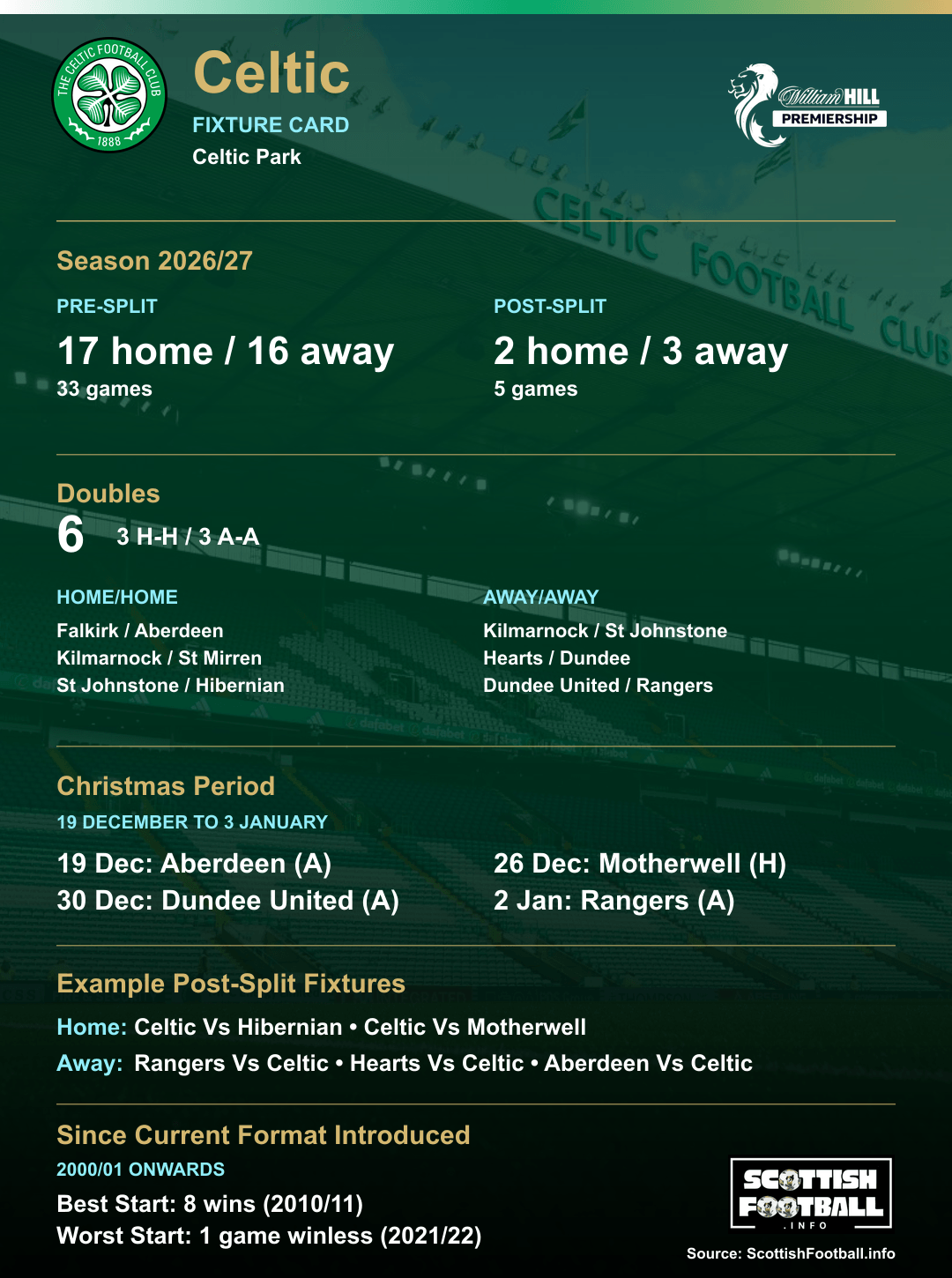
The following fixture cards summarise each club’s fixtures and show example post-split schedules.
They are based on a top six of Celtic, Hearts, Rangers, Hibs, Aberdeen and Motherwell. The actual post-split fixtures will depend on who reaches the top six, so these examples are illustrative only, and my apologies go to the Falkirk fans for my assumption that you finish bottom six this time!
Celtic
Hearts
