

Scouting For Rangers: Centre Backs
Part 3 of Josh Duncan's series on the summer rebuild at Rangers

This article was written for Scottishfootball.info by Josh Duncan, an aspiring sports writer, who has his own Substack account.
Please follow him there and on X.com - where you can find more of his work.
His previous writing for the website includes a well-received tactical analysis of Falkirk F.C this season. Josh’s latest article will be the third in a series of ‘squad building’ exercises, looking specifically at Rangers.
Rangers 2025/26 campaign was ended in familiar fashion against Hearts on Monday. With a second half collapse making them the first runner to drop out of the title race.
The second half performance at Tynecastle outlined the lack of quality throughout this team and reminded everyone just how much work there is to be done this summer. At least we can look forward to the next group of players that will disappoint us.
Which is exactly what this article will do! In the third part of this series looking at Rangers summer rebuild, we take a look at the centre back position.
Josh’s previous articles in the series can be found here:
Full Backs and Goalkeepers
Centre-back is another position that has felt turbulent in recent years, John Souttar has been the main constant presence. Before that Connor Goldson was the main man for 6 years.
I want to look today at how Rangers should build out the centre back group, what is required in a centre back partnership and then some specific targets for the club.
Centre Back
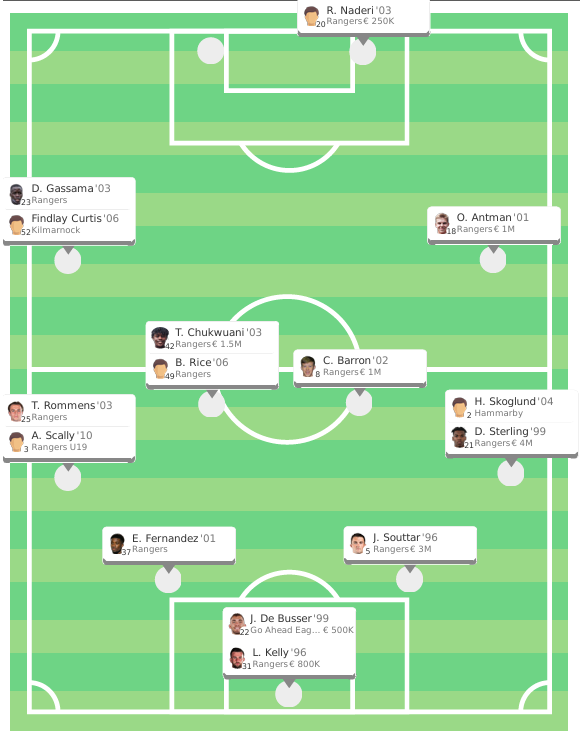
The is the situation at centre back heading into the summer. Firstly, Manny Fernandez has cemented himself as a starter this season. With some links to top clubs I would be cashing in on him, but most reports believe Rangers would like to keep him if possible.
John Souttar signed an extension during the season but saw a serious decline in performance. I don’t think the extension was a great idea, but he can serve as a fine backup.
Nasser Djiga and Derek Cornelius will return to their parent clubs, I doubt Rangers will try and sign either permanently. Rangers’ own player Clinton Nsiala will be retuning, I expect he will be moved on. Belgian top flight side Westerlo signed him on loan in February, with an option to buy included in the deal.
This means that there is one backup and one starting spot available, giving us a 4 centre back group. This gives solid depth while allowing room for any youth prospects that the club wants to bring through. Although I could see another CB loan for depth as a possibility this summer as well.
Let’s start with the backup centre back position. Instead of the usual plan of profiling and then using data, for this spot I’d like to take an opportunity to explain another concept.
Every window there is clamour for couple of players within the Premiership, Josh Mulligan was the main one in the summer. I assume Elliot Watt, who I will talk about in the midfielders article, will be the big one going into this summer.
Most of these players are simply not Rangers quality, the average Scottish Premiership team just does not prepare a player for Ibrox. Most teams aren’t developing great technical quality, which is what Rangers require from their starters.
This isn’t to say that Rangers shouldn’t have Scottish players or look at the Scottish market, just that care needs to be taken. Most of the options that Rangers can take are similar to Connor Barron or Lyall Cameron; hard working players who don’t add a lot on the ball.
These types of player are completely fine to have in the squad, but Rangers shouldn’t be spending money on them. Those qualities are the bare minimum that you expect from a footballer, you can develop hard workers in your own academy.
If Rangers are going to spend money on Scottish league talent, then they have to show clear signs of being a quality footballer. The sort of player who is obviously better than than the average level of the Premiership. Think of someone like John McGinn, the talent was obvious and one of the Old Firm should have taken advantage before another club noticed.
This style of thinking brings us to our first player of the article.
Luke Graham

Luke Graham has seriously impressed for Dundee in his first full premiership season. In his age 21 season, Graham has featured in nearly every league game this season and has been one of the better defenders in the league.
This is all great but given what I explained before, what makes Luke Graham good enough for Rangers? This is where we have to look at scalability. Meaning, how do Luke Grahams’ attributes look in a team like Rangers?
Physically, Luke Graham looks ready to step up a level. He has a strong build, standing at around 6’3 and shows good understanding of how to use that strength against Premiership competition. He also has good recovery pace for someone his size, able to be aggressive and still get back to position.
You can see that in Scotland, Graham is an imposing physical presence. I think his athletic profile will allow him to handle the sort of open space defending that Rangers centre backs are faced with.
This isn’t to say he’s the finished article in this regard, he’s sometimes a bit naïve when defending players who can match his physicality. When he faced Rangers earlier in the season, there were a few moments against Thelo Aasgaard where Graham was too aggressive and easily bypassed by a player strong enough to hold him off. Here’s a clip of one of those instances below. Aasgaard easily rolls Graham and he’s forced to foul.
Defensively, I think Graham is extremely well developed for such a young player. His positional discipline and defensive awareness are strong and make him a very assured defender. These skills are important when moving to European level as the movement of forwards gets increasingly more intelligent.
The clip above outlines this awareness. The player Graham is marking looks to run in behind but he is immediately alert to the danger, adjusting his position to block the space. He then considers following his man but realises that he will get dragged out of position so he decides to hold. As St Mirren move towards the box, he angles his body and drops back, protecting against a run into the box while remaining able to close down a cutback.
These next clips show some of Grahams’ on ball play, this is the area that has the most possibility for development in my opinion. His overall passing play isn’t particularly dynamic, although he does show quality under pressure. He does fizz passes into the middle, which some of his teammates struggle with. I think being in a team that has a lot of possession will allow him to substantially develop this area.
Graham is quite a talented ball carrier for his position. He is great at escaping pressure and carrying the ball forward. This is something John Souttar is very good at and it can open up a lot of avenues going forward when the centre backs can break lines this way.
All of these elements combine to make a player I think Rangers won’t want to miss out on. If he can continue to develop then you have the sort of player who can be a major part of this team for years.
The Starter
The centre back position is, more than any other in my opinion, a partnership. At teams like Rangers especially, where it can be you and your partner defending on your own against counter attacks all game.
These partners must compliment each other, Athletic writer Michael Cox defined the partnership of Johnny Evans and Çağlar Söyüncü at Leicester as “Cat and Dog”. Evans being the cat that waits to pounce and Söyüncü the dog eager to attack.
I prefer to call it an “aggressor” and an “anchor”, one to plug the attack at source and one to keep the ship steady. With our assumption that Emmanuel Fernandez stays at Rangers this summer, Rangers already have their aggressor.
Fernandez loves to engage opponents early and get involved in duels. He’s also the one who’s willing to step forward with the ball and play the risky pass. Now we need to find his anchor, someone to keep everything grounded.
The Profile
Our profile for this begins as you would expect, 6’2 and above with more than 1000 minutes played this season. I looked at players 21-26 as I wanted someone with solid first team experience to take on this role.
To find our anchor, I added in centre backs who were around the average in their leagues for duels taken, both ground and aerial, while maintaining above average win rates. This aims to find players who are picking their fights wisely and winning them.
Then I wanted someone who was above average in progressive passing and progressive pass accuracy. Even though the anchor is the less ball dominant of the pair, in a team like Rangers they need to be solid moving the ball.
The last profiling decision I made was to look for both right and left sided centre backs. I felt that Fernandez was much more comfortable on the right side when playing at Peterborough, with much more confidence in the passing game.
This allows the opportunity to move Fernandez to the right side of defence if we find a suitable left sided candidate. For this article I chose one centre back on each side as potential targets.
Casper Widell

Casper Widell is a 22 year old right sided centre back player for Excelsior Rotterdam in the Eredivisie. He stands at 6’4 and is an impressive physical specimen, finding very few matches in the Netherlands.
Widell is a clear leader, constantly organising the Excelsior backline and controlling the team. His communication would be a clear asset to a Rangers squad that lacks leadership, especially with the captain leaving.
The clips above outline his defensive ability, he is always patient and waits before engaging an opponent. He has won 68% of his defensive duels in the last year and averages 13 ball recoveries per game. This measured approach to defending is what makes an anchor.
His great acceleration and recovery speed allows him to get back even after making a mistake. He also positions himself in a way that allows him to closely mark players, relying on his pace to reposition to other dangers.
The clip above is a more settled defensive situation. The ball turns over, Widell is alert to the runner off the ball and his positioning contains the situation. As the play develops towards the box, Widell never loses track of his man while maintaining the body shape to defend the cross.
Widell is fantastic in the air, winning around 60% of his aerial duels. He is great in both boxes, getting good height and timing his jumps well. Adding this to being extremely tall makes him a proper goal scoring threat, especially if you add Fernandez in that mix as well. He’s also very composed when making defensive headers, aiming to find a teammate wherever possible and keep control.
Widell’s passing game is controlled and precise, sitting at around 85% pass accuracy. He is comfortable on both feet, even under pressure. He is efficient at progressing the ball from the back, rarely losing the ball while making around 8 progressive passes per game. He does sometimes go backward under pressure when there are passing options forward. This is the nature of the anchor however, stability is the key.
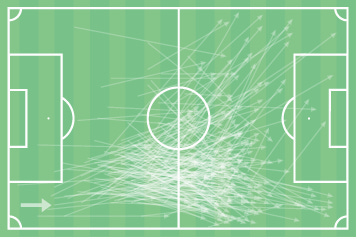
This map of his progressive passes shows this nature. Most of the passes are those simple balls that break the first line into midfield, getting attacks started. When he sees the opportunity, he will take on those long diagonal passes to the opposite flank.
Giannis Michailidis
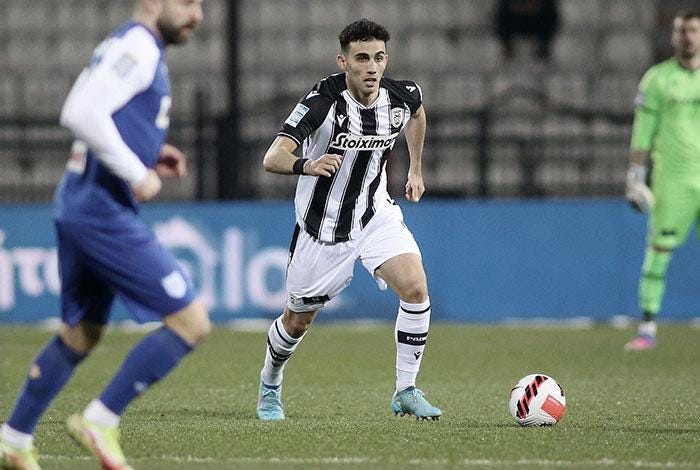
Giannis Michailidis is a 26 year old left sided centre back playing for PAOK in Greece. The Greek international was a major prospect in the early parts of this decade before an ACL injury derailed things. A few years on from this injury, I feel he’s found form again.
Before the injury, Michailidis was not the type of defender you would peg for an anchor. He was aggressive and front footed, loving to engage high up the pitch. He can still do this but in his recovery I believe he’s changed his game enough to handle being an anchor, just in a different way to Widell.
The clips above show some of his work in duels and defensive situations. You can see he will still take aggressive stances but only if there is sufficient cover, he also doesn’t put himself in positions where he would leave a gap if he lost the duel.
He waits for good timings to tackle 1 vs 1 and still has that great ability to nip in and win the ball from awkward angles. He has also become more of a “no nonsense” style of defender when in covering positions, he doesn’t take risks when sweeping up behind his partner.
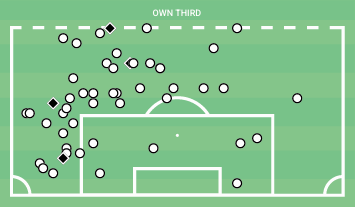
This graph shows his defensive duels won in the league over the last year, white dots are normal duels and the black dots are sliding tackles. Most of them are around the corner of the box defending the open spaces, this will translate well to Rangers where a lot of his defending will be isolated. He doesn’t take these duels as much as before but maintains a high win rate, 66% this season, showing his development after injury.
When the ball reaches the right flank, you see Michailidis take up the position to cover his full back. As the play progresses across the pitch, he always stays the deeper of the two centre backs. He keeps a balanced body position, ready to break on the cross while still able to affect the striker if he makes a move.
Micahilidis is excellent in the air, especially defensively. His timing of jumps and use of his arms is really good at beating opponents under pressure. He has maintained a 59% win rate in the last year, most of those losses coming nearer the middle of the pitch. Michailidis has only lost 4 aerial duels in the box in this time, this would make him a huge defensive asset in Scotland particularly.
The passing side is where Micahilidis differentiates himself, not as strong on both feet as Widell, but his left foot is fantastic. He can make those line breaking progressions and the clips show him getting out of trouble with those long passes out wide.
He averages an incredible 13 progressive passes per 90 and 27 forward passes per 90. This is at the top end for every position in the league, not just his centre back peers. Some of this is the nature of the centre back position, as they now see more of the ball than anyone else in football, but he’s still one of the best in position.
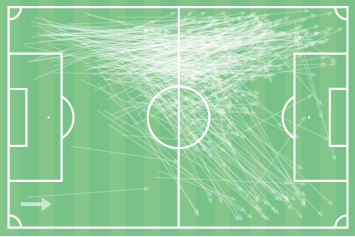
His progressive pass map reveals all of this, forward passing, diagonals to wingers in space and passes into the centre of the pitch. He really can do it all in this regard.
Conclusion
I think the decision here comes down to the Fernandez positioning idea. Widell is pretty clearly the best prospect out of the two, is a leader and at only 22 could make the club some money down the line too.
Michailidis is the better passer and has shown he can physically handle European football, even post injury. Bringing him in would allow Fernandez to be more comfortable positionally as well.
Both players have one year left on their contract, PAOK will be able to demand more money for Michailidis than Excelsior will for Widell. Right now there are no major rumours of competition for their signature but I expect that to change as we get into the window.
After watching them both play a considerable amount, I think Widell is just too good of a player to say no to. He could anchor the Rangers defence for years or turn a major profit. Despite the lack of European experience, his physical skills are so clear that I don’t think that transition will be a struggle for him.
So at the end of this one, we have our defence fully set. Next up will be the midfield group, an area Rangers have struggled to figure out for years now.
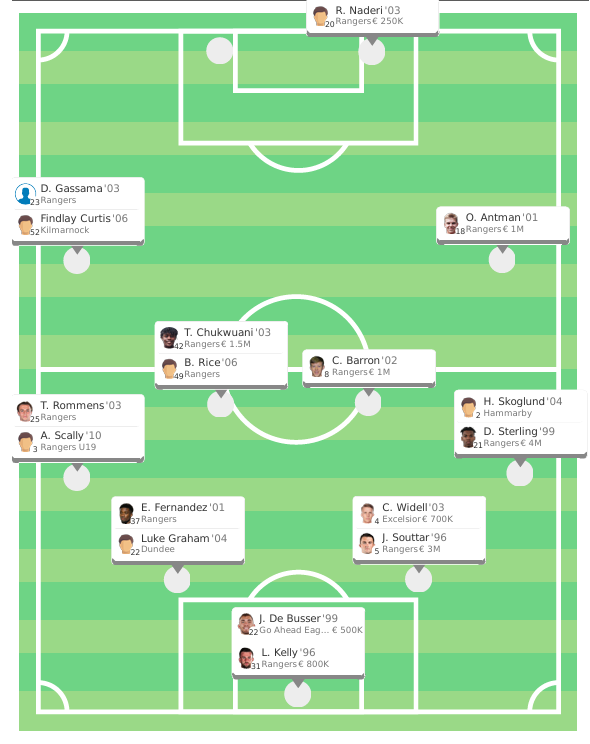
Great read mate. Looking forward to the midfielder episode but I notice your provisional squad has no dio so I’m prepared to be upset 🤣
Josh — I really enjoyed reading your article — it’s one of those pieces that just pulls you along — making the time pass quickly — and keeping you engaged throughout. The tone is engaging — the ideas are interesting — and it’s genuinely fun to spend time with. Overall — it was just a great read.