

Scouting For Rangers: Full Backs
Part 2 of Josh Duncan's series on the summer rebuild at Rangers

This article was written for Scottishfootball.info by Josh Duncan, an aspiring sports writer, who has his own Substack account.
Please follow him there and on X.com - where you can find more of his threads in the coming months.
His previous writing for the website includes a well-received tactical analysis of Falkirk F.C this season. Josh’s latest article will be the second in a series of ‘squad building’ exercises, looking specifically at Rangers.
In the opening instalment to this series, I gave an introduction to the Rangers squad and its future. The amount of change needed in the summer was outlined, due in part to the number of loans within the squad this season. I then explained my own ideas and philosophy about how the squad should be built, finishing with the addition of a new goalkeeper.

In this second article, we will take a look at the next positional group: the full backs. In recent years, this area of the pitch has been solidified on the right and the complete opposite on the other side.
Captain James Tavernier has seen off all combatants for his position for a decade now but has declined in the final year of his contract. The left side has been a revolving door since the departure of Borna Barišić but now looks to have been claimed by Tuur Rommens.
So heading into this summer we need to find Rangers a new starting right back and someone to push Tuur Rommens on the other side.
Right Back Profile
James Tavernier isn’t just Rangers best goal scorer, he’s the team’s focal point. In a recent away game against St Mirren, Tavernier had nearly double the completed passes of Nicolas Raskin. He is the player that teammates look to when they need an outlet or a way forward.
While James Tavernier has been incredible for the club, the success of the team should not be so heavily reliant on one player. The goal is to balance out the squad. So when finding a new right back, we will not be trying to find another James Tavernier; we want to find another Tuur Rommens.
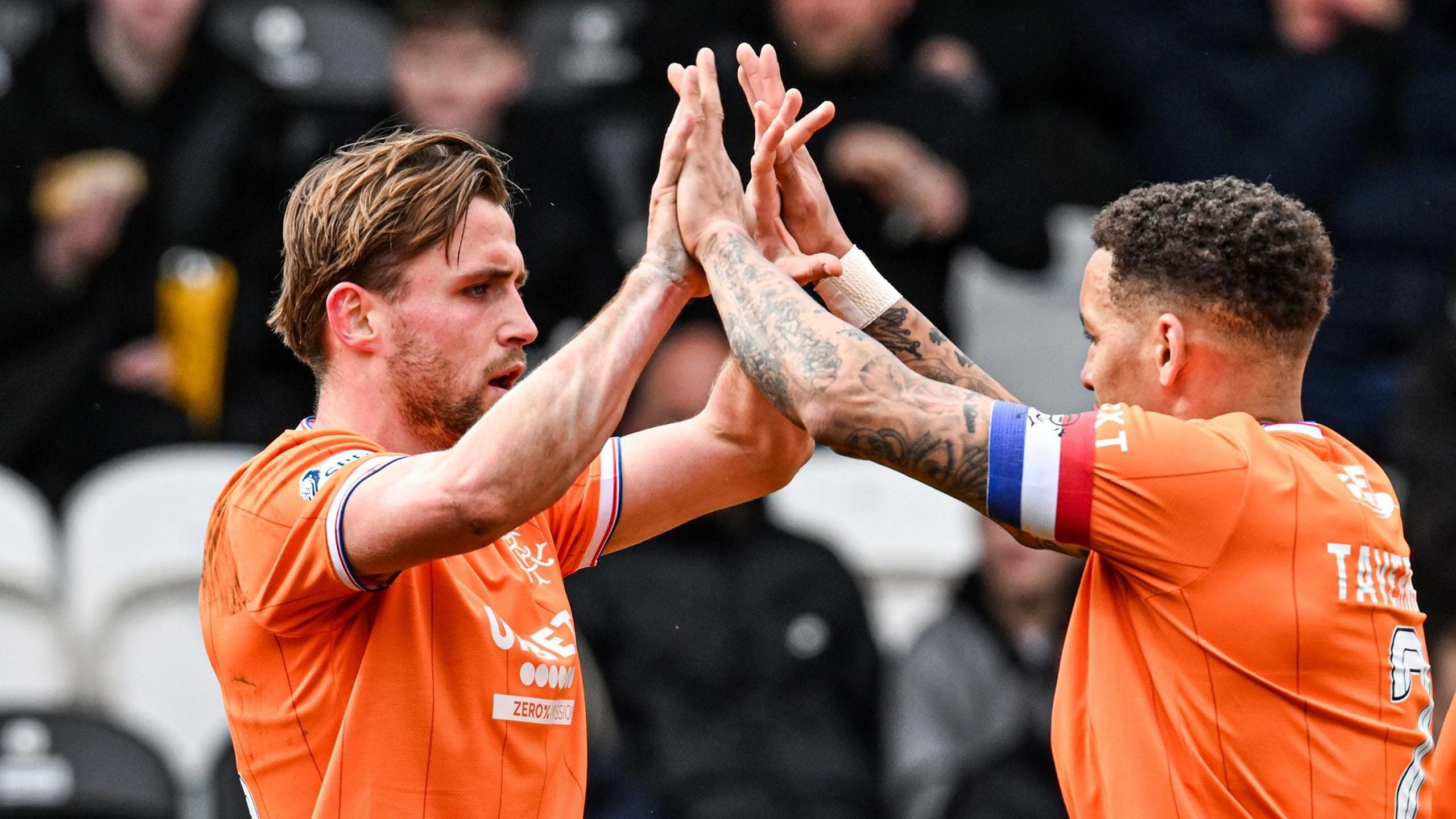
Rommens has been a breath of fresh air in this team and has really shown a level of quality that few of Rangers’ recent signings have managed. There are a lot of different attributes that have contributed to his impact but we are going to boil it down to a couple.
When watching Rommens play in Scotland, there are a couple of things that stand out. The first is his physicality, he really bullies opponents in Scotland and is clearly a level above most of the league in this regard. The second is decision making, whether that’s with his passing or running, Rommens knows when and where his actions need to be.
To give you an idea of his strengths, the above video is a compilation of one of Rommens’ best performances in a Rangers shirt so far - in the home 4-2 victory over Hearts,
So for our baseline, I wanted a player in the 20-24 age range that was at least 180cm tall, while playing at least 1500 minutes for their team this season. This gives us a physical foundation as well as a player young enough to develop, while also having decent experience.
To find the physicality we are looking for, I searched for players that take and win a lot of duels. I looked at all players who had taken an above average number of duels and won more than 50% of them in their respective leagues. I then filtered the same way, but with aerial duels.
Understanding a players decision making isn’t really possible through pure data analysis. To narrow down our list though, we will look at a few statistics that can outline a player that makes good decisions.
I first looked at right backs who were in the top 20% in their league for progressive passes per 90 minutes. This allows us to find players that are consistently taking opportunities to move the ball forward.
It is worth noting that the passing distance required to achieve a “progressive pass” extends the farther the pass is from goal. This means that our full backs aren’t accumulating them through 5 yard balls up to their winger.
I also looked at players that were above average for key passes, these are passes that lead directly to shots. This can show us players that are making good passing decisions to create for their teammates.
These attributes cover a lot of the system fit that we need from full backs in the way Danny Rohl likes to play. To aid this I also looked at players with high ball recovery stats and final third ball recoveries, given how much Rangers look to counter press.
The data parameters I’ve used here are quite wide overall, this is to open up the search a bit more. If we constrict the data without knowing all of the context then we could waste time with players that don’t fit, or conversely we could miss some players that do fit.
In the end I looked into 11 targets more deeply, settling on one that I will present in the article.
Right Back Target

Hampus Skoglund
Hampus Skoglund is a 22 year old Swedish right back who plays for Hammarby in the Allsvenskan. He’s been the main starter for Hammarby at the position since 2024 and had his best season last year, attracting interest from Wrexham in January.
Unlike with the goalkeepers, there is a lot more that data can add to our understanding of these players. Because of this, I will mix in some more data explanation when explaining my thoughts on the players.
Attacking
Skoglund is a modern full back in pretty much every sense. Incredibly talented in attack, great physical attributes and has questions defensively.
The clip above is a compilation of his best work going forward. What’s easy to notice straight away is his vision. Whether picking out a runner in behind or finding his team with a cross, Skoglund has really consistent execution. His weight of pass is excellent and he is very aware of his teammates movement. He also has the ability to ping those long cross field passes to players in space.
When we think of a player having vision, these are the sort of passes that usually come to mind. What Skoglund has is great vision without the ball. He is always already in space or running into space - and he’s great at exploiting the movement of his teammates; something Rommens is excellent at on the left flank.
You can see in the videos how smart he is when picking where to move. He loves to pick up positions in the half-space between the midfield and defence. He has also played an inverted full back role during the build up in some games for Hammarby.
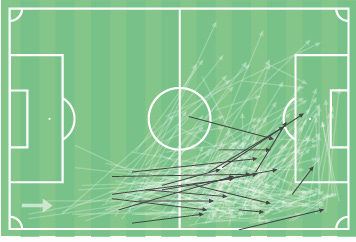
Above is a visualisation of his progressive actions, passes in white and runs in black. As you would expect the passes are a bit of a cluster, but notice how many of them come inside to the middle of the pitch.
These passes draw defenders central and create space out wide for Skoglund to run into. With his intelligence of movement he plays well off of his wing partner and causes serious problems for the opponents attempting to track all this movement.
As demonstrated in the video clips above, Skoglund’s best skill is his ball carrying. He is able to escape pressure and win fouls. He also links really well with teammates while on the move, he has a great first touch which allows him to combine and then take the ball back in stride.
He shows great deception with his body movement, despite his larger build. This means that you often see him bypass pressing opponents as if they weren’t there. He also manipulates the ball really well under pressure, allowing him to draw contact and win fouls under pressure.
Skoglund completed 75% of his dribbles last season and he’s willing to take on opponents all over the pitch. That number only drops to 69% when analysing dribbles in the final third.
Below are two graphics, illustrating the positions Skoglund is dribbling from, the first covering the whole pitch and the second just the final third. The white dots represent normal successful dribbles, the black dribbles leading to shots and the blue shows dribbles that led to a goal.
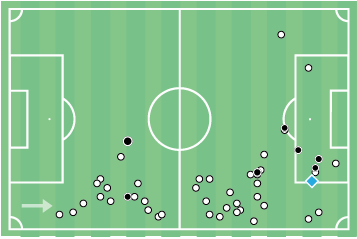
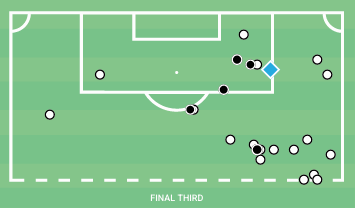
You can see just how well he carries the ball from deep and gets his team forward from these visualisations. Combining all of these skills makes him an extremely promising attacking talent.
Defending
Compared to his attacking talents, there is a lot more for Skoglund to work on going back the way. He has the physical ability to be a good defender but his technique in some situations lets him down.
These clips are a good representation of both his strengths and weaknesses. At his best, Skoglund is the aggressor, constantly winning the ball early and high up the pitch. He uses his physicality well and traps opponents when they receive the ball, forcing turnovers.
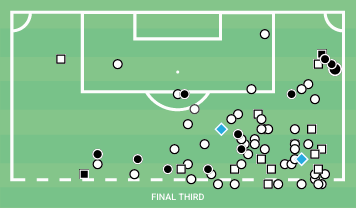
The graphic below shows his final third ball recoveries from the last year. The circles denominate counter pressing and the squares show pressing positionally. Once again black means it led to a shot and blue led to a goal.
Skoglund had 74 of these recoveries in the league last year which averages out to over 2 per game. He also averaged 0.7 ‘dangerous recoveries’ per 90 minutes last year; these are recoveries leading to a shot. This meant his defensive work was creating more than one shot every two games.
The issues appear when he defends in open space. You can watch him face up his opponent and see how frantic his movement is. He always wants to show his opponent down the line and ends up completely off balance when trying to backpedal at this angle. This allows his opponent to accelerate either direction with no chance of Skoglund to match the movement.
When the 1v1 situations are deeper towards his goal, Skoglund becomes solid again. He is much more composed and patient, winning the ball back often. The panic isn’t there in these situations and his footwork is much more controlled, with his strength he becomes a formidable defender.
Overall the upside of Skoglund’s talent is hard to ignore. The potential for him to become a fantastic attacking right back is clear to see. What he does well defensively fits Rangers well and what he struggles with is something that can be coached. There’s plenty of time for development with him being just 22 years old.
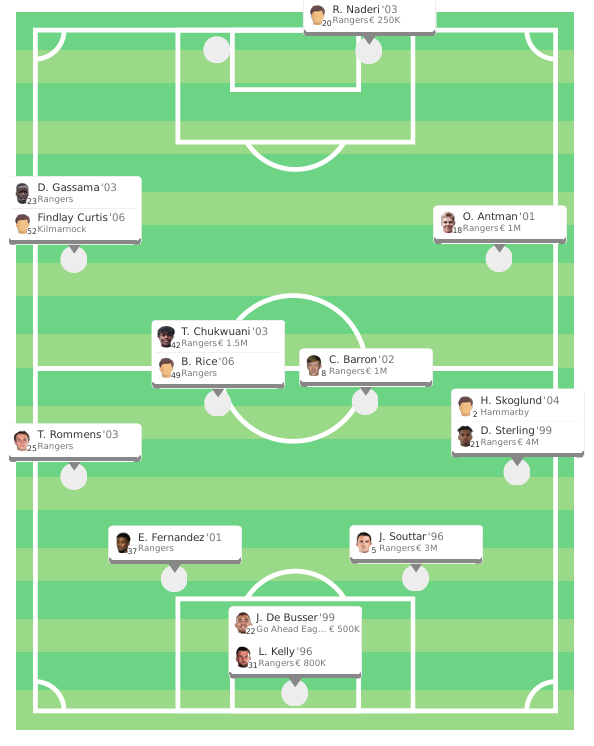
In the original article, I had James Tavernier as the backup. My original idea was that he would be a strong backup for another year if he would agree to a wage reduction.
After considering the position more while compiling this article, using Dujon Sterling as the back up right back just makes more sense. You lose one of the highest earning players, while keeping some continuity in a backline poised to lose at least 4 players - 5 if you include Tavernier.
Sterling’s flexibility means he can realistically cover the whole defence, while still having right back as his main role. In a summer with so much to achieve in terms of the squad, finding two right backs is a task that’s best avoided.
Left Back
The situation at left back is quite different than the opposite flank now that Tuur Rommens has arrived. His only drawback so far has been fitness, which you would hope is rectified by a full pre-season at the club. Still, with Jayden Meghoma returning to his parent club, the Belgian requires an understudy.
This summer, I expect a bit of a Scottish revolution within the squad. John Souttar and Connor Barron are the only senior Scottish players expected to be at the club next season. Although that is slightly harsh on the now Scotland international Findlay Curtis. I believe we will see a few more Scots in the door this summer.
In January, former Hearts full back James Penrice was linked as a possible alternative to Rommens. He may well be considered by the club as his possible competition. I think this would be missing an opportunity. This position may be less about scouting and more about trusting the talent already available to the club.
I wrote an article a few weeks ago talking about Rangers struggles to develop players, this extended to both the first team and youth setup. In this discussion, I mentioned the potential loss of young left back Ashton Scally.
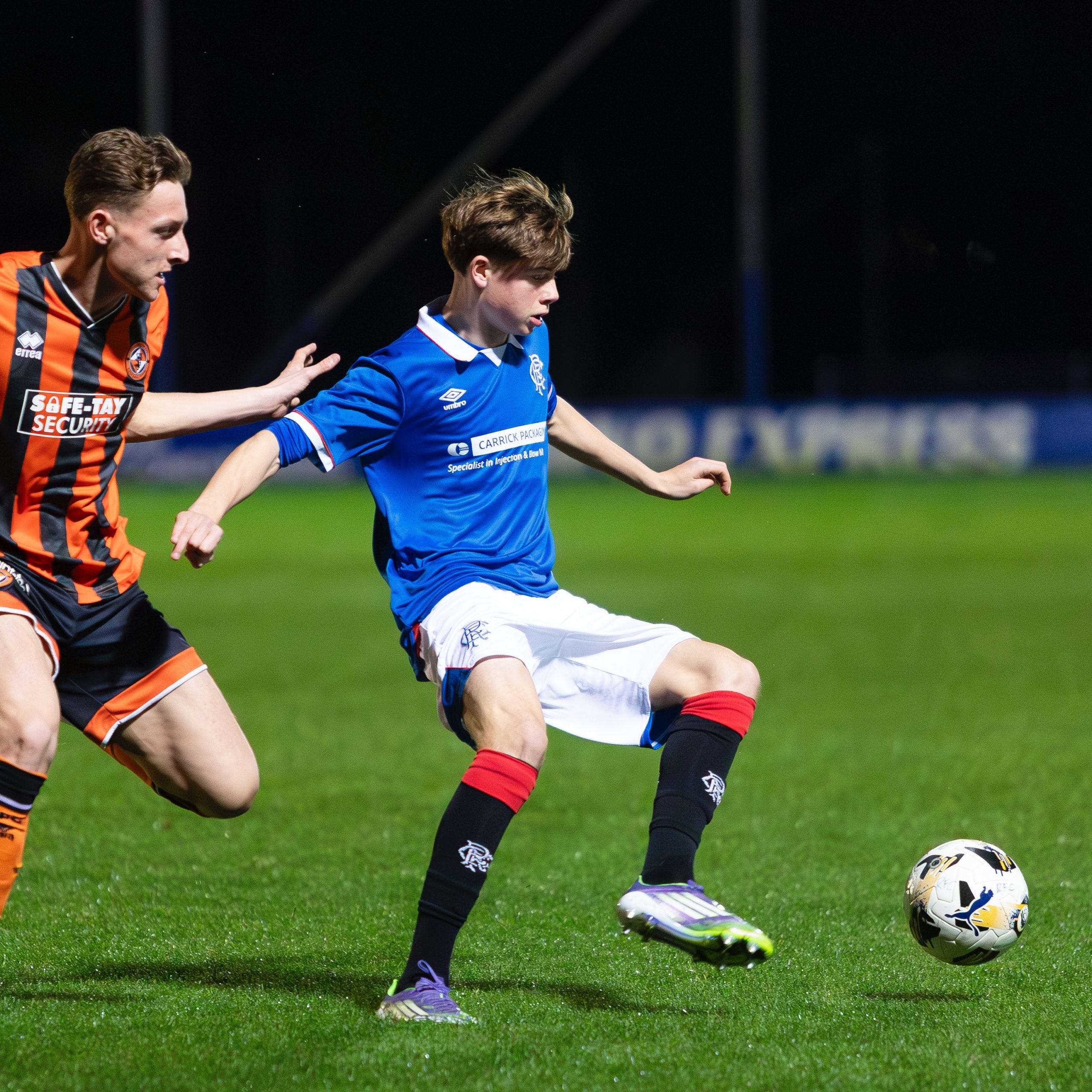
Multiple Premier League clubs have reportedly showed interest and Chelsea appeared to have come close to stealing his signature at the start of this year. Since those reports, there have been recent suggestions that Rangers may have fought the English teams off to secure Scally on his first professional contract.
The spot at left back could be a great opportunity to introduce one of your best talents to the first team. Scally has trained with the senior squad before and Danny Röhl was ready to give him his debut in the Scottish Cup before SFA rules got in the way.
He will be 16 by the time the next season starts and completely free to play in all competitions. There’s obviously a bit of risk here, trusting a 16 year old to be the backup here is a possible risk if Rommens were to sustain a major injury.
However, I firmly believe that the club need to start trusting these talents more. It is very difficult to develop into a Rangers player on loan at other Scottish clubs; the environment is too different at other teams. English teams frequently send youngsters up to Scotland to get experience, it’s time Rangers started developing talent for themselves rather than for others. The club also have Dujon Sterling who can cover here as well, so there’s not as much jeopardy.
Of course there’s still a possibility that the club lose Scally and in that case there would need to be other targets. Until that is the case I would suggest that giving him this opportunity is best for the club and the future of the academy.
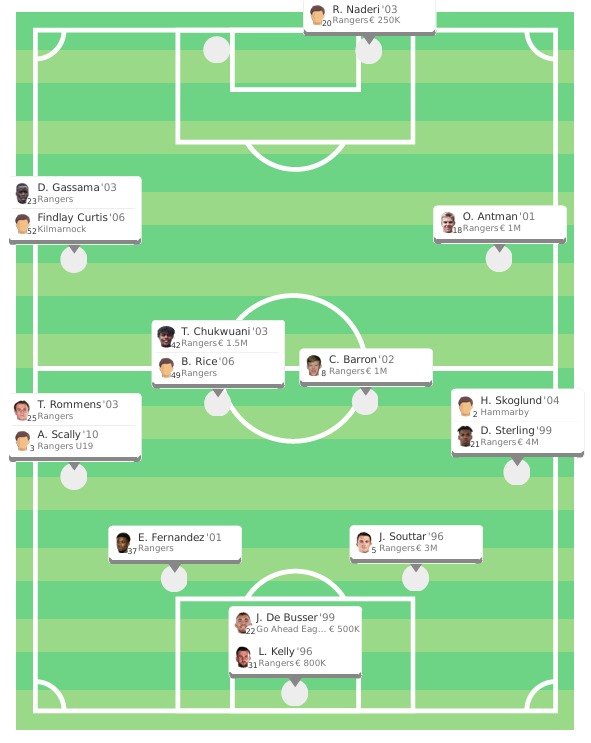
So after two articles here’s how my Rangers squad looks for next season. The centre back positions are up next - ensure you are subscribed here at ScottishFootball.info to receive the next article straight to your inbox.
This article was written for Scottishfootball.info by Josh Duncan, an aspiring sports writer, who has his own Substack account.
Please follow him there and on X.com - where you can find more of his threads in the coming months.
His previous writing for the website includes a well-received tactical analysis of Falkirk F.C this season. Josh’s latest article will be the second in a series of ‘squad building’ exercises, looking specifically at Rangers.
A great use of data and really well written
Great use of writing and well data’d